
Eye Bag Removal in Turkey: Lower Blepharoplasty in Istanbul
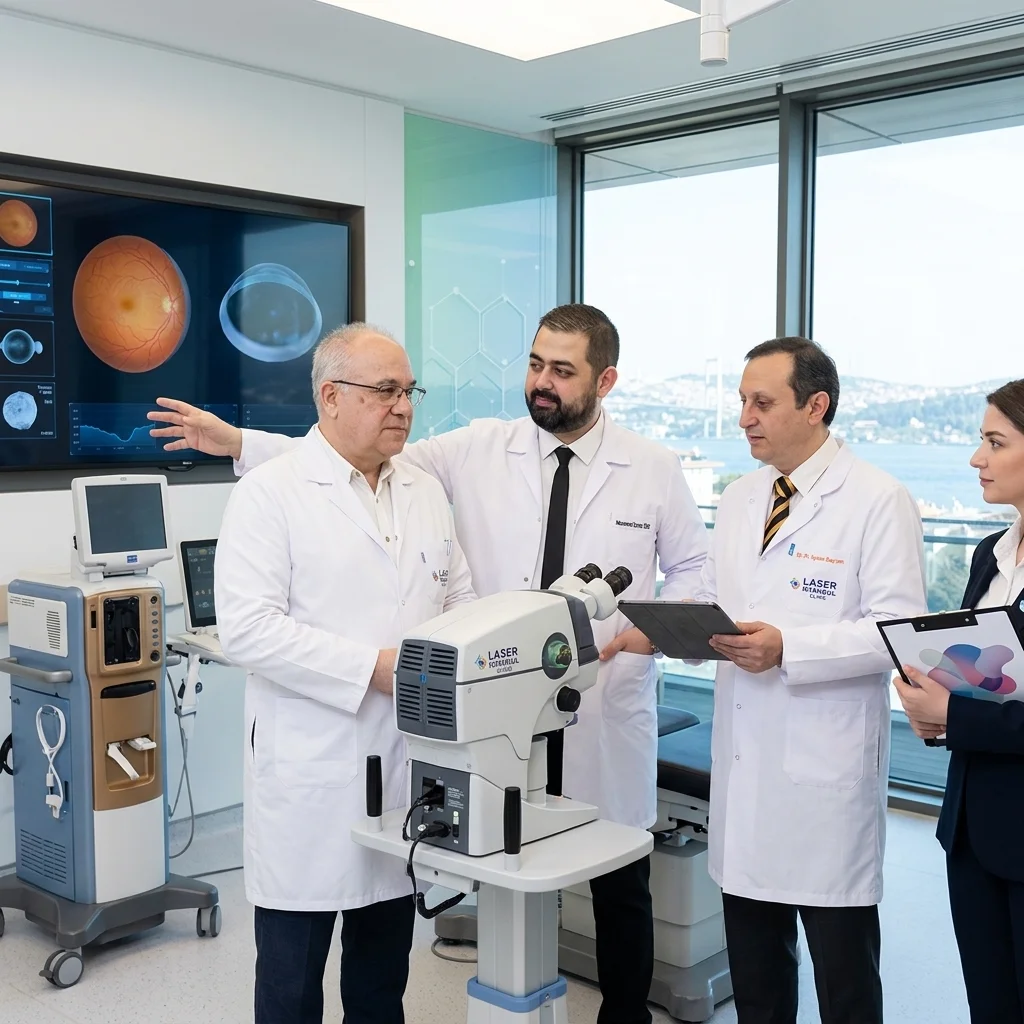
Eye bag removal in Turkey with Laser Istanbul Clinic is lower blepharoplasty performed by Prof. Dr. Ahmet Satıcı, an ophthalmologist who operates on the eye and eyelids. He examines your lids before recommending anything, you see the full price in writing before you travel, and a personal interpreter stays with you from your first consultation to your final check-up.
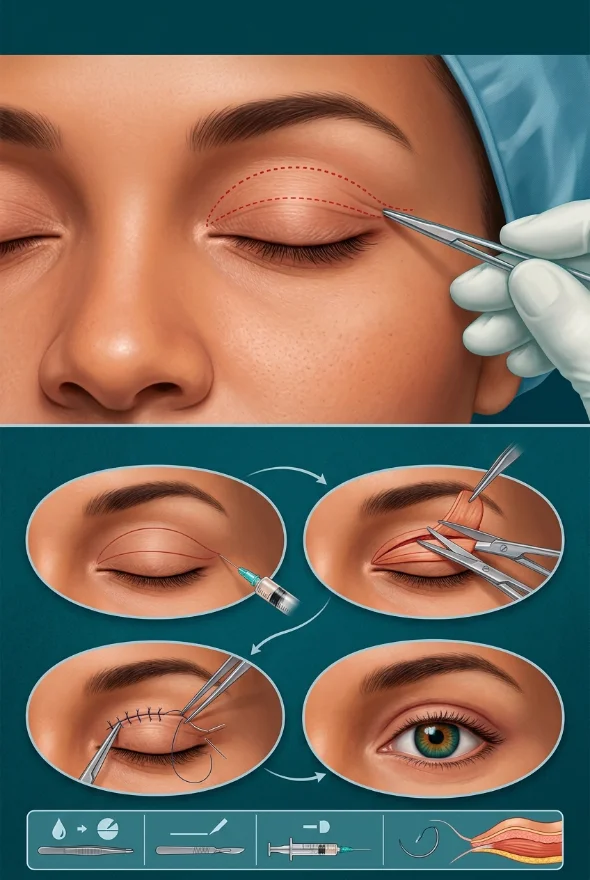
Under-eye bags are usually fat that has slipped forward as the tissues around the eye weaken with age. Lower blepharoplasty removes or repositions that fat, through an incision inside the lid or just below the lashes, and tightens loose skin if needed. Eye bag removal in Turkey with Prof. Dr. Ahmet Satıcı starts from {{£ price}}; most people take about two weeks off work. Hotel and transfers are extra.
What causes bags under the eyes?
Most persistent under-eye bags are caused by fat, not fluid. According to the American Academy of Ophthalmology (AAO, July 2025), the tissues around the eye gradually weaken and sag over time, which lets the fat that cushions the eyeball shift forward into the lower eyelids. Fluid can also pool in these weakened tissues and add morning puffiness. Doctors call bulging lower-lid fat steatoblepharon; the lower lid has three of these fat pads.
Other things make bags look worse, or come and go:
| Factor | Effect on under-eye bags |
|---|---|
| Age | Tissues weaken and fat bulges forward; the main cause of permanent bags |
| Genes | Bags can run in families and appear at a younger age |
| Salt, alcohol, too little sleep | Fluid retention and puffiness, worse in the morning |
| Allergies, smoking | Swelling and irritation around the eyes |
| A deep tear trough | The groove between lid and cheek casts a shadow that exaggerates a bag |
Iron deficiency and eye bags. Iron deficiency does not create fat bags, but it can make the under-eye area look darker and more tired. The NHS lists paler-than-usual skin and tiredness among the common symptoms of iron deficiency anaemia, and pale skin makes the thin, darker skin under the eyes stand out. In a 2014 study of 200 people with dark circles under the eyes (Sheth et al., Indian Journal of Dermatology), half had iron deficiency anaemia, and many said their dark circles improved once the anaemia was treated. If you also feel tired, breathless or have palpitations, ask your GP for a blood test; surgery will not fix dark circles caused by anaemia.
When to see a doctor rather than a surgeon. The AAO advises seeing an ophthalmologist if under-eye swelling is painful, itchy, red or does not go away.
What helps temporary puffiness: cool compresses while sitting upright, 7–9 hours of sleep with your head raised on an extra pillow, less fluid and salt before bed, stopping smoking and treating allergies (AAO). These reduce fluid swelling, but they do not shrink fat bags.
What is lower blepharoplasty (eye bags surgery)?
Lower blepharoplasty is the operation that removes or repositions the bulging fat under the eyes and, when needed, removes a thin strip of loose skin. It is the standard surgical treatment for eye bags. The NHS states that blepharoplasty can be done under local or general anaesthetic and that most people go home the same day. Depending on how much is done, it takes roughly 30 minutes to 2 hours (Cleveland Clinic).
There are two main ways in:
- Transconjunctival (from inside the lid). The incision is made on the inner surface of the lower eyelid, so there is no visible scar. EyeWiki (AAO) describes it as the approach for people with bulging fat but little or no excess skin, which is typical of younger patients and those with inherited bags.
- Transcutaneous or subciliary (skin approach). The incision runs 1–2 mm below the lash line and fades into a fine line. It gives access to the fat, the muscle and the skin, so it suits people who also have loose, wrinkled lower-lid skin.
Removing fat or moving it? Older techniques simply cut the fat away. Modern lower blepharoplasty often repositions the fat over the bony rim into the tear-trough groove instead, smoothing the step between eyelid and cheek. A 2020 review in the Indian Journal of Ophthalmology reports that surgeons now favour fat preservation and repositioning, and the authors describe smooth lid-to-cheek transitions in 1,000 eyelids treated this way over 18 years.
Supporting a loose lid. If your lower lid is lax, your surgeon may tighten it at the outer corner (a canthopexy or canthoplasty). This lowers the risk of the lid pulling down after surgery. In a Brazilian series of 200 blepharoplasty patients (Patrocinio et al., 2011), every case of lower-lid malposition occurred in patients who had not had this lateral support.
Technique we use: Prof. Dr. Satıcı chooses the approach after examining your lids: {{techniques Prof. Satıcı uses, e.g. transconjunctival with fat repositioning, skin-pinch, canthal support}}, under {{usual anaesthesia: local with sedation / general}}, in a fully equipped, Ministry of Health–licensed operating theatre in Istanbul.
Who is a good candidate for eye bag removal?
You are likely to be a good candidate if your bags are there every day, not just after a short night, and they are caused by bulging fat, loose skin or both. Your surgeon checks which of these you have during the examination.
Good signs:
- persistent bags that make you look tired even when you are rested
- inherited bags with little loose skin, often treatable from inside the lid
- loose, crepey lower-lid skin together with bags
- good general health, with realistic expectations and no smoking around the time of surgery
Your surgeon will check carefully, or suggest something else, if you have:
- dry eye: EyeWiki lists tear-film evaluation as part of every assessment, because eyelid surgery can make dryness worse for a while
- a loose lower lid (tested by gently pulling the lid away from the eye): it may need tightening at the same time
- puffiness that comes and goes, which points to fluid, allergy or a medical cause rather than fat
- thyroid eye disease, uncontrolled high blood pressure or a bleeding disorder
- blood-thinning medicines such as aspirin: a 2011 surgical study and review (Patrocinio et al.) advises stopping antiplatelet and anti-inflammatory medicines at least 10 days before eyelid surgery, but only with the agreement of the doctor who prescribed them
- dark circles only, without a bag: pigment and thin skin do not improve with fat surgery
Eye bags surgery vs under-eye filler vs skincare
| Lower blepharoplasty | Tear-trough filler (hyaluronic acid) | Creams, cool compresses, sleep | |
|---|---|---|---|
| Treats | Bulging fat and loose skin | A hollow groove below the eye | Fluid puffiness only |
| Works for true fat bags? | Yes | Usually not; it is designed for hollows | No |
| How long it lasts | Long-lasting; Cleveland Clinic notes lower-lid surgery rarely needs repeating | Usually 1–2 years, then repeat treatment (Cleveland Clinic) | Hours |
| Downtime | About 2 weeks off work (NHS) | Possible redness, swelling or bruising | None |
| Main serious risk | Rare bleeding behind the eye; lid malposition | Rare injection into a blood vessel, which can affect vision | None |
Filler for under-eye bags: cost and limits. Under-eye filler is cheaper per session than surgery, but you pay again every year or two. Cleveland Clinic dermatologists say tear-trough filler works best for hollows from volume loss, not for puffy bags caused by fluid or genetics, and that pain, loss of vision or floaters during an injection are warning signs. If your problem is a true fat bag, filler is a temporary disguise; surgery removes the cause.
Eye bag removal cost: Turkey vs the UK
Eye bag removal in Turkey with Laser Istanbul Clinic starts from {{£ price}} for both lower eyelids. Upper and lower blepharoplasty together starts from {{£ price combined}}. Prof. Dr. Satıcı confirms your exact price in writing after reviewing your photos, before you book anything.
How much is under-eye bag removal elsewhere? Typical published prices (2025–26):
| Where | Typical price range |
|---|---|
| UK private clinics, blepharoplasty (NHS figure) | £2,000–6,000 |
| UK, upper + lower blepharoplasty | about $4,000–10,000 |
| USA, upper + lower blepharoplasty | about $6,000–12,000 |
| Istanbul, upper + lower (published package prices) | about $2,200–4,800 |
| Istanbul with Laser Istanbul Clinic, lower lids | from {{£ price}} |
The UK range comes from the NHS and covers blepharoplasty in general; other figures are typical ranges published by clinics and price-comparison sites in 2025–26, not quotes. Published Istanbul prices are often packages that include a hotel.
Eye bag removal cost in the UK and the NHS. The NHS says blepharoplasty is not usually available on the NHS, so most people pay privately. It also advises budgeting for consultations and follow-up care on top of the operation price, which is why we quote everything in one written figure.
Your treatment price includes:
- consultation and eyelid examination with Prof. Dr. Satıcı, plus any pre-operative tests he needs
- lower blepharoplasty on both eyes by Prof. Dr. Satıcı
- medication, ointments and cold compresses for your recovery
- follow-up checks in Istanbul, including stitch removal if stitches are used
- a personal interpreter, a dedicated coordinator and remote follow-up after you return home
Not included: flights, hotel and airport transfers. Hotel and transfers are a separate charge, and we can arrange them for you if you ask.
How much to remove bags under your eyes in your case? Send three photos (front, left and right, in daylight, without make-up) and your medical history. Prof. Dr. Satıcı replies with the approach he recommends and a written quote within {{response time}}.
Your eyelid surgeon

Your eye bag removal journey, step by step
Free online assessment
Send your photos and medical history, including any medicines you take. Prof. Dr. Satıcı tells you whether surgery is likely to help and sends a written quote.
Book your dates
Plan about {{stay length, e.g. 6–7}} days in Istanbul. Stitches, if used, usually come out 5–7 days after surgery (EyeWiki).
Consultation and examination (day 1)
Your surgeon examines your lids, fat pads, skin and lid tone, checks your tear film and eye health, and takes photos. He explains the plan and the risks through your interpreter. If surgery is not right for you, he tells you.
Surgery (day 1 or 2)
Usually 30 minutes to 2 hours, under {{usual anaesthesia}}. You go back to your hotel the same day with cold compresses and ointment.
First check (the next day)
Your surgeon checks the lids, your vision and any bruising.
Stitch removal and final check
If stitches were used, they are removed at around 5–7 days. Your surgeon confirms you are ready to fly. Your coordinator stays in touch, and your surgeon reviews your progress by video at agreed intervals.
Why we ask you to stay close for the first day. In a review of 269,433 blepharoplasties (Hass et al., 2004), most bleeding behind the eye happened within the first 3 hours after surgery, and the risk fell sharply after 24 hours. High blood pressure, aspirin, vomiting and physical exertion were common in these cases. That is why you rest at your hotel, nearby, during that window.
Recovery after lower blepharoplasty
-
First 48 hours
Swollen, tight, numb lower lids; watery or gritty eyes. Rest with your head raised on pillows and use cold compresses as advised. Avoid bending, lifting and heavy exertion (AAO).
-
Days 3–7
Bruising peaks and starts to fade. Stitches, if any, are removed at 5–7 days. No contact lenses during recovery (NHS).
-
About 2 weeks
Most people take about 2 weeks off work (NHS) and feel ready for their usual routine after one or two weeks (Cleveland Clinic). No driving for several days, and not until your vision is clear.
-
Several weeks
Bruising and redness take several weeks to fade (NHS). Irritated or watery eyes can last a few weeks. Strenuous exercise only when your surgeon agrees.
-
A few months
Any skin scar may look visible and feel tight for a few months before it softens (NHS). Complete recovery takes a few months (Cleveland Clinic).
Wear dark sunglasses outdoors while you heal (Cleveland Clinic). Call your coordinator straight away if you have increasing pain, sudden swelling of one eye, bulging of the eye or any loss of vision: these can be signs of bleeding behind the eye and need same-day treatment.
Before and after under-eye bag surgery: what changes
The difference in before and after photos of under-eye bag surgery is usually a flatter, smoother lower lid, a softer step between lid and cheek, and a less tired look. It is not a change in who you are: a well-done result looks rested, not "operated".
What before and after pictures can and cannot show:
- Fat bags usually improve most, because the cause is removed or repositioned.
- Fine wrinkles and crepey skin improve less unless skin is removed or treated separately.
- Dark circles from pigment stay the same colour, though shadows from the bag disappear.
- Final results need time: compare photos taken at least a few months after surgery, once swelling has fully settled.
Risks and side effects of eye bag removal
Lower blepharoplasty is a well-established operation. A 2025 systematic review of 36 studies (Gimenez et al., Plastic and Reconstructive Surgery Global Open) concluded that it is generally safe, with low complication rates and high patient satisfaction. Risks still exist, and you should know them before you decide.
Common and usually temporary (NHS)
- puffy, numb eyelids and bruising for several weeks
- irritated, dry or watery eyes for a few weeks
- chemosis, swelling of the clear membrane over the white of the eye; a series of 200 patients reported it in 6%, settling on its own within 3–4 weeks
Less common
- Lower lid malposition: the lid pulls down (retraction, extra white showing below the iris) or turns out (ectropion). The 2025 review found rates between 0% and 12% across studies. In one comparison summarised in a 2020 review, extra white showing below the iris occurred after 3% of inside-the-lid operations and 28% of skin-approach operations.
- Asymmetry, under-correction or visible scarring, sometimes needing a revision. Revision rates were 0–9% in the 2025 review, below 3% in most studies.
- Double vision, from injury to a small eye muscle near the fat pads; rare, and it may be temporary or need further treatment.
Rare but serious
Your surgeon explains your personal risks in writing and through your interpreter before you sign anything.
- Bleeding behind the eye (retrobulbar haemorrhage), which can threaten sight. The AAO puts the risk of this with vision loss at less than 1 in 20,000. In the largest survey, of 269,433 blepharoplasties, orbital bleeding occurred in 0.055% and permanent vision loss in 0.0045% (12 cases). Quick recognition and treatment matter, which is why the first hours after surgery are monitored.
Eye bag removal in Turkey: frequently asked questions
With Laser Istanbul Clinic, eye bag removal in Turkey starts from {{£ price}} for both lower lids, including your consultation, surgery by Prof. Dr. Ahmet Satıcı, medication, follow-up checks, interpreter and coordinator. Published Istanbul prices for upper and lower blepharoplasty together are about $2,200–4,800, often as hotel packages. Hotel and transfers are extra with us. Your exact price is confirmed in writing after your free assessment.
The NHS puts the cost of blepharoplasty in the UK at £2,000–6,000, plus consultations and follow-up care. It is not usually available on the NHS. Prices vary with the technique and whether upper and lower lids are done together.
Surgery is better for true fat bags, because it removes or repositions the fat that causes them. Filler suits a hollow tear trough rather than a bulge, and Cleveland Clinic notes it may not suit people with puffiness from fluid or genetics. Filler usually needs repeating every one to two years, so the cost adds up.
Iron deficiency does not cause fat bags, but it can make the skin pale and the under-eye area look darker and more tired. In one 2014 study, half of the people with dark circles had iron deficiency anaemia, and many improved after treatment. See your GP for a blood test if you also feel tired or breathless.
If the fat is removed from inside the lid (transconjunctival approach), there is no visible scar. If skin also needs removing, the incision runs 1–2 mm below the lashes and usually fades into a fine line, though the NHS says it can look visible and feel tight for a few months.
The area is numbed, or you are asleep under general anaesthetic, so you should not feel pain during surgery. Afterwards your lids feel tight, swollen and sore for a few days; cold compresses and the pain relief your surgeon prescribes help. Increasing pain is not normal and should be reported straight away.
Most people take about two weeks off work, and bruising takes several weeks to fade. Plan about {{stay length}} days in Istanbul so stitches (if used) can be removed and your surgeon can check you before you fly.
Results are long-lasting: the fat that is removed does not grow back, and Cleveland Clinic notes that lower-lid surgery rarely needs repeating. Your face will keep ageing naturally, so skin and cheeks continue to change over the years.
Yes. Many patients have upper and lower blepharoplasty together, and eyelid surgery is often combined with lens or laser eye surgery in the same trip. Prof. Dr. Satıcı plans the order and timing so each operation heals safely.
Eye bag removal in Turkey can be as safe as at home when an experienced surgeon examines you properly and operates in a fully equipped operating theatre, with aftercare in place. Before you book, check your surgeon's name and qualifications, where the surgery takes place and how follow-up works once you are home. We give you all of this in writing before you pay.
Other eyelid treatments in Istanbul
Eye bags are only one reason the eyes can look tired. The right operation depends on which part of the lid is the problem.
| Lower blepharoplasty (eye bags) | Upper blepharoplasty | Ptosis surgery | |
|---|---|---|---|
| Problem | Bulging fat or loose skin under the eye | Excess, hooded skin on the upper lid | The upper lid itself droops over the eye |
| What is done | Fat removed or repositioned, skin tightened if needed | Excess skin (and sometimes fat) removed along the lid crease | The muscle that lifts the lid is tightened or reattached |
| Scar | None (inside the lid) or a fine line below the lashes | Along the natural lid crease | Depends on the technique |
| Often combined with | Upper blepharoplasty | Lower blepharoplasty, lens surgery | Upper blepharoplasty |
Upper and lower eyelid surgery together
Hooded upper lids and lower bags often appear together. Treating both in one operation means one recovery period and one trip.
Eyelid surgery (blepharoplasty) in TurkeyPtosis (droopy eyelid) correction
If your upper lid sits low over your pupil, removing skin will not lift it; the lifting muscle needs repair.
Ptosis (droopy eyelid) surgerySources for the facts on this page
- American Academy of Ophthalmology, How to Get Rid of Bags Under the Eyes (29 July 2025): causes (weakened tissues, fat shifting forward, fluid), contributing factors, home remedies (cool compresses, 7–9 hours' sleep, head raised, less salt, allergies, smoking), see an ophthalmologist if painful/itchy/red/persistent, non-surgical options, blepharoplasty as outpatient surgery. https://www.aao.org/eye-health/tips-prevention/bags-under-eyes
- American Academy of Ophthalmology, Lower Eyelid Blepharoplasty: transconjunctival, fat redraping, transcutaneous with infraciliary incision; avoid heavy exertion, lifting, bending; risks incl. dry eye, revision; retrobulbar haemorrhage with vision loss < 1:20,000. https://www.aao.org/eye-health/treatments/lower-eyelid-blepharoplasty
- EyeWiki (AAO), Lower Eyelid Blepharoplasty: three lower-lid fat pads, steatoblepharon, transconjunctival vs infraciliary (1–2 mm below lashes) approach, fat repositioning, tear-film and lid-laxity evaluation, complications (retrobulbar haemorrhage, retraction, ectropion, inferior oblique injury/diplopia), sutures removed at 5–7 days. https://eyewiki.org/Lower_Eyelid_Blepharoplasty
- NHS, Eyelid surgery (blepharoplasty): UK cost £2,000–6,000 plus consultations/follow-up; local or general anaesthetic; same-day discharge; about 2 weeks off work; no driving for several days; bruising several weeks; avoid contact lenses; scars visible/tight for a few months; side effects and serious risks; not usually on the NHS. https://www.nhs.uk/conditions/cosmetic-procedures/eyelid-surgery/
- NHS, Iron deficiency anaemia: symptoms incl. tiredness, shortness of breath, palpitations, paler-than-usual skin; see a GP. https://www.nhs.uk/conditions/iron-deficiency-anaemia/
- Cleveland Clinic, Blepharoplasty (Eyelid Surgery): 30 minutes to 2 hours; local anaesthetic, numbing drops and sedation; lower-lid incision below the lashes; stitches about a week or dissolvable; back to routine after one or two weeks; a few months to recover completely; temporary dry eyes. https://my.clevelandclinic.org/health/treatments/8409-eyelid-surgery-blepharoplasty
- Cleveland Clinic, Eyelid Surgery (cosmetic and plastic surgery): "lower eyelid surgery rarely needs to be repeated"; sunglasses during healing. https://my.clevelandclinic.org/cosmetic-plastic-surgery/procedures/blepharoplasty-eyelid-surgery
- Cleveland Clinic Health Essentials, Are Tear Trough Fillers Effective for Undereye Bags? (17 Jan 2022): filler for volume-loss hollows rather than fluid/genetic puffiness; lasts and is repeated every 1–2 years; rare intravascular injection; warning signs (pain, vision loss, floaters). https://health.clevelandclinic.org/is-tear-trough-filler-safe
- Bhattacharjee K, et al. Lower eyelid blepharoplasty: An overview. Indian J Ophthalmol 2020;68(10):2075–2083: transconjunctival for minimal skin excess, transcutaneous for skin redundancy; fat preservation/repositioning; 1,000 eyelids over 18 years; scleral show 3% (transconjunctival) vs 28% (transcutaneous). https://pmc.ncbi.nlm.nih.gov/articles/PMC7727946/
- Gimenez AR, Rohrich R, Borab Z, et al. Safety and Complications in Lower Eyelid Blepharoplasty: A Systematic Review. Plast Reconstr Surg Glob Open 2025;13(9):e7102: 36 articles; lid malposition 0–12%; revision 0–9% (mostly < 3%); generally safe with high satisfaction. https://pmc.ncbi.nlm.nih.gov/articles/PMC12456572/
- Patrocinio TG, Loredo BA, Arevalo CE, Patrocinio LG, Patrocinio JA. Complications in blepharoplasty: how to avoid and manage them. Braz J Otorhinolaryngol 2011 (PMID 21739006): stop antiplatelet and anti-inflammatory drugs at least 10 days before surgery; control blood pressure; in 200 patients, malposition 3% (all without lateral canthal anchoring), chemosis 6% resolving spontaneously in 3–4 weeks. https://pmc.ncbi.nlm.nih.gov/articles/PMC9443734/
- Hass AN, Penne RB, Stefanyszyn MA, et al. Incidence of postblepharoplasty orbital hemorrhage and associated visual loss. Ophthal Plast Reconstr Surg 2004;20(6):426–432: 269,433 cases; orbital haemorrhage 0.055%; permanent visual loss 0.0045% (12 cases); most within 3 hours; risk falls after 24 hours; hypertension, aspirin, vomiting, physical activity. Summary: https://www.semanticscholar.org/paper/Incidence-of-Postblepharoplasty-Orbital-Hemorrhage-Hass-Penne/ed50bad908bdd33a488291f015f8c34b651fd1d3
- Sheth PB, Shah HA, Dave JN. Periorbital hyperpigmentation: a study of its prevalence, common causative factors and its association with personal habits and other disorders. Indian J Dermatol 2014;59(2):151–157 (PMID 24700933): 200 patients; anaemia in 50%; many improved after correcting anaemia. https://pmc.ncbi.nlm.nih.gov/articles/PMC3969674/
Find out if eye bag removal suits you, free
Send us three photos of your eyes and your medical history. Prof. Dr. Ahmet Satıcı will tell you whether lower blepharoplasty, another eyelid operation or no surgery at all suits you, and what it would cost, with no obligation.
3 eye surgeons
Your case is reviewed by a named surgeon, not a salesperson. Reply within {{response time}}.
 Prof. Dr. Ahmet Satıcı
 Doç. Dr. Muhammet Derda Özer
 Op. Dr. Aysan Bayram