
- Home: eye surgery in Istanbul
- Free eye tools
- Astigmatism test
Astigmatism Test: A Free Online Check You Can Do at Home
Before you start: use a bright screen in a lit room, sit about one metre (3 feet) away and keep your distance glasses or contact lenses on for the first run.
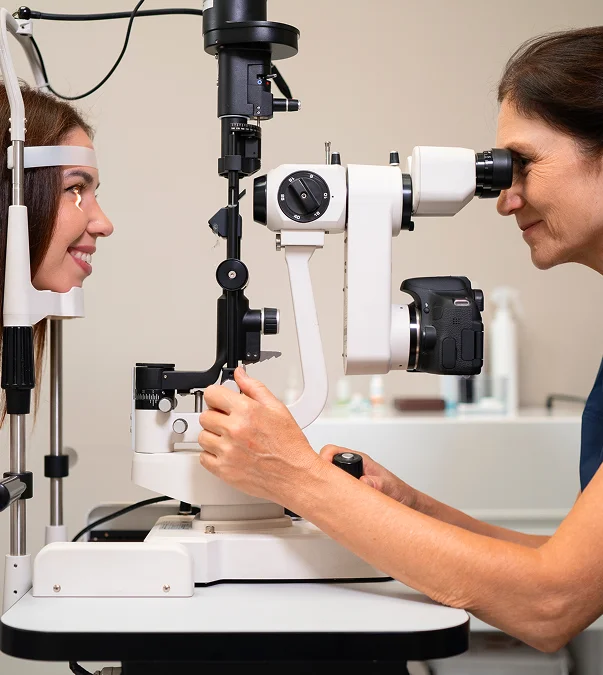
An astigmatism test checks whether your eye focuses light evenly in every direction. Our free astigmatism test shows a clock-dial chart: look at it with one eye at a time and note whether some lines look darker or sharper than others. That pattern can point to astigmatism. It is a screening check, not a diagnosis; Prof. Dr. Ahmet Satıcı and Op. Dr. Aysan Bayram can confirm it with a full eye examination.
Before you start: use a bright screen in a lit room, sit about one metre (3 feet) away and keep your distance glasses or contact lenses on for the first run.
Astigmatism test results: what they mean
How do I take the astigmatism test at home?
Take the astigmatism test one eye at a time, in five steps:
- Check you have none of the urgent symptoms listed below.
- Keep your distance glasses or contact lenses on for the first run, so you see any astigmatism left uncorrected. Repeat without them if you wish.
- Sit about one metre away, eyes level with the screen. On a phone, hold it at arm's length.
- Cover one eye with your palm, without pressing, and keep your head straight.
- Decide whether all the lines look equally dark or some look darker and sharper, tap the clock numbers of the darkest lines, then swap eyes.
What do the astigmatism test numbers and results mean?
The numbers on the dial are clock hours, 1 to 12. They name the direction of the lines you found sharpest, so "3 to 9" means the horizontal line. Clinics use the same chart to find the axis, the direction of astigmatism, which appears on a prescription in degrees. The American Academy of Ophthalmology (AAO) explains that "cylinder" shows how much astigmatism you have and "axis" shows where it sits; our eye prescription reader decodes both.
| What you see | What it can mean | What to do |
|---|---|---|
| All lines equally dark | No clear sign on this check; mild astigmatism is easily missed | Keep up regular eye tests |
| One direction looks darker or sharper | Possible astigmatism | Book an eye examination |
| Same pattern with your glasses on | Glasses may be out of date or not fully correct it | Book an eye examination |
| Different pattern in each eye | Each eye can have its own astigmatism | Book an eye examination |
| Everything blurred, hard to tell | Short or long sight can blur every line; this does not rule out astigmatism | Book an eye examination |
A 2018 systematic review in the Journal of Current Ophthalmology found astigmatism in about 40% of adults and 15% of children, making it the most common refractive error. The AAO says most people have 0.5 to 0.75 dioptres; 1.5 or more typically needs correction.
Is there a red-green astigmatism test?
No: the red-green (duochrome) test checks your sphere, your short- or long-sighted power, not astigmatism. EyeWiki says it verifies the spherical endpoint, while the cylinder is found separately with a Jackson cross-cylinder. A red-green chart cannot show astigmatism, so this tool does not use one.
What does an astigmatism test with lights show?
In astigmatism, a headlight or street lamp can stretch into a streak, starburst or halo, and the US National Eye Institute lists trouble seeing at night as a typical symptom. The AAO says cataract, Fuchs' dystrophy, glaucoma and keratoconus can cause similar halos, so our optional light check only tells you whether an examination is worthwhile.
When to see an eye doctor
Get urgent help today, whatever your result, for sudden loss or blurring of vision, a dark curtain across your vision, or new flashes or floaters. Halos with severe eye pain, headache or nausea can signal acute angle-closure glaucoma, which the AAO calls a true eye emergency. Call your local emergency number (112 in the EU and Türkiye, 999 in the UK, 911 in the US and Canada).
Book a routine eye examination if a pattern looked uneven, you get headaches or eye strain, or you have not had a test for two years, as the NHS advises. Astigmatism can be linked to keratoconus, so worsening blur deserves a corneal scan.
This astigmatism test is a screening tool only. It does not diagnose astigmatism or any other eye condition, cannot measure your prescription and does not replace an examination by an optometrist or ophthalmologist. Results depend on your screen, lighting and distance. If you are worried, or your vision changes suddenly, see an eye doctor.
What if the test shows a pattern?
A pattern on this chart does not tell you whether you need treatment; your surgeon decides after measuring your cornea. Most astigmatism is corrected with glasses or contact lenses, and some adults choose laser or lens surgery. Read our guide to astigmatism treatment, or see how laser eye surgery in Turkey works.
Prof. Dr. Ahmet Satıcı and Op. Dr. Aysan Bayram treat astigmatism; our cornea specialist, Doç. Dr. (Associate Professor) Muhammet Derda Özer, reviews irregular astigmatism and keratoconus.
Colour blindness test · Amsler grid test for the macula · Visual acuity converter (20/20, 6/6, decimal) · Eye colour calculator · Which lens is right for me? quiz.
Astigmatism test: frequently asked questions
Use a clock-dial chart, one eye at a time, and see whether some lines look darker or sharper. Our free test takes about five minutes. It can suggest astigmatism but cannot measure or diagnose it.
Yes, but a laptop or desktop is better. Hold the phone at arm's length at eye level; the lines are thin on a small screen, so treat the result as a hint.
Eye care professionals use eye charts, a phoropter, an autorefractor and a keratometer, says the AAO. Before surgery, our surgeons also map the cornea with topography and tomography to see whether astigmatism is regular or irregular.
This tool is for adults. Children often do not realise their vision is not normal, says the National Eye Institute, and the AAO says untreated astigmatism can lead to amblyopia (lazy eye). The NHS says lazy-eye treatment should ideally start before age 7, so book a professional eye test for your child.
Yes. Print the same dial at 100% scale and test each eye from one metre in good light. It is no more accurate than the screen version.
Glasses and contact lenses correct it while you wear them. Laser or lens surgery can correct it more permanently, but the NHS notes these are costly and carry surgical risks. Your surgeon decides after examining you.
Sources for the facts on this page
- Definition, rugby-ball shape, symptoms, eye test every two years, early detection to prevent lazy eye; glasses, contacts and surgery options; surgery costly with risks: NHS, "Astigmatism" https://www.nhs.uk/conditions/astigmatism/
- Symptoms (blurry or distorted vision, squinting, headaches, eye strain, trouble seeing at night), mild cases may have none, children less likely to realise their vision is not normal: US National Eye Institute, "Astigmatism" https://www.nei.nih.gov/learn-about-eye-health/eye-conditions-and-diseases/astigmatism
- Most people have 0.5 to 0.75 D; 1.5 or more typically needs correction; cylinder and axis meaning (axis in degrees); diagnosis tools (eye charts, phoropter, autorefractor, keratometer); untreated astigmatism in children can affect school and sport and lead to amblyopia: AAO, "What Is Astigmatism?" https://www.aao.org/eye-health/diseases/what-is-astigmatism
- Prevalence about 40.4% of adults and 14.9% of children; most common refractive error: Hashemi et al., "Global and regional estimates of prevalence of refractive errors", J Curr Ophthalmol 2018;30(1):3-22 https://pmc.ncbi.nlm.nih.gov/articles/PMC5859285/
- Red-green (duochrome) test verifies sphere only, cylinder found separately with Jackson cross-cylinder, unreliable below about 20/40: EyeWiki (AAO), "Duochrome Test" https://eyewiki.aao.org/Duochrome_Test
- Clock dial technique (darkest and sharpest line, 12 lines, 1 or 3 parallel lines per hour, rule of 30, cylinder axis perpendicular to the sharpest line): StatPearls, "Subjective Refraction / Astigmatic dial" https://www.statpearls.com/point-of-care/144069 (the site blocked automated access; wording taken from the search summary of that page, developer and reviewing surgeon to confirm against the full text)
- Regular and irregular astigmatism, with-the-rule and against-the-rule definitions: StatPearls, "Astigmatism" https://www.ncbi.nlm.nih.gov/books/NBK582142/ (blocked to automated access; summary seen in search results)
- Home vision tests are no substitute for an exam, many eye diseases have no symptoms: AAO, "Home vision tests for children and adults" https://www.aao.org/eye-health/tips-prevention/home-eye-test-children-adults
- Halos and starbursts can come from cataract, Fuchs' dystrophy, glaucoma, keratoconus: AAO, "Starbursts Around Lights" https://www.aao.org/eye-health/symptoms/starbursts-around-lights
- Acute angle-closure attack (halos, severe eye pain, headache, nausea, vomiting) is a true eye emergency: AAO, "Glaucoma" https://www.aao.org/eye-health/diseases/what-is-glaucoma
- Lazy eye often first found at an eye test; treatment ideally before age 7: NHS, "Lazy eye" https://www.nhs.uk/conditions/lazy-eye/
- Urgent symptoms (floaters, flashes, curtain, sudden blurred vision): NHS, "Detached retina" https://www.nhs.uk/conditions/detached-retina-retinal-detachment/
- Emergency numbers: 112 in the EU https://digital-strategy.ec.europa.eu/en/policies/112 · 112 in Türkiye https://www.112.gov.tr/kilis/acil-durumlarda-tek-numara-112 · 999 in the UK https://www.nhs.uk/nhs-services/urgent-and-emergency-care-services/when-to-call-999/ · 911 in Canada https://parks.canada.ca/voyage-travel/securite-safety/urgence-emergency · 911 in the US: CDC https://www.cdc.gov/stroke/signs-symptoms/index.html
- Irregular astigmatism is usually caused by corneal disease such as keratoconus, trauma or surgery: StatPearls, "Astigmatism" (source above; seen via search summary). Stated on the page only as "can be linked", not quantified.
- Own design choices, not external facts: line width, dial size, 15° repeat-run check, one-metre distance, printable chart, result bands and wording.
Want to know what your result means for your eyes?
Send us your result or prescription and a surgeon will tell you which treatments may suit you.
3 eye surgeons
Your case is reviewed by a named surgeon, not a salesperson. Reply within {{response time}}.
 Prof. Dr. Ahmet Satıcı
 Doç. Dr. Muhammet Derda Özer
 Op. Dr. Aysan Bayram