
IOL Master Biometry: How Your New Lens Power Is Calculated
IOL Master biometry is the quick, painless scan that decides which power of artificial lens goes into your eye. It measures how long your eye is and how steeply your cornea curves, and those numbers go into a formula that gives your surgeon the lens strength needed for the vision you are aiming for. It is the key step in biometry before cataract surgery and before lens replacement, and at Laser Istanbul Clinic it is part of your pre-operative examination, read and checked by your surgeon.
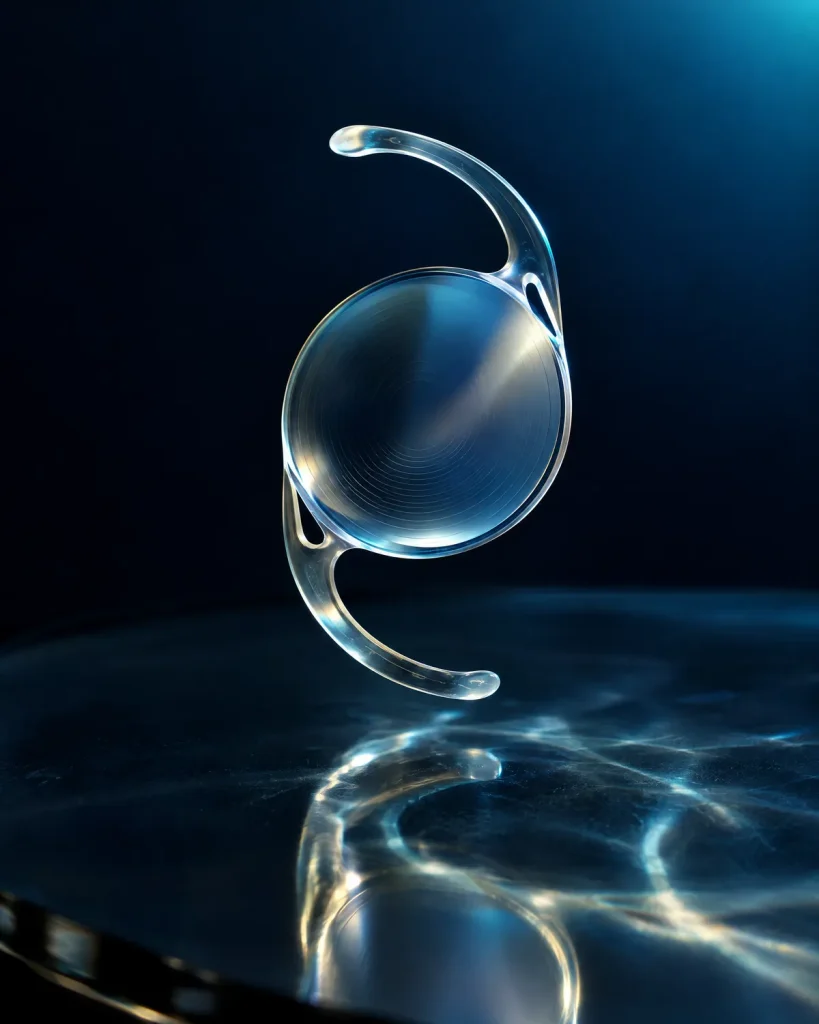
IOL Master biometry is a no-touch, painless scan that measures the length of your eye and the curvature of your cornea so your surgeon can calculate the exact power of the lens implant for cataract surgery or lens replacement. It takes only a few minutes. At Laser Istanbul Clinic, Prof. Dr. Ahmet Satıcı, Doç. Dr. Muhammet Derda Özer and Op. Dr. Aysan Bayram use it to plan your lens.
What is IOL Master biometry, and what does it measure?
Biometry means measuring the eye. The Royal College of Ophthalmologists (RCOphth) states that the primary aim of biometry is to select the correct intraocular lens (IOL) power to achieve the desired refractive result after cataract surgery, and calls it an essential step before the operation.
"IOL Master" is the name of an optical biometer made by Carl Zeiss Meditec. Patients and clinics often use it as a general word for the whole test, and other manufacturers make optical biometers that do the same job. This page uses "IOL Master biometry" for the test and "optical biometry" for the technology. Our examination uses {{biometer model used by your surgeons}}.
What the scan measures:
| Measurement | What it is | Why it matters for your lens |
|---|---|---|
| Axial length | The distance from the front of the cornea to the back of the eye (the retina) | The most important number. A longer eye needs a weaker lens; a shorter eye needs a stronger one |
| Keratometry (K) | How steeply the front of the cornea curves, in dioptres, with the axis of any astigmatism | Gives the focusing power of the cornea, and shows whether a toric (astigmatism-correcting) lens is needed |
| Anterior chamber depth | The distance from the cornea to the front of your natural lens | Helps predict where the new lens will sit in the eye |
| White-to-white (corneal diameter) and, on some devices, lens thickness | The width of the cornea and the thickness of the natural lens | Used by some formulas and by some premium lens plans |
RCOphth describes the two major components as axial length and central corneal curvature, with extra measurements such as white-to-white and anterior chamber depth used by some formulae. An optical biometer takes them all in one session.
How does optical biometry work?
An optical biometer measures with harmless infrared light, and nothing touches your eye. EyeWiki (American Academy of Ophthalmology) explains that optical biometry uses partial coherence interferometry. The newer IOL Master 700 uses swept-source optical coherence tomography (SS-OCT): a 2020 study in the Korean Journal of Ophthalmology lists its wavelength as 1,050 nm, compared with 760 nm for the older IOL Master 500. Because an SS-OCT scan captures a cross-section of the whole eye, it can also show that you were looking at the target correctly during the measurement, according to ESCRS.
Why biometry is essential before cataract surgery and lens replacement
Cataract surgery and refractive lens exchange both replace your natural lens with an artificial one, and every artificial lens has a fixed power that cannot easily be changed once it is in. The lens power has to be right the first time.
1. It decides the strength of your lens. Without accurate biometry, the lens that goes in could leave you short-sighted or long-sighted after surgery. EyeWiki notes that changes in axial length alter the lens power needed in a ratio of nearly 2.5 to 3, so an axial length error of just 1 mm translates into an error of roughly 2.5 to 3 dioptres. That is why a precise optical measurement matters so much. RCOphth reports that optical axial length readings are precise to about ±0.02 mm, against about 0.12 mm for a standard ultrasound probe.
2. It lets you choose your vision goal. The American Academy of Ophthalmology (AAO) explains that before cataract surgery your surgeon measures your eye to determine the proper focusing power for your lens. Monofocal lenses give clear vision at one distance (usually far); toric lenses treat astigmatism; multifocal and accommodating lenses give a range of vision, though some people may still need glasses. The biometry results show which of these your eye can realistically support.
3. It improves the plan for your second eye. NICE guideline NG77 says surgeons can consider using 50% of the first eye's prediction error to guide the lens power for the second eye, so the result in your first eye sharpens the plan for your second.
4. It finds problems before the operation. RCOphth recommends measuring both eyes even when only one is being operated on, so that the two can be cross-checked. A large difference between the eyes can point to something that needs a closer look before surgery.
Many patients who come to Istanbul for lens surgery have waited a long time for an NHS cataract operation, or want a premium lens that the NHS does not fund. In both cases the lens is only as good as the measurement behind it.
How is the lens power calculated from the measurements?
Your surgeon enters the axial length, corneal curvature and other measurements into an IOL power formula. There are several, and each has been tested on thousands of eyes. Choosing the right one for your eye matters, especially if your eye is unusually short or long.
NICE guideline NG77 gives this advice for people who have not had previous corneal refractive surgery:
| Axial length of your eye | Formula NICE recommends |
|---|---|
| Less than 22.00 mm (short eye) | Haigis or Hoffer Q |
| 22.00 to 26.00 mm (average eye) | Barrett Universal II, if it is installed on the biometry device and does not need results to be transcribed by hand; otherwise SRK/T |
| More than 26.00 mm (long eye) | Haigis or SRK/T |
The Barrett Universal II formula has a strong track record. In a 2018 study in Ophthalmology of 18,501 eyes measured with a single optical biometer, Melles, Holladay and Chang found that it gave the lowest prediction error of the seven formulas tested, for both lens models studied. Newer artificial-intelligence-based formulas such as Kane and Hill-RBF are also in use; a 2020 review reported that the Kane formula showed the lowest absolute error across all axial length categories.
Your surgeon decides which formula, or combination of formulas, suits your eye. The result is a list of lens powers with the refractive outcome each would give. You and your surgeon then choose the lens power and target together.
How accurate is IOL power calculation?
Modern IOL power calculation is accurate, but it is a prediction, not a guarantee. A 2020 review in the Asia-Pacific Journal of Ophthalmology describes the progress: the share of eyes within 0.5 dioptres of the target rose from 55% with a common formula in 2007 to over 80% with contemporary formulas, and the share within 1.0 dioptre rose from 85% to 95%. RCOphth sets a benchmark for busy NHS departments of a result within 1 dioptre of the target in 85% of cases.
So most people land close to their planned target, and a minority end up with a small difference that glasses or a touch-up can correct. Your surgeon will explain this plainly before surgery and cannot promise that you will be completely glasses-free.
What affects accuracy?
- Good fixation. RCOphth notes that optical biometry relies on good fixation. Looking steadily at the target gives the best reading.
- A smooth tear film. Dry eye can distort the corneal readings, so you may be asked to blink and repeat a scan.
- Dense cataracts. Older optical biometers can fail to measure some eyes. EyeWiki puts the failure rate of partial coherence interferometry at around 8 to 17%, mainly in dense cataracts. SS-OCT does better: in a 2020 comparison of 124 eyes, axial length could not be measured in 9.7% of eyes with the IOL Master 500 but only 2.4% with the IOL Master 700, and a study of 1,226 eyes reported by ESCRS found 6.4% against 0.5%.
- The right lens constants. RCOphth explains that optimising the lens constants for each lens model and measurement method has a much bigger effect on the predictability of the result than the choice between modern formulas.
- Previous eye surgery. See the next section.
If the optical scan cannot read your eye, ultrasound is the backup. RCOphth notes that immersion ultrasound gives more accurate results than contact ultrasound, and an NHS trust leaflet describes the usual method as a probe placed on the surface of the eye after a numbing drop.
Special cases: LASIK, keratoconus and unusual eyes
Previous laser eye surgery (LASIK, PRK, SMILE). Corneal refractive surgery changes the relationship between the front and back of the cornea, so standard keratometry misjudges the power of the central cornea. RCOphth warns that this typically causes an unpredictable undercorrection of corneal power and a hyperopic "surprise" (the eye ends up long-sighted) after cataract surgery, and advises aiming for low short-sightedness to avoid it. NICE says not to rely on standard biometry techniques alone in these eyes, and to tell patients that results are harder to predict and that they may need further surgery if they want to avoid distance glasses. Special methods exist for these eyes, including the Barrett True-K formula and the free ASCRS online calculator. If you have had laser eye surgery, bring your old records. The original pre-laser prescription and keratometry make the calculation more accurate.
Keratoconus and an irregular cornea. When the cornea is cone-shaped, the keratometry reading is less reliable. The 2020 review mentioned above notes that a corneal tomography scan gives the most reproducible measurements in these eyes, that a slightly short-sighted target is recommended, and that all formulas perform less well in severe cases. These eyes are planned with the cornea specialist, Doç. Dr. Muhammet Derda Özer, together with corneal topography.
Very long or very short eyes. The formula is chosen by axial length, as in the NICE table above. RCOphth notes that for highly myopic eyes (axial length over 28 mm) optical biometry is usually reliable if you can fixate accurately.
Dense cataract or other eye disease. Where the biometer cannot measure through a cataract or scar, other methods such as ultrasound are used, with the extra care that these eyes need.
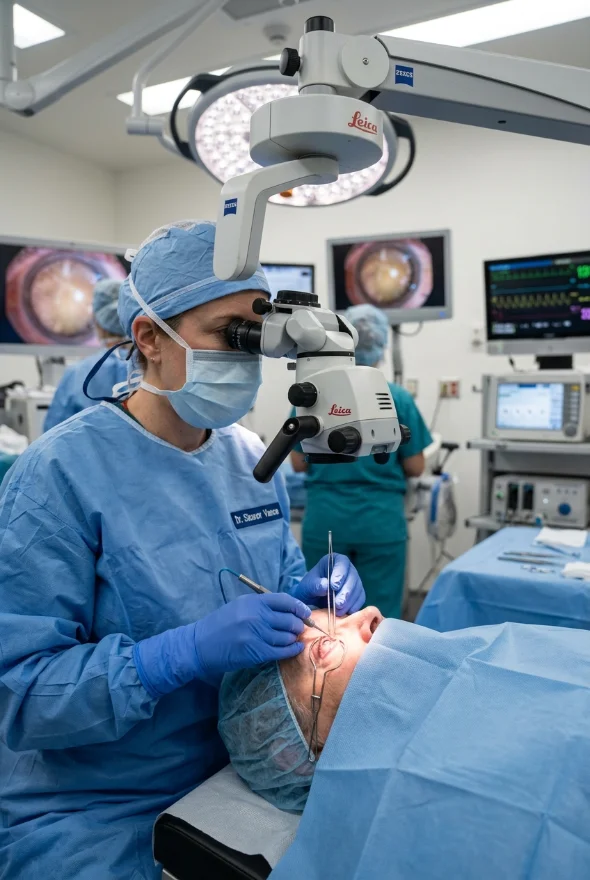
What to expect: IOL Master biometry procedure and duration
Before the test
- Take a break from contact lenses, because lenses temporarily change the shape of your cornea. RCOphth advises that soft lenses ideally be left out for one week and hard lenses for four weeks before measurement. A Leicester NHS Trust leaflet (2025) gives 7 days for soft lenses of every type and 4 weeks for rigid gas permeable lenses. Your coordinator will confirm the timing for your lenses.
- Bring your glasses, your current prescription and, if you have had laser eye surgery, your old records.
- Biometry is ideally done before dilating drops and before eye pressure measurement, according to RCOphth, so it comes early in your examination.
During the test
- You sit facing the machine with your chin and forehead resting on supports.
- You look at a coloured light or a cross inside the device and keep your eye open and still.
- The device takes the measurements. The NHS leaflet confirms that the scan does not touch your eye or blow air at it, and that there is no pain or discomfort.
- Both eyes are measured, even if only one is going to be operated on, so that the surgeon can compare them. Some readings are repeated to check they agree.
How long does it take? The leaflet states that the test takes only a few minutes. It is one part of your pre-operative examination.
After the test: there is nothing to recover from. You can carry straight on with the rest of your appointment.
How IOL Master results are read
The device prints a report for each eye with the measurements and the calculated lens powers. Your surgeon checks that the numbers make sense before using them. RCOphth gives typical ranges: 92% of axial lengths lie between 21.0 and 25.5 mm, and 99% of corneal readings between 40 and 48 dioptres.
Based on this 95% distribution, RCOphth advises that measurements should be repeated when any of the following apply.
| Check | Repeat the measurement if |
|---|---|
| Axial length | below 21.20 mm or above 26.60 mm |
| Average corneal power | below 41 D or above 47 D |
| Difference between the steep and flat corneal readings (delta K) | above 2.5 D |
| Axial length difference between your two eyes | above 0.7 mm |
| Difference in average corneal power between your two eyes | above 0.9 D |
These are checks used by surgeons, not diagnoses. A value outside the range is often perfectly genuine, for example in a very long eye. It simply means the surgeon double-checks the number before choosing your lens.
RCOphth adds that large differences between the eyes can point to an amblyopic ("lazy") eye, an unusually shaped back of the eye or vitreous opacities. Your surgeon then talks you through the lens options and the target you would like.
IOL Master biometry price
Biometry is included in every cataract and lens replacement price at Laser Istanbul Clinic, as part of your pre-operative examination and scans with your surgeon. If you only want your measurements taken, for example for a second opinion on a lens plan, a standalone examination with biometry costs {{£ price for a standalone biometry examination}}. Hotel and airport transfers are not included and are a separate charge if you would like us to arrange them; flights are not included either.
You can also send recent biometry printouts from your own optician or eye clinic for a free initial review before you travel.
Who reads your biometry
Your biometry is read by the surgeon who will operate on you, not just by the machine. Prof. Dr. Ahmet Satıcı, who specialises in cataract surgery and premium (trifocal) lenses, plans lens and refractive lens exchange surgery. Doç. Dr. Muhammet Derda Özer (Doç. is the Turkish title for Associate Professor) treats cataract as well as corneal disease and keratoconus, so he also plans lenses for eyes with corneal problems. Op. Dr. Aysan Bayram, a female surgeon who speaks English, performs cataract surgery. If anything on your report is unusual, your surgeon explains it and the options, through your personal interpreter if you wish.
Treatments IOL Master biometry supports
| Treatment | How biometry is used |
|---|---|
| Cataract surgery | Calculates the power of the replacement lens, and informs the plan for the second eye |
| Lens replacement (RLE / smart lens) | Calculates the power of a premium lens (trifocal, EDOF or toric) when the natural lens is replaced |
Other tests in your eye examination
IOL Master biometry is done alongside other tests, each answering a different question:
- Corneal topography: maps the shape of the cornea; important for astigmatism and keratoconus (/en/eye-tests-diagnostics/corneal-topography/)
- OCT scan (optical coherence tomography): detailed cross-section scans of the retina and macula (/en/eye-tests-diagnostics/oct-scan/)
- FFA (fundus fluorescein angiography): imaging of the blood vessels at the back of the eye (/en/eye-tests-diagnostics/fluorescein-angiography/)
- Eye ultrasound (B-scan): imaging when the inside of the eye cannot be seen directly (/en/eye-tests-diagnostics/eye-ultrasound/)
- Visual field test (perimetry): checks your side vision (/en/eye-tests-diagnostics/visual-field-test/)
- Tonometry (eye pressure measurement): important for glaucoma checks (/en/eye-tests-diagnostics/tonometry/)
IOL Master biometry: frequently asked questions
IOL Master biometry is an optical, no-touch scan that measures the length of your eye and the curvature of your cornea. Surgeons use the numbers to calculate the power of the lens implant for cataract surgery or lens replacement. "IOL Master" is a manufacturer's product name that many people use for the test in general.
Because the artificial lens has a fixed power, and the right power depends on the exact size and shape of your eye. RCOphth calls biometry an essential step before cataract surgery, and an error of 1 mm in axial length can change the result by roughly 2.5 to 3 dioptres.
No. The scan does not touch your eye or blow air at it, and an NHS trust leaflet confirms there is no pain or discomfort. You sit still and look at a light or a cross while the measurements are taken.
Only a few minutes for the test. It is one short part of your full pre-operative examination.
Yes. Contact lenses change the shape of the cornea and can distort the measurements. RCOphth advises one week without soft lenses and four weeks without hard lenses, and an NHS trust leaflet gives 7 days for soft lenses and 4 weeks for rigid gas permeable lenses. We confirm the exact timing for you.
Most eyes end up close to the planned target: a 2020 review reports over 80% of eyes within 0.5 dioptres and about 95% within 1.0 dioptre with contemporary formulas. It is still a prediction. Some people need a light pair of glasses after surgery, and your surgeon will discuss this with you beforehand.
Yes, but the calculation is harder because laser surgery changes the cornea. Special methods and your old pre-laser records are used, and your surgeon may aim for a slightly short-sighted target to avoid a long-sighted surprise. Please bring or send your earlier prescriptions and scans.
Yes. RCOphth recommends measuring both eyes even when only one is being operated on, so the surgeon can compare them and spot errors. It also helps plan the second eye if you need it later.
Dense cataracts and some corneal problems can stop an optical scan from working. In that case your surgeon uses another method, usually ultrasound, which takes the measurement with a probe after a numbing drop.
Biometry is included in every cataract and lens replacement price at Laser Istanbul Clinic. A standalone examination with biometry costs {{£ price for a standalone biometry examination}}. Hotel and transfers are not included.
Yes. Upload your latest biometry printout, prescription and any scans, and a surgeon will review them free of charge. A new measurement is still taken in Istanbul before surgery, so that your lens is chosen from current numbers.
Sources for the facts on this page
- EyeWiki (AAO), Biometry for Intra-Ocular Lens (IOL) Power Calculation: axial length, keratometry, ACD; optical biometry uses partial coherence interferometry and fails in about 8–17% of cases; immersion ultrasound; changes in axial length alter IOL power in a ratio of nearly 2.5 to 3. https://eyewiki.aao.org/Biometry_for_Intra-Ocular_Lens_(IOL)_Power_Calculation
- NICE, Cataracts in adults: management (NG77), recommendations 1.3 on biometry: formula by axial length (<22.00 mm Haigis or Hoffer Q; 22.00–26.00 mm Barrett Universal II or SRK/T; >26.00 mm Haigis or SRK/T); previous corneal refractive surgery; use 50% of first-eye prediction error for second eye. (The nice.org.uk page returned an access error to our fetch tool; wording taken from NICE search excerpts. Re-check against the live page before go-live.) https://www.nice.org.uk/guidance/NG77/chapter/Recommendations
- Leicester's Hospitals (NHS), Having a biometry test of your eye, leaflet 874 v2 (reviewed March 2025): non-invasive, does not touch the eye or blow air; takes only a few minutes; no pain or discomfort; ultrasound backup with local anaesthetic drop; contact-lens breaks (soft 7 days, RGP 4 weeks). https://yourhealth.leicestershospitals.nhs.uk/library/musculoskeletal-specialist-surgery-mss/ophthalmology/982-having-a-biometry-test-of-your-eye/file
- American Academy of Ophthalmology, Cataract Surgery: Risks, Recovery, Costs (reviewed by Arjan S. Hura, MD, Dec 2025): surgeon measures the eye to determine IOL power; monofocal, toric and multifocal options. https://www.aao.org/eye-health/treatments/what-is-cataract-surgery
- Song JS, Yoon DY, Hyon JY, Jeon HS. Comparison of ocular biometry and refractive outcomes using IOL Master 500, IOL Master 700, and Lenstar LS900. Korean J Ophthalmol 2020: wavelengths 760 nm (IOL Master 500) and 1,050 nm SS-OCT (IOL Master 700); axial length measurement failure 9.7% vs 2.4% in 124 eyes. https://pmc.ncbi.nlm.nih.gov/articles/PMC7105785
- O'hEineachain R. OCT biometry. ESCRS EuroTimes, 18 May 2017: SS-OCT captures the whole eye; failure 0.5% vs 6.4% (IOL Master 500) in 1,226 eyes; scan confirms fixation. https://www.escrs.org/eurotimes/oct-biometry
- Melles RB, Holladay JT, Chang WJ. Accuracy of intraocular lens calculation formulas. Ophthalmology 2018;125:169–178: 18,501 eyes, Barrett Universal II lowest prediction error. https://pubmed.ncbi.nlm.nih.gov/28951074/
- Xia T, Martinez CE, Tsai LM. Update on intraocular lens formulas and calculations. Asia-Pac J Ophthalmol 2020: over 80% within 0.5 D and about 95% within 1.0 D with contemporary formulas (55% / 85% in 2007); Kane lowest error across axial lengths; Barrett True-K and ASCRS calculator after refractive surgery; keratoconus guidance. https://pmc.ncbi.nlm.nih.gov/articles/PMC7299214/
- NHS, Cataract surgery (page last reviewed 6 March 2025): measurement before surgery; glasses may still be needed afterwards. https://www.nhs.uk/conditions/cataract-surgery/
Planning cataract or lens surgery? Let a surgeon look at your measurements, free
Upload your prescription and any biometry or eye reports. Prof. Dr. Satıcı, Doç. Dr. Özer or Op. Dr. Bayram will tell you what they show and which lens options may suit you, with no obligation.
3 eye surgeons
Your case is reviewed by a named surgeon, not a salesperson. Reply within {{response time}}.
 Prof. Dr. Ahmet Satıcı
 Doç. Dr. Muhammet Derda Özer
 Op. Dr. Aysan Bayram