
- Home
- Knowledge centre
- Eye glossary A–Z
- Behçet’s Eye Disease: Symptoms, Treatment and Celebrities With Behçet’s Disease
Behçet's Eye Disease: Symptoms, Treatment and Celebrities With Behçet's Disease
Medically reviewed by {{surgeon}}, {{surgeon's title and specialty}}, on {{review date}}. Last updated {{date}}.
Behçet's eye disease (noun; also written Behcet's eye disease or Behçet uveitis): inflammation inside the eye that occurs as part of Behçet's disease, a rare, long-term condition in which inflammation of blood vessels affects the mouth, skin, joints and eyes. It usually appears as uveitis, comes in repeated attacks, often affects both eyes and can permanently damage vision if it is not treated. Doç. Dr. Muhammet Derda Özer (Doç. means Associate Professor), who leads uveitis and retina care at Laser Istanbul Clinic, reviews it.
Looking for celebrities with Behçet's disease? The few who have spoken publicly are covered below, after what the disease does to the eyes.
Behçet's eye disease: key facts
- What it is
- Eye inflammation, usually uveitis or retinal vasculitis, caused by Behçet's disease, an autoinflammatory condition of blood vessels
- How common in Behçet's
- About 7 in 10 people with Behçet's disease develop eye inflammation (NHS); EyeWiki gives roughly 70%
- Typical start
- Often in the 20s and 30s; in a large Istanbul study the average age at onset of uveitis was 28.5 years in men and 30 years in women
- Both eyes?
- Usually: 78.1% of 880 patients had both eyes involved
- Who is hit hardest
- Men, in whom eye disease is more common and often more severe
- Where it is common
- Countries along the old Silk Road, with the highest rates in Türkiye; lower in North America and Northern Europe
- Cure
- None, but treatment can control attacks and protect sight
- Main treatments
- Corticosteroids, immunosuppressants such as azathioprine and ciclosporin, and TNF-inhibitor biologics (infliximab, adalimumab)
- Specialist
- Ophthalmologist who treats uveitis, working with a rheumatologist; at Laser Istanbul Clinic, Doç. Dr. Muhammet Derda Özer

What is Behçet's disease, and what does it do to the eye?
Behçet's disease is a condition of inflammation in the blood vessels and tissues, and the NHS describes it as rare and poorly understood. It is named after the Turkish dermatologist Hulusi Behçet, who described the combination of mouth ulcers, genital ulcers and eye inflammation in the 1930s. Because it can inflame veins and arteries of every size, it can touch many organs.
In the eye, the inflammation most often affects the uvea (the middle layer, which holds most of the eye's blood vessels) and the retina. EyeWiki, the American Academy of Ophthalmology's wiki, describes the typical picture as non-granulomatous uveitis, with attacks that are "explosive and recurrent". The whole uveal tract can be involved, and the most sight-threatening part is the back of the eye, where the disease causes an obliterative, necrotizing retinal vasculitis that, unusually, attacks both arteries and veins.
Behçet's eye disease is not an infection and is not contagious. Attacks come and go, and the damage from each one adds up, which is why preventing repeat attacks is the aim of treatment.
Celebrities with Behçet's disease: who has spoken publicly about it?
Very few well-known people have said publicly that they have Behçet's disease, because it is rare in the countries where celebrity news is produced and most people keep their health private. We include only people who have talked about their own diagnosis, so the list is short.
- Rosie Marcel, the British actress known for the hospital drama Holby City, told The Mirror in 2011 that she developed Behçet's disease. By her own account it left her almost bed-bound for two years and unable to walk unaided for about twelve months. She takes immunosuppressant medicines and has liver function and blood tests every three months, and said that untreated, the disease can affect the lungs, heart and blood vessels.
- Hulusi Behçet is not a celebrity patient. He was the Turkish dermatologist (1889–1948) whose name the disease carries.
What a search for celebrities with Behçet's disease shows is that the condition varies a great deal: some people mainly have mouth ulcers and tiredness, while others, as in this account, are severely unwell. For the eye, that variation matters, because the people at greatest risk of lasting vision loss are those with posterior uveitis or retinal vasculitis, which can be painless.
We list only publicly reported cases and make no claim about anyone's current health. A famous name tells you nothing about your own eyes; only an examination does.
Who gets Behçet's disease? Causes and risk factors
The cause is unknown. The NHS describes Behçet's as an autoinflammatory condition, in which the immune system causes inflammation of blood vessels, and points to two contributors:
- Genes. The disease is much more common in some ethnic groups. A gene variant called HLA-B51 (especially HLA-B5101) is linked to it, but EyeWiki stresses that having it is only a minor factor and that the disease rarely runs in families.
- Environment. Rates are lower in at-risk groups who live outside their home regions, which suggests an environmental trigger, although none has been proven.
Who is affected. The NHS says people of Mediterranean, Middle Eastern and Asian origin are thought to be most likely to develop it, though it affects all ethnic groups. Symptoms often start in adults in their 20s and 30s but can start in childhood. EyeWiki lists Türkiye, Japan, Korea, China, Iran, Iraq and Saudi Arabia among the countries with the highest prevalence, which is why Behçet's is a familiar diagnosis to eye doctors in Istanbul and to patients from the Gulf, Central Asia and the Mediterranean.
Behçet's disease symptoms: eye symptoms and other signs
The NHS lists the main features of Behçet's disease:
| Part of the body | Typical features |
|---|---|
| Mouth | Painful ulcers on the tongue, lips, gums or cheeks; nearly everyone has them; they usually heal within two weeks without scarring but keep coming back |
| Genitals | Recurrent painful ulcers, which may scar |
| Skin | Red swellings on the legs (erythema nodosum) and acne-like spots, usually settling within 14 days |
| Joints | Arthritis-like pain and stiffness, affecting about half of patients, often knees and ankles |
| Eyes | Inflammation (uveitis) in around 7 in 10 people |
| General | Marked tiredness |
Behçet's eye symptoms
The symptoms of Behçet's eye disease depend on which part of the eye is inflamed (EyeWiki, NHS):
- Front of the eye (anterior uveitis): redness, tearing, pain, sensitivity to light and blurred vision. EyeWiki notes that in about 25% of cases a layer of white cells, a hypopyon, settles at the bottom of the front chamber; it moves when the head moves.
- Back of the eye (posterior uveitis and retinal vasculitis): painless blurring, floaters and patches missing from the field of vision. Because it is painless, people can delay seeing a doctor.
- Sudden vision loss: this needs emergency care. The NHS says to call 999 or go to A&E for sudden blurred vision or sudden loss of vision.
These are the symptoms of uveitis in general, so Behçet's is often only recognised once ulcers or other signs are noticed alongside them.
Behçet eye complications: can it cause blindness?
It can, which is why treatment is taken seriously. EyeWiki states that up to 25% of people with Behçet's disease suffer severe vision loss (defined as acuity worse than 20/200), and that eye inflammation can appear early and lead to severe loss in about 20% of cases. The complications EyeWiki describes include:
| Complication | What happens |
|---|---|
| Optic nerve damage (optic atrophy) | Described as the most common cause of visual impairment |
| Retinal vein occlusion | Blockage of a retinal vein from vasculitis |
| Macular oedema | Swelling at the centre of the retina, blurring central vision |
| New abnormal blood vessels | Retinal ischaemia can cause neovascularisation of the retina and the iris |
| Glaucoma | Usually a late feature linked to relapses; neovascular glaucoma can follow ischaemia |
| Cataract | Clouding of the lens from inflammation and from long-term steroid treatment (the NHS lists cataracts among steroid side effects) |
The outlook has improved. In the Istanbul University study of 880 patients with Behçet uveitis, men who first attended in the 1990s had a significantly lower risk of losing useful vision than men who attended in the 1980s. Even so, the risk of losing useful vision (better than 0.1) at 10 years was estimated at 30% for men and 17% for women in that series, which is why early specialist care and regular follow-up matter.
Behçet's disease diagnostic criteria: how is it diagnosed?
There is no single test for Behçet's disease. The NHS says diagnosis usually needs at least three episodes of mouth ulcers in 12 months plus at least two more features (genital ulcers, eye inflammation, skin lesions or a positive pathergy test), supported by blood tests, scans and sometimes a biopsy.
Two sets of Behçet's disease diagnostic criteria are in wide use:
| Criteria | How they work |
|---|---|
| International Study Group (ISG), 1990 | Recurrent mouth ulcers plus any two of: genital ulcers, typical eye lesions, typical skin lesions, or a positive pathergy test (a skin-prick reaction). Developed from data on 914 patients |
| International Criteria for Behçet's Disease (ICBD), 2014 | A points score: eye lesions, mouth ulcers and genital ulcers 2 points each; skin lesions, nervous-system involvement and vascular signs 1 point each; the pathergy test, when used, 1 point. A score of 4 or more classifies the patient as having Behçet's. Developed from 27 countries' data (2,556 patients, 1,163 controls); sensitivity 94.8% against 85.0% for the ISG criteria in the validation set |
These are classification criteria designed for research and consistency; a doctor's clinical judgement still decides the diagnosis for an individual patient.
How the eye specialist confirms Behçet's eye disease
An eye doctor looks at the inflammation and its pattern. This usually means a slit-lamp examination (a microscope check of the front of the eye), a dilated examination of the retina, optical coherence tomography (OCT) scans, and fluorescein angiography, a dye test that shows leaking and blocked retinal vessels. EyeWiki notes that the severe vasculitis can resemble a necrotizing herpes infection (acute retinal necrosis), so infection has to be ruled out, and other causes of uveitis such as HLA-B27 disease, sarcoidosis and lupus are considered. Because inflammation and infection can look alike, the same care applies to keratitis, endophthalmitis and other infections of the eye.
Imaging in Behçet uveitis is also an active research area. In a 2026 study co-authored by Doç. Dr. Özer, 66 eyes with Behçet uveitis had a significantly lower choroidal vascularity index (an OCT-derived measure) than healthy eyes, and the lowest values were seen in eyes with both clinical and angiographic activity.
Which doctor treats Behçet's eye disease? Behçet's disease specialist
Behçet's disease is treated by a team. The NHS advises that any eye inflammation from Behçet's should be carefully monitored by an ophthalmologist, and the 2018 EULAR recommendations were written by a task force that included specialists in internal medicine, rheumatology, ophthalmology, dermatology, neurology, gastroenterology and vascular surgery. In practice:
- an ophthalmologist with uveitis expertise treats and monitors the eyes;
- a rheumatologist or internist usually prescribes and monitors the systemic immunosuppressant and biologic medicines;
- other specialists join if the nervous system, gut or blood vessels are involved.
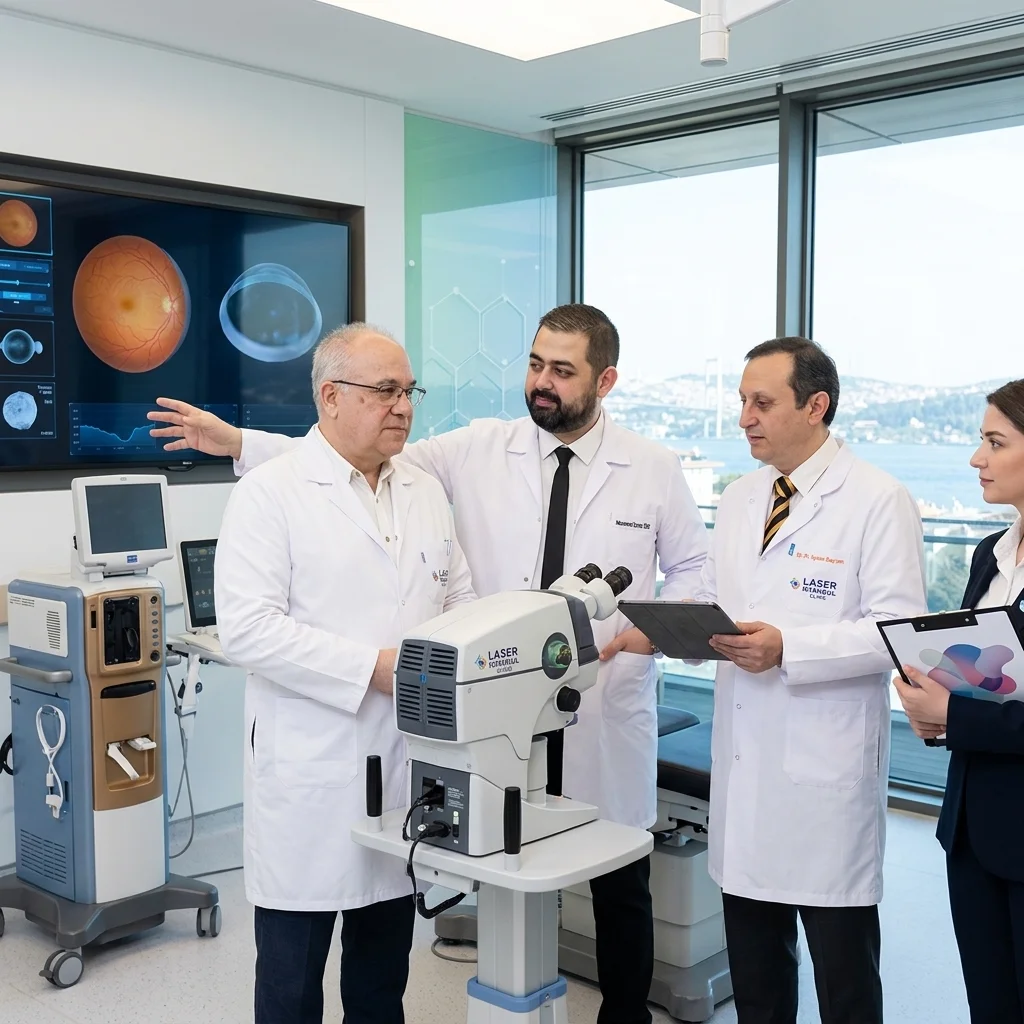
At Laser Istanbul Clinic, uveitis and retinal inflammation are led by Doç. Dr. Muhammet Derda Özer, who speaks Turkish and English. He is a co-author of a 2024 study of TNF-inhibitor treatment in patients with Behçet's disease and of the 2026 Behçet uveitis imaging study mentioned above. Cataract and laser care are led by Prof. Dr. Ahmet Satıcı and Op. Dr. Aysan Bayram, for example if a quiet eye with Behçet's later needs cataract surgery.
Behçet's eye disease treatment: how is it treated?
There is no cure for Behçet's disease, but the NHS says treatment can control symptoms and prevent complications. For the eyes the aims are to calm the attack quickly and then stop new ones.
| Treatment | What it does | Typical use in Behçet's eye disease |
|---|---|---|
| Corticosteroids (drops, tablets, injections) | Quickly reduce inflammation | The NHS lists steroid eye drops and oral steroids; EyeWiki cites prednisone at 1.5 mg/kg/day with a taper for acute inflammation. Long-term oral use has side effects including weight gain, raised eye pressure (glaucoma), cataract and diabetes |
| Azathioprine | Immunosuppressant that reduces relapses | EyeWiki calls it a preferred first-line immunosuppressant for preserving vision; the NHS pairs it with steroids as standard eye treatment |
| Ciclosporin (also tacrolimus, mycophenolate) | Other immunosuppressants | Used for chronic or more severe inflammation; need regular blood tests |
| TNF inhibitors: infliximab, adalimumab | Biologic medicines that block an inflammation signal | For sight-threatening panuveitis or severe retinal vasculitis, and when other medicines fail |
| Interferon-alpha | Immune-modulating injection | Has been used for refractory eye disease |
| Surgery | Treats complications | Cataract surgery is usually considered after at least 3 months without intraocular inflammation (EyeWiki) |
In Türkiye, a retrospective study of 469 people with Behçet's disease from the east of the country found that 80 (17%) received TNF inhibitors, and most of those achieved attack-free, steroid-free disease and stayed on the treatment; no deaths occurred in that group. Doç. Dr. Özer was one of the authors. This was a single-centre review, not a trial.
Treatment with us: Doç. Dr. Muhammet Derda Özer can assess the eyes, review your imaging and current medicines, and plan eye treatment together with your own rheumatologist, who normally continues the systemic medicines. Behçet's is a long-term condition that needs regular checks, so we advise keeping your home specialist involved, and our remote follow-up is there for questions after a visit.
Living with Behçet's eye disease: outlook
Behçet's disease follows a waxing and waning course, with flare-ups separated by quiet periods. Attacks are more severe in younger men. Early, aggressive immunosuppressive treatment improves visual outcomes (EyeWiki), and a good plan is mostly about keeping the eye quiet:
Take immunosuppressant medicines exactly as prescribed
, and do not stop them when the eye feels well.
Attend monitoring appointments and blood tests
, which check for side effects on the liver and blood cells.
Treat a red, painful or blurred eye as urgent
and contact your eye doctor the same day.
Tell every doctor you have Behçet's
before any eye surgery or new medicine.

When to see a doctor about Behçet's or eye inflammation
Get emergency care the same day if you have:
- sudden blurred vision or sudden loss of vision (the NHS says to call 999 or go to A&E)
- a painful red eye with light sensitivity
- a sudden shower of floaters or a dark patch in your vision
Book an appointment with your GP or an eye specialist if you have:
- repeated mouth ulcers (three or more in a year) together with an eye problem, genital ulcers, skin lesions or joint pain
- red eyes or blurred vision that keeps coming back
- an existing Behçet's diagnosis and any change in your vision, even without pain
If you already have a diagnosis and want a second opinion on an eye plan, you can send your reports and scans for review.
Frequently asked questions
Few celebrities have talked about it. One public example is the British actress Rosie Marcel, who told The Mirror in 2011 that Behçet's left her almost bed-bound for two years. The disease is rare in the UK and US, and most people with it, famous or not, keep their health private.
It is eye inflammation caused by Behçet's disease, usually uveitis or retinal vasculitis. It tends to come in attacks, often affects both eyes and can permanently damage vision without treatment.
Redness, pain, light sensitivity, floaters and blurred vision. Inflammation at the back of the eye can be painless. Sudden blurred vision or sudden vision loss is an emergency.
Yes, it can. EyeWiki reports that up to 25% of people with Behçet's disease suffer severe vision loss, and optic nerve damage is the most common cause. Early treatment reduces the risk, and outcomes have improved over recent decades.
The 1990 ISG criteria require recurrent mouth ulcers plus two of genital ulcers, eye lesions, skin lesions or a positive pathergy test. The 2014 ICBD criteria use a points score in which 4 or more classifies the patient as having Behçet's.
No. The NHS says there is no cure, but medicines such as steroids, immunosuppressants and biologics can control attacks and prevent complications.
An ophthalmologist who treats uveitis, usually together with a rheumatologist. At Laser Istanbul Clinic that is Doç. Dr. Muhammet Derda Özer.
It is not contagious. It is not usually inherited directly: a gene variant, HLA-B51, is linked to it, but EyeWiki notes that family clustering is rare.
Often yes, but the eye should first be free of inflammation. EyeWiki suggests considering surgery after at least 3 months without intraocular inflammation. Your surgeon will plan it alongside your uveitis treatment.
Sources for the facts on this page
- NHS. Behçet's disease (overview, symptoms, treatment). https://www.nhs.uk/conditions/behcets-disease/ · https://www.nhs.uk/conditions/behcets-disease/symptoms/ · https://www.nhs.uk/conditions/behcets-disease/treatment/
- EyeWiki (American Academy of Ophthalmology). Behçet Disease. https://eyewiki.org/Behcet_Disease
- National Eye Institute. Uveitis. https://www.nei.nih.gov/learn-about-eye-health/eye-conditions-and-diseases/uveitis
- International Study Group for Behçet's Disease. Criteria for diagnosis of Behçet's disease. Lancet 1990;335(8697):1078–80. PubMed: https://pubmed.ncbi.nlm.nih.gov/1970380/
- International Team for the Revision of the International Criteria for Behçet's Disease. The International Criteria for Behçet's Disease (ICBD): a collaborative study of 27 countries. J Eur Acad Dermatol Venereol 2014;28(3):338–47. PubMed: https://pubmed.ncbi.nlm.nih.gov/23441863/
- Tugal-Tutkun I et al. Uveitis in Behçet disease: an analysis of 880 patients. Am J Ophthalmol 2004;138(3):373–80. PubMed: https://pubmed.ncbi.nlm.nih.gov/15364218/
- Hatemi G et al. 2018 update of the EULAR recommendations for the management of Behçet's syndrome. Ann Rheum Dis 2018;77(6):808–18 (abstract). PubMed: https://pubmed.ncbi.nlm.nih.gov/29625968/
- Tan RB, Özer MD et al. Association between choroidal vascularity index and disease activity in Behçet uveitis using BOS24 and FFA scores. Graefes Arch Clin Exp Ophthalmol 2026 (abstract). PubMed: https://pubmed.ncbi.nlm.nih.gov/42720747/
- Bektaş M, Özer MD, Oğuz E. The safety and efficacy of TNF inhibitors in patients with Behçet's disease: retrospective study from eastern Turkey. Clin Immunol 2024;264:110239. PubMed: https://pubmed.ncbi.nlm.nih.gov/38734038/
- Wikipedia. Rosie Marcel (personal life section, citing Carroll H, "Rosie Marcel interview: Holby star on her own nightmare battle with life-threatening illnesses", The Mirror, 21 April 2011). https://en.wikipedia.org/wiki/Rosie_Marcel (the original Mirror page could not be opened from our tools; to be re-checked, see "Facts needed")
- Wikipedia. Hulusi Behçet. https://en.wikipedia.org/wiki/Hulusi_Beh%C3%A7et
Have Behçet's disease or recurrent eye inflammation?
Send us your eye reports, scans and medication list. Doç. Dr. Muhammet Derda Özer, who leads uveitis and retina care at Laser Istanbul Clinic, will review them and tell you which options may suit your eyes, with no obligation.
3 eye surgeons
Your case is reviewed by a named surgeon, not a salesperson. Reply within {{response time}}.
 Prof. Dr. Ahmet Satıcı
 Doç. Dr. Muhammet Derda Özer
 Op. Dr. Aysan Bayram