
- Home
- Knowledge centre
- Retina & glaucoma guides
- Blurry Vision After Retina Surgery: What Is Normal, and What Not to Do After Retinal Tear Laser Surgery
Blurry Vision After Retina Surgery: What Is Normal, and What Not to Do After Retinal Tear Laser Surgery
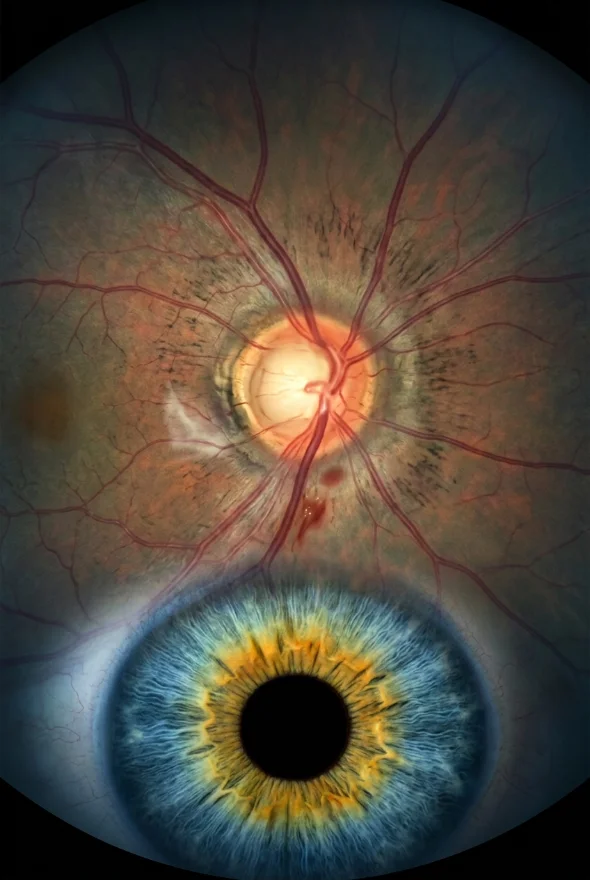
Some blur is normal after retina treatment. After laser for a retinal tear, vision is misty for a few hours and usually back to normal the next day. After vitrectomy or detachment surgery with a gas bubble, vision is very blurred for weeks and improves as the bubble is absorbed. New floaters, flashes or a dark curtain are never normal. Retina surgeons Doç. Dr. Muhammet Derda Özer and Op. Dr. Aysan Bayram treat these conditions.
Is blurry vision normal after retina surgery?
Yes, some blurry vision is expected after every type of retina treatment, but how much, and for how long, depends on what was done. A quick laser seal around a tear causes a short spell of mistiness. Keyhole surgery inside the eye, with a gas bubble that holds the retina in place, causes blur that lasts weeks and then fades slowly.
| Treatment | What you see afterwards | How long it usually lasts |
|---|---|---|
| Laser around a retinal tear (laser retinopexy) | Dazzled, misty vision; light sensitivity and glare; floaters may increase | Misty for a few hours and back to normal by the next day; floaters settle after a few days (NHS patient leaflet) |
| Vitrectomy or detachment surgery with a gas bubble | Very blurred vision; later a moving line like a spirit level, fuzzy below the line and clear above | The eye heals over about 2 to 6 weeks; the bubble lasts from about 2 to 12 weeks depending on the gas |
| Macular hole surgery with gas | Vision "a bit like having your eye open under water" (NHS) | Gradual improvement as the gas is absorbed, which generally takes a few months |
| Vitrectomy or detachment surgery with silicone oil | The oil stays in the eye until a second, smaller operation removes it | Several months; your surgeon decides when the oil comes out |
Timelines come from NHS and AAO patient information (see Sources); your own recovery depends on your eye and your condition.
The American Academy of Ophthalmology (AAO) says that after detachment surgery your sight should begin to improve about four to six weeks after surgery, and that it can take months for vision to stop changing. The NHS gives 2 to 6 weeks for the eye to settle, during which vision may be blurry and the eye sore and red.
What to expect after laser surgery for a retinal tear
Laser retinopexy is a short outpatient treatment that seals the retina around a tear so it cannot peel away, and recovery is quick. The surgeon places rows of laser spots around the tear; these form scar tissue that acts as a barrier. The AAO says laser treatment is typically completed in under 15 minutes in an office setting, and an NHS patient leaflet describes about 20 minutes.
Why the treatment matters: a retinal tear usually follows a posterior vitreous detachment, the natural separation of the eye's jelly from the retina. An NHS patient leaflet states that this causes a tear in about 1 in 10 people who have a vitreous detachment. Studies cited in that leaflet show that about half of untreated tears lead to a retinal detachment, and laser reduces that risk to less than 1 in 20.
Blurry vision after retinal tear laser surgery
Expect dazzled, misty vision straight after the laser, which should clear by the next day. The bright flashes leave your vision dazzled. An NHS leaflet says vision is misty for a few hours and should return to normal by the next day, and that you may have light sensitivity and glare outdoors. Another NHS leaflet says vision may stay a little blurred and sensitive to light for a few days, and that this should get better. Your pupil is also widened by the drops used for the examination; the effect wears off after about 6 hours or overnight.
Floaters after retinal tear laser surgery
Laser does not remove floaters, and you may notice more of them for a few days. The laser is done to reduce the risk of detachment, not to clear floaters. An NHS patient leaflet says floaters you had before treatment will still be there, may increase straight after the laser and settle after a few days, and will become less noticeable with time. The AAO says floaters and flashes can continue for a few weeks after treatment.
The key difference is new or sudden symptoms, covered in the warning-signs section below.
How long does the laser take to work?
The scar takes about two weeks to form. NHS leaflets say it usually takes about 14 days for the scar tissue to develop. EyeWiki, the AAO's clinical encyclopedia, reports maximal adhesion at roughly 7 to 10 days after laser and a firm adhesion at 3 weeks. For a symptomatic tear, EyeWiki describes follow-up at 1 to 2 weeks, again at 4 to 6 weeks, then at 3 to 6 months, and then yearly. Prompt sealing reduces the chance of detachment to less than 5%.
What not to do after retinal tear laser surgery
Do not drive on the day, do not ignore new symptoms, do not skip your check-up, and follow your surgeon's rules on exercise. These are the precautions after laser eye surgery for a retinal tear that published patient information agrees on, plus a few points where the evidence is thinner than people expect.
- Do not drive on the day of treatment. Both NHS leaflets say not to drive on the day of laser, because your vision is dazzled and your pupils are widened. Wait until the drops have worn off and your vision is clear, and ask your surgeon when you can drive again.
- Do not ignore new floaters, flashes or a shadow. The NHS and the AAO say these can mean a new tear or a retinal detachment, and you need an urgent eye examination.
- Do not skip the follow-up. The check about two weeks after laser is how your surgeon confirms the tear is sealed. Some tears need more laser.
- Do not expect the laser to cure floaters. It protects the retina; it does not clear the floaters you already have.
- Do not assume you must stop all activity, but do follow your surgeon's instructions. EyeWiki says vigorous physical activity is often discouraged at first, but adds that no clinical studies support the idea that reduced activity improves treatment results. The AAO says to expect activity restrictions for several weeks. Because advice differs between surgeons, ask for your own limits in writing.
- Do not rub or press the eye hard. This is general good practice rather than a published rule for laser, so ask your surgeon what applies to you. {{surgeon's own rules for the first 2 weeks after laser retinopexy}}
Exercise after retinal tear laser surgery
Gentle walking is fine for most people; strenuous exercise and heavy lifting are the activities to ask about. No trial sets a precise rule, so your surgeon decides. Many surgeons ask for a pause on running, contact sport and heavy lifting while the scar forms, which fits the AAO's "several weeks" of restrictions. {{surgeon's exercise advice after laser retinopexy}}
Can you fly after laser surgery for retinal tear?
Laser retinopexy does not put gas in the eye, so the gas-bubble flying ban does not apply. There is no incision and no bubble, so cabin pressure is not the issue it is after vitrectomy. Even so, travel only after your surgeon has examined the eye and agreed, make sure your follow-up check (about 1 to 2 weeks later) is arranged, and know where to go for urgent eye care at your destination.
Can I drive after laser eye surgery for retinal tear?
Not on the day of treatment; after that, when your vision is clear and your surgeon agrees. Most people see normally again the next day. For driving rules in your own country, follow your surgeon's advice and your licensing authority.
Blurry vision after vitrectomy or retinal detachment surgery
After keyhole surgery with a gas bubble, very blurred vision is expected and is not a sign that something has gone wrong. In a vitrectomy the surgeon removes the eye's jelly, repairs the retina and may leave a bubble of air, gas or silicone oil as an internal splint. An NHS patient leaflet says that with a gas bubble your vision is very blurred immediately after surgery.
What you see as the bubble shrinks
You will notice a line in your vision, like a spirit level. Above the line you can see; below it, vision is fuzzy or blurred. The line moves lower as the gas is absorbed until the bubble disappears. Floaters are common, particularly with gas in the eye.
How long does the gas bubble last?
| Gas in the eye | Usually lasts up to | Flying |
|---|---|---|
| Air | about 2 weeks | Not until it has gone |
| SF6 | 4 weeks | Not until it has gone |
| C2F6 | 8 weeks | Not until it has gone |
| C3F8 | 12 weeks | Not until it has gone |
| Silicone oil | Stays until removed in a later operation | Not for 2 weeks after insertion unless your consultant clears you |
Durations from NHS vitreoretinal patient guidance; your surgeon tells you which gas your eye needs.
What not to do with a gas bubble
- Do not fly or travel to high altitude. The AAO says you cannot fly, go to the mountains or scuba dive until the gas bubble is gone. The gas expands at altitude and can raise eye pressure dangerously.
- Do not accept nitrous oxide ("laughing gas", used in childbirth and in some emergency departments). It reacts with the gas in your eye. Tell any nurse, dentist or anaesthetist that you have gas in your eye.
- Do not drive until your surgeon confirms your vision allows it. After detachment surgery this depends largely on the vision in your other eye; after macular hole surgery the NHS advises not driving until the bubble has completely gone.
- Do not skip positioning if your surgeon asks for it. The NHS says you may need to hold a set position for up to a week, and your surgeon tells you if you need it at all.
- Avoid strenuous exercise. Light, gentle exercise such as walking is fine, and reading, TV and screens do not harm the eye, according to an NHS leaflet.
Planning a trip? This is why a gas bubble decides how long you must stay near your surgeon.
How long until vision improves after retina surgery?
Most people see gradual improvement over weeks to months, and how much sight returns depends mainly on whether the centre of the retina (the macula) was affected. The NHS says the eye takes 2 to 6 weeks to heal, and the AAO says it can take months for vision to stop changing.
-
First days
Blur, soreness, sticky eyelids and a gritty feeling are normal; these last 5 to 10 days (NHS leaflet)
-
1–2 weeks
First check with your surgeon, usually within 7 to 14 days of the operation
-
2–6 weeks
The eye heals and redness settles; vision begins to improve; gas shrinks
-
4–12 weeks
Gas is absorbed (depending on the gas); the blurred area clears
-
Months
Vision keeps changing slowly; a new glasses prescription may help
Does the macula matter? Yes. A 2025 review in Wiener Medizinische Wochenschrift reports that a final vision of 20/40 or better is reached in about 90% of successfully repaired detachments where the macula was still attached, but only 50% reach 20/50 when the macula had detached, with worse results the longer the macula was off. This is why prompt treatment of new symptoms matters so much.
Why is my vision still blurry weeks after retina surgery?
Persistent blur usually has a cause that can be found and treated. Your surgeon will look for these:
Cataract
Vitrectomy makes the natural lens cloud sooner. A 2023 review reports cataract in about 72% of eyes after smaller-gauge vitrectomy, and cataract surgery treats it.
Swelling or a film on the macula
Cystoid macular oedema and epiretinal membranes are recognised causes of poor vision after a technically successful repair. An NHS leaflet notes that an epiretinal membrane can also follow laser, causing blurred or distorted vision; it is often mild and sometimes needs surgery.
A new tear or a detachment coming back
The retina can detach again, most often because of scar tissue (proliferative vitreoretinopathy), which EyeWiki reports in about 8 to 10% of first repairs. Overall success is above 90% according to EyeWiki, and the National Eye Institute says about 9 in 10 people are successfully treated, though some need more than one operation.
Bleeding in the eye
Vitreous haemorrhage after laser usually clears by itself, according to an NHS leaflet.
A changed glasses prescription
Your surgeon can check whether new glasses would help once the eye has settled.
When is blurry vision after retina surgery an emergency?
Any sudden change after treatment needs same-day attention. Use the table to tell normal recovery from a warning sign.
| Normal after retina treatment | Not normal: get urgent help |
|---|---|
| Misty vision for hours after laser, clearing by the next day | A shower of new floaters, or floaters suddenly getting worse |
| Light sensitivity and glare for a few days | New flashes of light |
| A few extra floaters for a few days after laser | A shadow or dark curtain across part of your vision |
| Very blurred vision and a spirit-level line with gas | Sudden loss of vision, or vision getting worse after it had started to improve |
| Soreness, itching and sticky lids for 5–10 days after surgery | Severe pain or increasing redness |
The NHS says to call 111 or go to A&E if floaters or flashes appear suddenly or increase, a shadow moves across your vision, or your sight becomes suddenly blurred, and to call the hospital or go to A&E if pain, redness or blurriness gets worse after surgery. NHS patient information for laser asks people to seek help immediately for new floaters, flashing lights or a curtain after treatment.
If you are at home, go to your nearest eye emergency service. If you are in Istanbul, call your coordinator at once.

Retina care in Istanbul: who treats you and how recovery is managed
Retina surgery at Laser Istanbul Clinic is performed by Doç. Dr. Muhammet Derda Özer (Doç. = Associate Professor) or Op. Dr. Aysan Bayram. Doç. Dr. Özer's focus includes retina, uveitis and ocular oncology, and he speaks Turkish and English; Op. Dr. Bayram treats retinal disease alongside cataract and laser surgery, and speaks English. Surgery takes place in a fully equipped, Ministry of Health–licensed operating theatre in Istanbul.
For planned retina care, your treatment includes a pre-operative examination and scans, surgery by your named surgeon, medication, follow-up checks in Istanbul, a personal interpreter, a coordinator and remote follow-up once you are home. Flights, hotel and airport transfers are not included; hotel and transfers can be arranged for a separate charge on request. If a gas bubble is likely, plan a longer stay, because you cannot fly until it has gone.
Sudden new symptoms are different: get examined locally the same day rather than waiting to travel.
Frequently asked questions
Yes. Blur is expected after every retina treatment. After laser for a tear it clears within a day; after vitrectomy with a gas bubble it is very blurred for weeks and improves as the bubble is absorbed. The eye usually heals in 2 to 6 weeks, and vision can keep changing for months. Blur that suddenly worsens is not normal.
Do not drive on the day, do not ignore new floaters, flashes or a shadow, and do not skip the check-up about two weeks later. Ask your surgeon for written limits on exercise and lifting: the evidence for strict restriction is limited, but several weeks of care is typical.
Usually a few hours, and back to normal by the next day. Some people stay slightly blurred and light-sensitive for a few days. Blur that lasts longer or gets worse needs a check.
Yes. Floaters you had before remain, and they may increase for a few days before settling. They become less noticeable over time. New floaters, a sudden shower of them, flashes or a curtain are not normal.
Gentle walking is generally fine. Strenuous exercise, contact sports and heavy lifting are the activities to ask about. The AAO mentions several weeks of restrictions, while EyeWiki notes that no studies show reduced activity improves results, so follow your surgeon's specific advice.
Do not drive on the day of the laser. Flying is not restricted by a gas bubble because laser leaves none, but fly only after your surgeon has examined the eye and agreed, with your follow-up planned. After vitrectomy with gas, you must not fly until the bubble has gone.
The gas expands at altitude and can raise the pressure inside the eye to a dangerous level, causing severe pain and permanent loss of sight. Depending on the gas, the bubble lasts from about 2 to 12 weeks. Your surgeon confirms when it has gone.
Common causes are a cataract, swelling or a film on the macula, or a change in your glasses prescription. A cataract is common after vitrectomy and is treated with routine cataract surgery. Blur with new floaters or a shadow can mean the retina has detached again and is an emergency.
Facing retina surgery, or unsure about your recovery?
Send your scans and symptoms and one of our retina surgeons will review them and explain your options honestly. Retina care is led by Doç. Dr. Muhammet Derda Özer and Op. Dr. Aysan Bayram.
Sources for the facts on this page
- NHS. Detached retina (retinal detachment). https://www.nhs.uk/conditions/detached-retina-retinal-detachment/ (checked 7 Oct 2026: recovery 2–6 weeks, blurred vision, positioning up to a week, no driving or flying with gas, go to A&E if pain, redness or blurriness worsens)
- NHS. Retinal detachment (symptoms and urgency). https://www.nhs.uk/conditions/retinal-detachment/ (checked 7 Oct 2026: floaters, flashes, shadow, sudden blurriness; call 111)
- NHS. Macular hole. https://www.nhs.uk/conditions/macular-hole/ (checked 7 Oct 2026: vision "under water", improvement over a few months, no flying up to 12 weeks, no driving until gas gone)
- Moorfields Eye Hospital NHS Foundation Trust. Laser retinopexy patient leaflet. https://www.moorfields.nhs.uk/mediaLocal/zj1pq40t/laser-retinopexy.pdf (read 7 Oct 2026: scar about 14 days; misty for hours, normal next day; no driving that day; floaters not removed, may increase then settle; review about two weeks; warning symptoms)
- University Hospitals of Leicester NHS Trust. Treating a tear or hole in your retina by laser (leaflet 1325, reviewed March 2026). https://yourhealth.leicestershospitals.nhs.uk/library/musculoskeletal-specialist-surgery-mss/ophthalmology/2280-treating-a-tear-or-hole-in-your-retina-by-laser/file (read 7 Oct 2026: 1 in 10 PVD; half of untreated tears detach, under 1 in 20 with laser; blurred, light-sensitive for a few days; epiretinal membrane; dilation about 6 hours)
- Moorfields Eye Hospital NHS Foundation Trust. Retinal detachment surgery patient leaflet. https://www.moorfields.nhs.uk/mediaLocal/s1jdmews/retinal-detachment-surgery-_0.pdf (read 7 Oct 2026: very blurred with gas; spirit-level line; 5–10 days itching and sticky lids; 2–6 weeks; first review 7–14 days; nitrous oxide; light exercise only; floaters with gas)
- Moorfields Eye Hospital NHS Foundation Trust. Retinal detachment: diagnosis and treatment. https://www.moorfields.nhs.uk/eye-conditions/retinal-detachment/diagnosis-and-treatment (checked 7 Oct 2026: gas durations and flying; 2–6 weeks recovery)
- American Academy of Ophthalmology. Detached retina treatment. https://www.aao.org/eye-health/diseases/detached-torn-retina-treatment (checked 7 Oct 2026: sight improves from 4–6 weeks, months to stop changing; no flying, altitude or scuba with gas)
- American Academy of Ophthalmology. What is a torn retina? https://www.aao.org/eye-health/diseases/what-is-torn-retina (checked 7 Oct 2026: laser under 15 minutes, activity restrictions for several weeks, floaters and flashes may continue for a few weeks)
- American Academy of Ophthalmology. What is vitrectomy? https://www.aao.org/eye-health/treatments/what-is-vitrectomy (checked 7 Oct 2026: gritty feeling; no flying, mountains or scuba with gas)
- EyeWiki (AAO). Horseshoe or Flap Tear. https://eyewiki.org/Horseshoe_or_Flap_Tear (checked 7 Oct 2026: adhesion 7–10 days and firm at 3 weeks; follow-up schedule; no studies support restricted activity; detachment risk under 5% with prompt treatment)
- EyeWiki (AAO). Retinal Detachment. https://eyewiki.org/Retinal_Detachment (checked 7 Oct 2026: anatomic success over 90%; PVR about 8–10% of primary repairs)
- National Eye Institute (NIH). Retinal Detachment. https://www.nei.nih.gov/learn-about-eye-health/eye-conditions-and-diseases/retinal-detachment (checked 7 Oct 2026: warning signs; about 9 in 10 successfully treated)
- Xiong J, et al. A review of rhegmatogenous retinal detachment: past, present and future. Wiener Medizinische Wochenschrift 2025;175(7-8):186-202. https://pmc.ncbi.nlm.nih.gov/articles/PMC12031774/ (checked 7 Oct 2026: macula-on 90% reach 20/40 or better, macula-off 50% reach 20/50; cataract; cystoid macular oedema and epiretinal membrane)
- Warren A, Wang DW, Lim JI. Rhegmatogenous retinal detachment surgery: a review. Clin Exp Ophthalmol 2023;51(3):271–279. https://pmc.ncbi.nlm.nih.gov/articles/PMC12489960/ (checked 7 Oct 2026: cataract 72% after smaller-gauge vitrectomy)