
- Home
- Knowledge centre
- Eye conditions & symptoms A–Z
- What Is Normal Eye Pressure? Range by Age, and What Raises It
What Is Normal Eye Pressure? Range by Age, and What Raises It

What is normal eye pressure? In adults it is about 10 to 21 mmHg, with an average near 15 mmHg. The sources we checked give one adult range, not one per age. A reading above 21 is high, and in the UK 24 or more means referral to an eye specialist. Glaucoma can occur at normal pressure, so the optic nerve is checked too. Laser Istanbul Clinic's glaucoma care is led by Prof. Dr. Ahmet Satıcı.
What is normal eye pressure?
Normal eye pressure is about 10 to 21 mmHg, with an average of around 15 mmHg in healthy adults. That is the range reported in a 2023 review in Cureus; the American Academy of Ophthalmology (AAO) gives the typical range as about 10 to 20 mmHg. The unit, mmHg, means millimetres of mercury, the same unit used for blood pressure, but the two are unrelated: high blood pressure does not mean high eye pressure.
Eye pressure, also called intraocular pressure (IOP), is the pressure of the fluid inside the eye. A clear fluid called aqueous humour is made all the time and leaves the eye through a drainage angle. When the drainage works poorly, fluid builds up and the pressure rises; over time, that can damage the optic nerve, the cable that carries what the eye sees to the brain (AAO).
Here is how to read a measurement:
| Eye pressure reading | What it usually means | What usually happens next |
|---|---|---|
| About 10–21 mmHg | Within the normal range | Routine eye tests. Glaucoma can still occur at normal pressure, so the optic nerve is checked too |
| 22–23 mmHg | Just above the usual range | Below the UK referral threshold. Doctors usually repeat the measurement and look at your optic nerve and visual field |
| 24 mmHg or more | High eye pressure | In the UK, NICE advises referral to an eye specialist |
| Very high pressure with a painful red eye, headache, halos and nausea | Possible acute angle-closure glaucoma | Emergency: get care straight away |
One caution: the AAO and the 2023 Cureus review give a population range, not a personal target. The National Eye Institute (NEI) puts it plainly: normal eye pressure varies by person, and what is normal for one person could be high for another. A single reading is a starting point, not a diagnosis.
What is the normal eye pressure by age?
The sources we checked give one normal range for adults and do not split it by age. So the figure for a 40-year-old, a 60-year-old and a 70-year-old is the same 10–21 mmHg. What studies show about age is more nuanced than "pressure rises as you get older":
- A 2023 Cureus study of eye pressure through the day found no significant correlation between age and pressure.
- The 2026 Two-Continent Eye Study, of 17,977 people aged 6 to 100, found that higher pressure readings went with younger age, female sex, diabetes and higher systolic blood pressure (the pressure in your arteries when the heart beats).
- A 2026 study of 10,625 Korean adults without glaucoma found that the 95th percentile of eye pressure was 18.1 to 19.2 mmHg in most age and sex groups, below the traditional 21 mmHg cut-off, and higher in short-sighted people. Populations differ, which is one reason doctors look at more than one number.
What does change with age is your risk of glaucoma, which is why age matters for testing, not for the number itself:
| Age | Normal eye pressure | Why age matters |
|---|---|---|
| Around 40 | About 10–21 mmHg | The AAO lists age over 40 as a glaucoma risk factor; the NEI names African American people over 40 as higher risk |
| Around 60 | About 10–21 mmHg | The NEI lists being over 60 as a risk factor, especially for Hispanic or Latino people |
| 70 and over (seniors) | About 10–21 mmHg | Risk keeps rising with age. The NHS says everyone should have an eye test at least every 2 years, and more often if you are at higher risk |
The NHS also lists being over 50, having a close relative with glaucoma, being of Black African, Caribbean or Asian heritage, being short-sighted or long-sighted, and having diabetes as reasons you may be at higher risk.
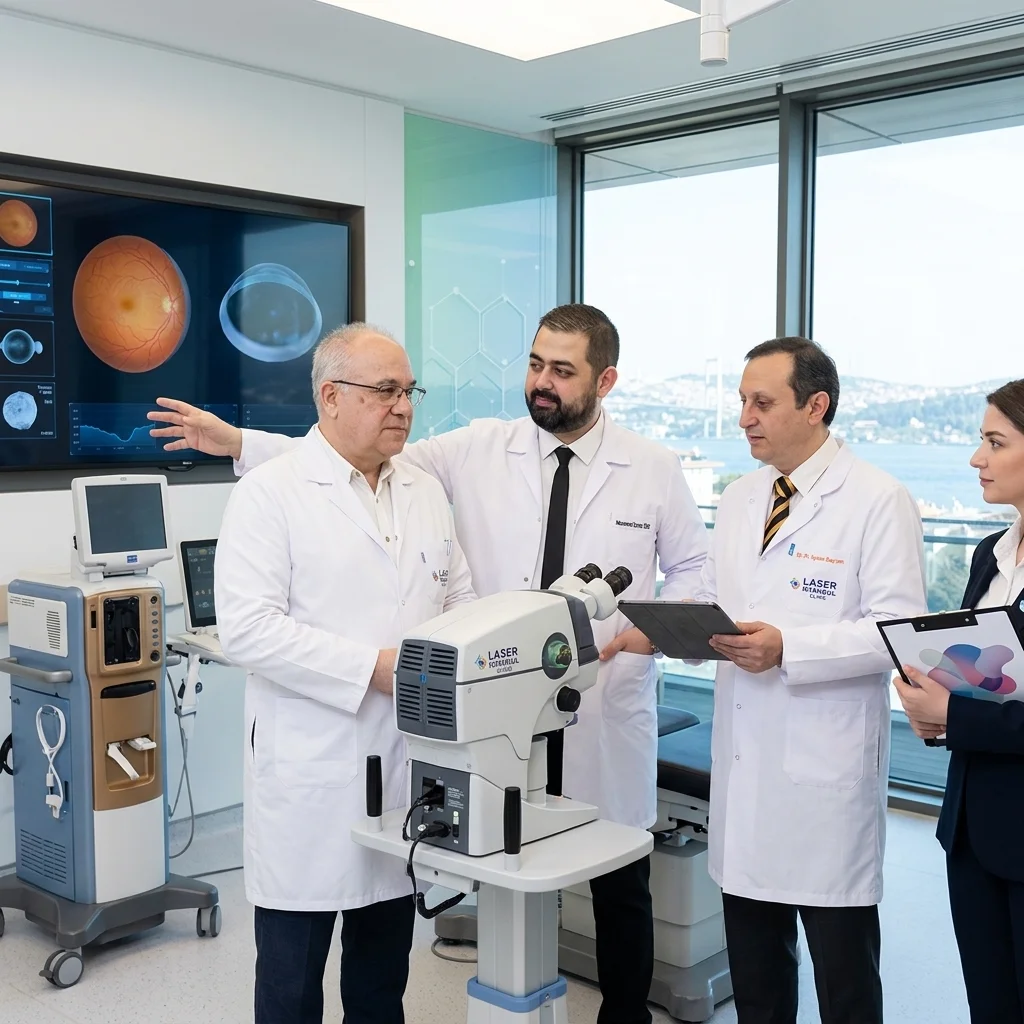
What is the normal eye pressure range if you have glaucoma?
There is no separate "glaucoma range": glaucoma is defined by damage to the optic nerve and visual field, not by one pressure number. Some people with high pressure never get glaucoma (that is called ocular hypertension), and some people with pressure inside the normal range still develop it (normal-tension glaucoma). The AAO describes the second group as having eye pressure within normal limits but optic nerve damage and blind spots. In the 2025 Chinese American Eye Study of 4,310 adults, 88.5% of people with glaucoma had a pressure of 21 mmHg or less.
So if you have glaucoma, your surgeon works with an individual target pressure that is lower than your starting pressure, because lowering eye pressure is the only proven way to slow the disease (NEI; 2026 World Journal of Methodology review). That target can sit well inside the "normal" range. Treatment is by drops, laser or surgery. Glaucoma treatment & surgery in Turkey →
What is the normal eye pressure range after cataract surgery?
After cataract surgery the normal range is the same 10–21 mmHg, and for many people the pressure ends up slightly lower than before. The Ocular Hypertension Treatment Study (OHTS) followed people with ocular hypertension (42 patients, 63 eyes) who had cataract surgery. Their average pressure fell from 23.9 to 19.8 mmHg, a drop of about 16.5%, and it stayed lower for at least 36 months. About 4 in 10 operated eyes (39.7%) dropped by 20% or more, while eyes that did not have surgery stayed the same. The fall was bigger in eyes that started with higher pressure.
This does not mean cataract surgery is a treatment for high eye pressure, and the numbers come from a group who already had ocular hypertension. If you have glaucoma and cataract, your surgeon decides which procedure suits you; some people have both treated at the same time.
What does high eye pressure mean?
High eye pressure means the fluid inside the eye is not draining as well as it should, and the pressure is above the normal range. When pressure is high but the optic nerve and visual field are healthy, doctors call it ocular hypertension. It is not glaucoma, but it raises your risk of developing it (AAO). EyeWiki (AAO) defines it as pressure consistently greater than 21 mmHg without optic nerve damage.
Is 24 high? Yes. In the UK, NICE uses 24 mmHg as the point at which it recommends referral to an eye specialist, ideally after a repeat measurement. A reading of 22 or 23 sits just above the usual range but under that threshold, so it normally leads to a repeat check, not an urgent referral.
Does high eye pressure always need treatment? No. In the large OHTS trial, 9.5% of people with high pressure who were only observed developed glaucoma within five years, compared with 4.4% of those treated with eye drops: treatment cut the risk by more than half. Most people with ocular hypertension do not develop glaucoma, so the decision depends on your pressure, corneal thickness, optic nerve, age and family history. In OHTS, thin central corneas (under 555 micrometres) were among the strongest predictors of glaucoma.
What raises eye pressure?
Eye pressure rises when too much fluid is made or, far more often, when it cannot drain well enough. The causes fall into three groups: conditions inside the eye, medicines, and everyday triggers that cause short rises.
Medical and eye causes
According to EyeWiki (AAO), secondary causes of raised pressure include steroid response, pigment dispersion (pigment from the iris clogging the drain), pseudoexfoliation (flaky material clogging the drain), inflammation and eye injury. Most people with high pressure have none of these: the cause is a drainage channel that works less well than it should, and the exact reason is often not known.
Steroids
Steroids are the best-known medicine that raises eye pressure. The AAO warns that long-term or high-dose steroids can raise eye pressure, especially in people with glaucoma, with steroids taken by mouth or put around the eyes carrying the greatest risk. EyeWiki lists the routes that can do it: eye drops and ointments, injections around or inside the eye, creams on the eyelids, tablets or drips, and even nasal, inhaled or joint injections. With steroid drops the rise most often appears after 3 to 6 weeks, and a short course usually settles within days to weeks after stopping. Always tell your eye doctor about any steroid you use.
Everyday triggers that cause short rises
- Caffeine. A 2026 meta-analysis of 16 studies found that caffeine, especially more than 100 mg, raises eye pressure for a short time. In healthy people the average rise peaked at about 1.6 mmHg after 1.5 hours; in people with glaucoma the rise was about 1.4–1.5 mmHg at 1 to 1.5 hours.
- Lying flat. Pressure is higher lying down than sitting up (2023 Cureus study). A 2026 study of people with primary open-angle glaucoma found that posture changed their pressure by about 3.5 mmHg in the morning and 2.7 mmHg in the evening.
- Head-down positions. The AAO advises people with glaucoma to avoid head-down positions, including inversion tables, gravity boots and some yoga poses.
- Intense exercise. The AAO says intense exercise that raises your heart rate can raise eye pressure, while brisk walking and regular moderate exercise can lower it.
These short rises matter mainly if you already have glaucoma or ocular hypertension. They are not a reason for a healthy eye to worry.
Factors that raise your risk of high pressure or glaucoma
The AAO lists these risk factors: high eye pressure, short-sightedness or long-sightedness, eye injury or earlier eye surgery, long-term steroid use, thin corneas, optic nerve thinning, diabetes, migraine, high blood pressure and poor circulation, age over 40, a family history of glaucoma, and African, Hispanic or Asian heritage. Pigment dispersion and pseudoexfoliation are also on the AAO's list for ocular hypertension.

Why does your eye pressure change between readings and tests?
Eye pressure is not a fixed number: it changes over the day, and the measurement itself has a margin of error.
- Time of day. In the 2023 Cureus study, average pressure was highest at 9 a.m. (15.8 mmHg) and lowest at 6 p.m. (14.3 mmHg). A swing of 3–5 mmHg over a day is considered normal.
- Glaucoma changes the swing. EyeWiki reports that two-thirds of glaucoma patients have their highest pressure outside clinic hours, particularly during sleep, and that pressure can vary by 10 mmHg or more over 24 hours. A single daytime reading can therefore miss the peak.
- Your cornea. The standard test (Goldmann tonometry) was designed for an average corneal thickness of 520 micrometres. EyeWiki says the reading shifts by roughly 2.5–3.5 mmHg for every 50 micrometres your cornea differs from that, so a thick cornea can make pressure read too high and a thin one too low. That is why doctors measure corneal thickness (pachymetry) too.
- Laser eye surgery. The Royal College of Ophthalmologists (RCOphth) says laser vision correction can make pressure readings under-read, especially after treatment for high short-sightedness, and that a record of your pre-laser prescription helps your doctor adjust the reading. Tell any optician or doctor who checks your pressure that you had laser eye surgery.
How is eye pressure measured?
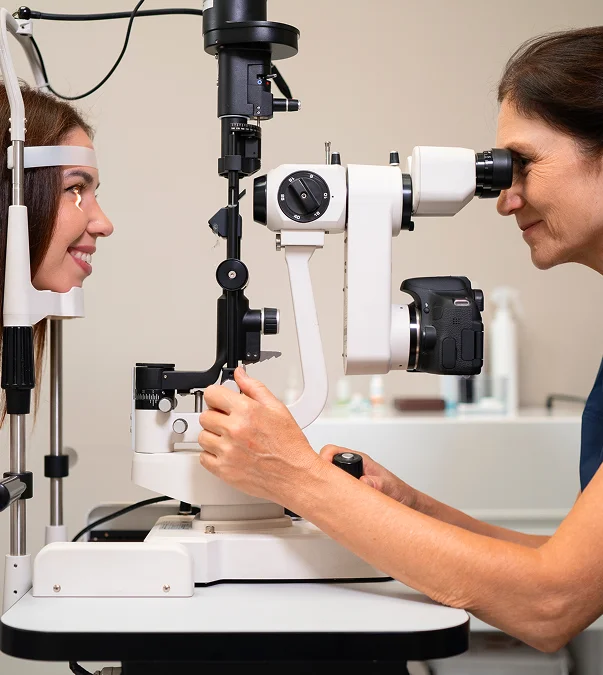
Eye pressure is measured with tonometry, a quick test done after numbing drops or with a puff of air. Which device is used changes how far you can trust the number.
| Test | How it works | What to know |
|---|---|---|
| Goldmann applanation tonometry | A yellow drop and a blue light; a small probe flattens a 3.06 mm area of the cornea | The long-standing reference method, introduced in 1954. In a study cited by EyeWiki, expert doctors disagreed by more than 2 mmHg in 17% of readings |
| Rebound tonometer (iCare) | A tiny probe touches the cornea very briefly | 73% of readings were within 5 mmHg of Goldmann; some studies show a small over-reading of about 3.35 mmHg |
| Air-puff ("non-contact") tonometer | A puff of air flattens the cornea | Common at routine eye tests. It tends to over-read at low pressures and under-read at high ones compared with Goldmann |
If a puff-of-air reading is high, the usual next step is a repeat check, not a diagnosis. EyeWiki notes that 30–57% of elevated readings in glaucoma suspects were measurement artefacts.
A full glaucoma check also looks at the optic nerve and the visual field (peripheral vision), not just the pressure (AAO).
Can you feel high eye pressure?
Usually no: high eye pressure typically causes no pain and no symptoms, which is why it is normally found at a routine eye test. The AAO says ocular hypertension usually has no signs or symptoms, and the NHS says most people with glaucoma notice no warning signs at first.
The "pressure behind my eye" feeling most people describe is rarely high eye pressure. The AAO notes that diseases of the eye are one of the least common causes of headaches; eyestrain from long periods of near work is more usual, and sinus problems can also cause headaches. Eye conditions & symptoms A-Z →
The exception is an emergency. Acute angle-closure glaucoma is a sudden blockage of fluid drainage with a rapid rise in pressure. The NHS lists intense eye pain, a red eye, blurred vision, nausea or vomiting, headache and rainbow-coloured circles around bright lights. In the UK, call 999 or go to A&E straight away; abroad, go to the nearest emergency department. Sight can be lost permanently if it is not treated quickly.
Can you lower eye pressure yourself?
There is no safe way to bring eye pressure down instantly at home: real, measurable pressure is lowered by prescribed eye drops, laser or surgery. What you can do is support the treatment you are given and avoid things that push the pressure up.
- Use prescribed drops exactly as directed. The AAO says taking glaucoma medicine exactly as your doctor says is as important as early detection for protecting sight.
- Exercise at a moderate pace. The AAO says brisk walking and regular moderate exercise can lower eye pressure (see above for intense exercise).
- Avoid head-down positions if you have glaucoma, and ask your eye doctor before doing yoga or using an inversion table.
- Do not rely on herbal remedies. The AAO says many are advertised for glaucoma, but none have been proven effective, and they should never replace the treatment your doctor prescribes.
- Eat well for your eyes. A balanced diet supports overall eye health, but it does not replace pressure-lowering treatment. Foods and vitamins that are good for your eyes →
- Keep your eye tests. Because high pressure and early glaucoma are silent, regular tests are the main protection.
If your doctor finds the pressure is too high, treatment usually starts with drops or laser, and surgery is for pressure that stays too high or glaucoma that keeps getting worse.
When should you see an eye doctor?
See an eye doctor for a pressure check if you are over 40 and have never had one, if you have a close relative with glaucoma, or if a routine test gave a high reading. Book a routine eye test at least every 2 years (NHS), and more often if you are at higher risk.
Get urgent help for any of the following:
- Severe eye pain with a red eye, headache, nausea or vomiting.
- Blurred vision with rainbow-coloured halos around lights.
- Sudden loss of vision.
If you have been told your pressure is high, ask: what is my pressure, in both eyes? How thick are my corneas? Is my optic nerve healthy? What is my target pressure, and when is my next check? An eye test also looks for other age-related conditions such as macular degeneration. Macular degeneration (yellow spot): symptoms and treatment →
Frequently asked questions
Normal eye pressure for adults is about 10 to 21 mmHg, with an average of about 15 mmHg. The AAO gives the typical range as about 10 to 20 mmHg. Your own normal can sit a little above or below this, which is why doctors check the optic nerve and corneal thickness as well as the number.
The sources we checked give one adult range of about 10–21 mmHg and do not split it by age. Age changes your risk of glaucoma, not the normal range: the AAO lists age over 40 as a risk factor, the NEI lists over 60, and the NHS lists over 50. That is why testing becomes more important as you get older.
It is the same 10–21 mmHg range. A 2023 Cureus study found no significant link between age and average pressure. For seniors the main point is regular testing, because glaucoma risk rises with age; the NHS advises an eye test at least every 2 years.
Yes. 17 mmHg is within the normal range and, on its own, is not a sign of glaucoma. Some people develop normal-tension glaucoma, so if you have a family history or your optician has noticed changes in your optic nerve, keep having regular checks.
Yes. 24 mmHg is above the normal range and is the UK NICE threshold for referral to an eye specialist, ideally after a repeat reading. It does not mean you have glaucoma: it means you need a full assessment of your optic nerve, corneas and visual field.
There is no separate range. Glaucoma is diagnosed from optic nerve and visual field damage, and in one large study 88.5% of people with glaucoma had pressure of 21 mmHg or less. Your surgeon sets a personal target pressure and treats to reach it.
In people with ocular hypertension, the OHTS found the average pressure fell from 23.9 to 19.8 mmHg after cataract surgery, and stayed lower for at least 36 months. If your pressure was normal before, the normal range after surgery is the same 10–21 mmHg.
Caffeine and lying flat raise eye pressure by small amounts for a short time: about 1.6 mmHg at the peak for caffeine in healthy people, and about 3.5 mmHg between postures in a glaucoma study. For a healthy eye these changes are not a concern. We did not find a reliable source quantifying the effect of stress on eye pressure, so we do not give a figure.
High eye pressure can be lowered and monitored. In glaucoma, treatments that lower eye pressure help slow the disease (NEI), but they do not undo damage already done to the optic nerve, which is why early detection matters.
Been told your eye pressure is high?
Laser Istanbul Clinic's glaucoma care is led by Prof. Dr. Ahmet Satıcı, who examines you in Istanbul, checks your pressure, corneas and optic nerve, and recommends the least invasive treatment that can reach your target pressure. Doç. Dr. Muhammet Derda Özer (Doç. is the Turkish title for Associate Professor) reviews glaucoma linked to eye inflammation (uveitis), retinal disease or corneal problems. We tell you honestly when monitoring is enough and when treatment is needed.
Sources for the facts on this page
- Noya-Padin V, et al. Intraocular Pressure Fluctuation Throughout the Day. Cureus 2023. https://pmc.ncbi.nlm.nih.gov/articles/PMC10722343/ (normal 10–21 mmHg, mean about 15; 3–5 mmHg daily swing; 9 a.m. vs 6 p.m. values; no significant correlation with age; supine higher than upright)
- American Academy of Ophthalmology. What Is Glaucoma? https://www.aao.org/eye-health/diseases/what-is-glaucoma (typical range about 10–20 mmHg; risk factors; normal-tension glaucoma)
- American Academy of Ophthalmology. What Is Ocular Hypertension? https://www.aao.org/eye-health/diseases/what-is-ocular-hypertension (definition; no symptoms; tonometry and pachymetry; risk factors)
- American Academy of Ophthalmology. Easy steps to prevent vision loss from glaucoma. https://www.aao.org/eye-health/tips-prevention/easy-steps-to-prevent-vision-loss-from-glaucoma (exercise, head-down positions, steroids, taking drops)
- American Academy of Ophthalmology. Is there any way to lower eye pressure using home remedies? https://www.aao.org/eye-health/ask-ophthalmologist-q/home-remedies-to-lower-eye-pressure (exercise; herbal remedies not proven)
- American Academy of Ophthalmology. Headaches and Eye Problems. https://www.aao.org/eye-health/diseases/headaches-eye-problems (eye disease one of the least common causes of headache; angle-closure emergency)
- National Eye Institute (NIH). Glaucoma. https://www.nei.nih.gov/learn-about-eye-health/eye-conditions-and-diseases/glaucoma (normal pressure varies by person; risk groups; lowering pressure slows glaucoma)
- NHS. Glaucoma. https://www.nhs.uk/conditions/glaucoma/ (risk groups; eye test at least every 2 years; acute glaucoma symptoms and emergency)
- EyeWiki (AAO). Ocular Hypertension. https://eyewiki.org/Ocular_Hypertension (definition above 21 mmHg; OHTS 9.5% vs 4.4%; corneal thickness under 555 micrometres; secondary causes)
- EyeWiki (AAO). The Reliability of Intraocular Pressure Measurements. https://eyewiki.org/The_Reliability_of_Intraocular_Pressure_Measurements (Goldmann 1954, 3.06 mm, 520 micrometres; corneal correction; two-thirds of glaucoma patients peak outside clinic hours; iCare and air-puff accuracy; 30–57% artefacts)
- EyeWiki (AAO). Steroid-Induced Glaucoma. https://eyewiki.org/Steroid-Induced_Glaucoma (routes; 3–6 weeks timing; reversibility)
- Mansberger SL, et al. Reduction in intraocular pressure after cataract extraction: the Ocular Hypertension Treatment Study. Ophthalmology 2012 (PMID 22608478). https://pubmed.ncbi.nlm.nih.gov/22608478/ (23.9 to 19.8 mmHg; 16.5%; 39.7%; 36 months)
- Simanjuntak OP, et al. Caffeine Intake Effects on Intraocular Pressure in Healthy and Glaucomatous Populations: A Systematic Review and Meta-Analysis. Journal of Current Ophthalmology 2026 (PMID 42666870). https://pubmed.ncbi.nlm.nih.gov/42666870/
- Mino T, et al. Posture-Induced Intraocular Pressure Changes at Different Times of Day in POAG. Clinical Ophthalmology 2026 (PMID 42371553). https://pubmed.ncbi.nlm.nih.gov/42371553/
- Jonas JB, et al. Ocular and General Determinants of Intraocular Pressure: Two-Continent Eye Study. Investigative Ophthalmology & Visual Science 2026 (PMID 41642027). https://pubmed.ncbi.nlm.nih.gov/41642027/
- Choe S, Kim YK. Data-Driven Redefinition of Normal Intraocular Pressure in Nonglaucomatous Korean Adult Population. Ophthalmology Science 2026 (PMID 42293343). https://pubmed.ncbi.nlm.nih.gov/42293343/
- Richter GM, et al. Prevalence and Risk Factors of Open-Angle Glaucoma in an Adult Chinese American Population: The Chinese American Eye Study. American Journal of Ophthalmology 2025 (PMID 40796025). https://pubmed.ncbi.nlm.nih.gov/40796025/
- Aggarwal S, et al. Role of Lifestyle Modifications in Glaucoma: A Systematic Review. World Journal of Methodology 2026 (PMID 41809163). https://pubmed.ncbi.nlm.nih.gov/41809163/
- The Royal College of Ophthalmologists. Laser Vision Correction: Patient Information. https://www.rcophth.ac.uk/wp-content/uploads/2026/08/Laser-vision-correction-patient-information.pdf (pressure readings can under-read after laser; Goldmann described as a yellow drop and blue light)
- NICE. Glaucoma: diagnosis and management (NG81). https://www.nice.org.uk/guidance/ng81 (refer if IOP is 24 mmHg or more on Goldmann-type tonometry; carried from content/en/glaucoma.md, not re-opened on 7 Oct 2026 because the site returned HTTP 403)