
- Home: eye surgery in Istanbul
- Free eye tools
- Visual acuity converter
20/20 Vision Test Online: Visual Acuity Converter (6/6, Decimal, %)
Don't have a result yet? Take our online eye test (vision check) first, then come back and convert it.
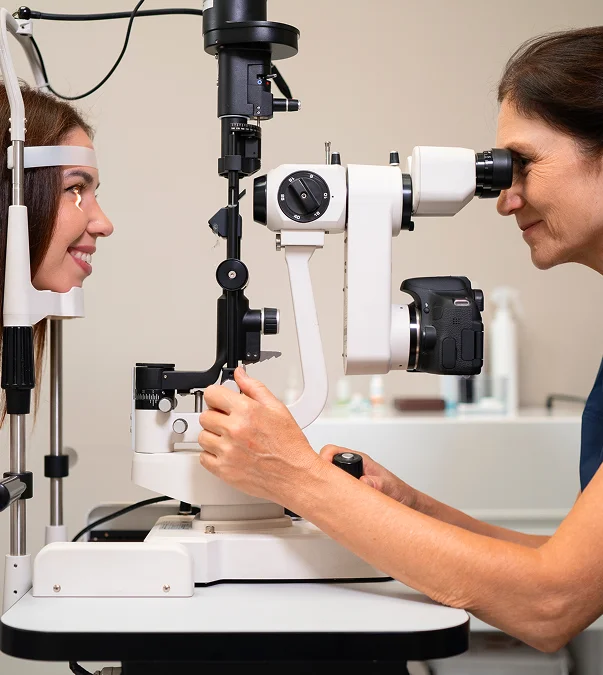
20/20 and 6/6 are the same visual acuity, written in feet and in metres; in decimal form it is 1.0. Use this free converter to turn any result (6/9, 20/30, 0.8 or a percentage) into every other notation and see what it means. It converts a result you already have; it is not an eye examination. Prof. Dr. Ahmet Satıcı, Doç. Dr. Muhammet Derda Özer and Op. Dr. Aysan Bayram, our surgeons in Istanbul, see patients at every level of vision.
Don't have a result yet? Take our online eye test (vision check) first, then come back and convert it.
What your visual acuity result means
What does 20/20 vision mean?
20/20 vision means you can read at 20 feet what the average person reads at 20 feet. The American Academy of Ophthalmology (AAO) stresses that this is average, not perfect: some people see 20/15, which is sharper than average. According to the AAO, only about 35% of adults have 20/20 without correction, and about 75% reach it with glasses, contacts or surgery.
Is 6/6 the same as 20/20?
Yes. 6/6 is the metric version of 20/20: the chart is read from 6 metres instead of 20 feet. Both equal 1.0 in decimal. The first number is the distance you stand at; the second is the distance at which an average eye would read that same line. A bigger second number therefore means weaker distance vision.
What do 6/9, 6/12 and the other lines mean?
The Snellen chart, created by the Dutch ophthalmologist Herman Snellen in 1862, gives each line its own fraction.
- 6/5 (about 20/17, decimal 1.2): sharper than average.
- 6/6 (20/20): normal distance vision.
- 6/7.5 (20/25, decimal 0.8): just below 6/6. For reference, the UK standard for lorry and bus drivers requires 6/7.5 in the better eye.
- 6/9 (20/30, decimal 0.67): one line below 6/6. At 6 metres you read what a typical eye reads from 9 metres. Slightly below normal, but not poor sight.
- 6/9.5 (about 20/32, decimal 0.63): the metric form of the 20/32 line on some charts.
- 6/12 (20/40, decimal 0.5): two lines below 6/6. The UK minimum for car drivers is 6/12 using both eyes, with glasses or lenses if needed, and the AAO notes that most US states ask for 20/40 for an unrestricted driving licence.
- 6/60 (20/200, decimal 0.1): the biggest letter on the chart. In the US, 20/200 or worse in the better eye with the best correction is part of the definition of blindness.
How do I convert visual acuity to a percentage?
There is no single official "percent vision". Two different calculations are used, and they give different numbers:
- Decimal x 100. This compares your acuity with 6/6: 6/12 (0.5) becomes 50%. It is simple, but it does not mean you have lost half your sight.
- The older "visual efficiency" scale. Here 20/20 is 100%, 20/25 is 94%, 20/30 is 88% and 20/40 is 77.4%, falling to 0% at 20/200. Other published tables differ slightly (about 84-85% at 20/40), which is why modern clinics quote Snellen, decimal or logMAR, not percentages.
If someone says "I have 50% vision", ask which scale they mean.

When to see an eye doctor
Get urgent help today, whatever your number, if you notice sudden loss or blurring of vision, a dark curtain or shadow across your vision, a sudden increase in floaters or new flashes of light, or sudden double vision. Call your local emergency number (112 in the EU and Türkiye, 999 in the UK, 911 in the US and Canada) or go to the nearest emergency department.
Book a routine eye examination if your result is below 6/6 (20/20) in either eye, if your vision has changed, or if you have not been checked for years. A good number is not a clean bill of health: a visual acuity result cannot detect eye diseases with hidden symptoms, such as glaucoma.
More free checks: the colour blindness test, the astigmatism test, the Amsler grid test for the centre of your vision, the eye prescription reader for sphere, cylinder and axis, the eye colour chart and inheritance calculator, and the lens finder quiz.
This converter only changes one way of writing a visual acuity into another. It does not test your eyesight, diagnose any eye condition or replace an eye examination by an optometrist or ophthalmologist. If you are worried about your eyes, or your vision changes suddenly, see an eye doctor.
Want to see without glasses?
Your acuity shows how well you see, not why, and not whether a treatment suits you. That depends on measurements of your cornea, lens and retina, taken by your surgeon at a full examination in Istanbul. Surgery takes place in a fully equipped, Ministry of Health–licensed operating theatre in Istanbul.
Prof. Dr. Ahmet Satıcı (laser, lens and cataract surgery), Doç. Dr. Muhammet Derda Özer (cornea and retina; "Doç." means Associate Professor) and Op. Dr. Aysan Bayram (cataract, laser and retinal disease) will tell you which treatments may suit you.
- Short-sighted, long-sighted or astigmatic, and 18 or over? Read about laser eye surgery in Turkey.
- Haven't had a distance check yet? Try the online eye test (vision check).
Visual acuity: frequently asked questions
You can take a screening check at home, but this page only converts a result you already have. For a chart you can do on your own screen, use our online eye test, calibrate it and test one eye at a time. No online test replaces an eye examination.
6/9 means you read at 6 metres what a typical eye reads from 9 metres. It is the same as about 20/30 or decimal 0.67, one line below 6/6, and better than the 6/12 minimum for UK car drivers.
6/12 is the same as 20/40 and decimal 0.5: you read at 6 metres what a typical eye reads from 12 metres. It is the UK minimum for car driving, but it is not "50% vision"; see the percentage section above.
6/7.5 equals 20/25 and decimal 0.8, a little below 6/6. UK lorry and bus drivers need at least 6/7.5 in the better eye.
6/5 is about 20/17 and decimal 1.2: sharper than average, because you read at 6 metres what a typical eye reads from 5 metres.
6/9.5 is about 20/32 (decimal 0.63), between 6/9 (20/30) and 6/12 (20/40).
Sources for the facts on this page
- What 20/20 means; 20/15 is sharper than average; about 35% of adults have 20/20 uncorrected, about 75% with correction; most US states require 20/40 for an unrestricted driving licence: American Academy of Ophthalmology, "What does 20/20 vision mean?" https://www.aao.org/eye-health/tips-prevention/what-does-20-20-vision-mean
- Snellen fraction = test distance / distance at which the letter subtends 5 arcmin; 20/20 = 6/6; 20/10 = 6/3, 20/40 = 6/12, 20/100 = 6/30, 20/200 = 6/60; logMAR 0.0, 0.3, 0.7, 1.0; US definition of blindness (20/200 or worse in the better eye with best correction): EyeWiki (AAO), "Visual Acuity Testing in Adults" https://eyewiki.aao.org/Visual_Acuity_Testing_in_Adults
- Snellen chart created by Herman Snellen in 1862; 6 m or 20 ft; 5 arcmin letter; largest letter 6/60 (20/200); logMAR preferred by many professionals: Wikipedia, "Snellen chart" https://en.wikipedia.org/wiki/Snellen_chart
- 6/6 = 20/20 = 1.00 = logMAR 0.00; 6/9 = 20/30 = 0.67 = 0.18; 6/12 = 20/40 = 0.5 = 0.30; 6/18 = 20/60 = 0.33; healthy young eyes often reach 6/4 to 6/5: Wikipedia, "Visual acuity" https://en.wikipedia.org/wiki/Visual_acuity
- UK car driving: at least decimal 0.5 (6/12) on the Snellen scale; lorry and bus drivers at least 0.8 (6/7.5) in the better eye and 0.1 (6/60) in the other: GOV.UK, "Driving eyesight rules" https://www.gov.uk/driving-eyesight-rules
- Older "visual efficiency" scale (20/20 100.0%, 20/25 94.0%, 20/30 88.0%, 20/40 77.4%, 20/50 68.1%, 20/70 52.5%, 20/100 35.9%, 20/200 0.0%): https://www.law.cornell.edu/regulations/missouri/8-CSR-50-5-020 . Other tables give about 83.6% at 20/40 (https://regulations.justia.com/states/minnesota/agency-151/chapter-5223/part-5223-0030) and about 85% (Prevent Blindness, https://lowvision.preventblindness.org/eye-conditions/how-visual-acuity-is-measured). Used only to show that percentage scales differ. The second and third links returned HTTP 403 to our tool and are quoted from search summaries: check them before publishing.
- Emergency numbers: 112 EU (https://digital-strategy.ec.europa.eu/en/policies/112), 112 Türkiye (https://www.112.gov.tr/kilis/acil-durumlarda-tek-numara-112), 999 UK (https://www.nhs.uk/nhs-services/urgent-and-emergency-care-services/when-to-call-999/), 911 Canada (https://parks.canada.ca/voyage-travel/securite-safety/urgence-emergency), 911 US (https://www.cdc.gov/stroke/signs-symptoms/index.html)
- Urgent symptoms (curtain, flashes, floaters, sudden blurred vision): NHS, "Detached retina" https://www.nhs.uk/conditions/detached-retina-retinal-detachment/
- Own calculations (not external facts): decimal = a/b; logMAR = -log10(decimal); 6/5 = about 20/17; 6/9.5 = about 20/32 (31.7); percent of normal = decimal x 100.
Want to know what your result means for your eyes?
Send us your result or prescription and one of our surgeons will tell you which treatments may suit you, with no obligation.
3 eye surgeons
Your case is reviewed by a named surgeon, not a salesperson. Reply within {{response time}}.
 Prof. Dr. Ahmet Satıcı
 Doç. Dr. Muhammet Derda Özer
 Op. Dr. Aysan Bayram