
- Home: eye surgery in Istanbul
- Free eye tools
- Lens finder quiz
Which Lens Is Best for Cataract Surgery? A Free Lens Finder Quiz
Before you start: have your glasses prescription to hand if you have one (look for "CYL", the cylinder column). If not, answer "Don't know".
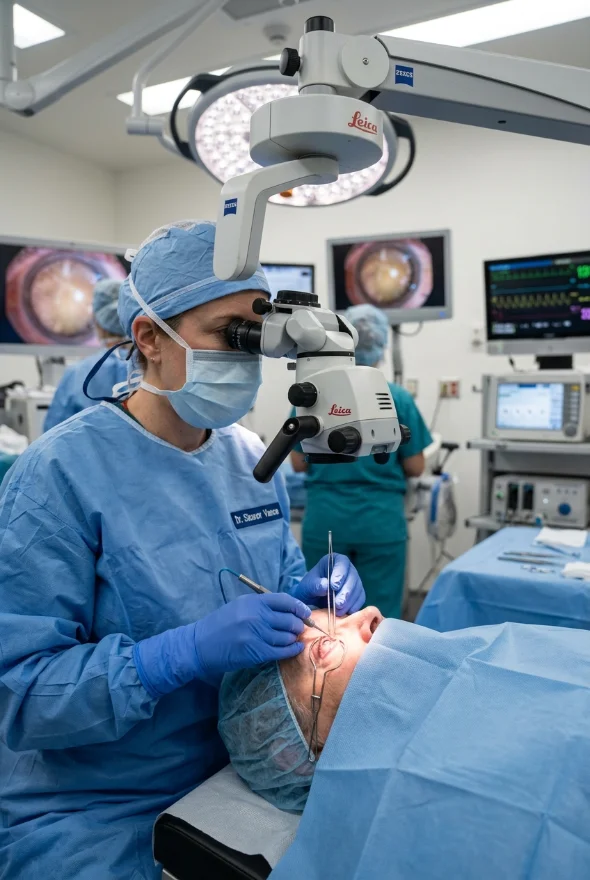
There is no single best lens for cataract surgery. The right one depends on how much you want to depend on glasses, how often you drive at night, whether you have astigmatism and whether your eyes have another condition. This free three-minute quiz points you to a monofocal, blended-vision, EDOF or trifocal lens, with or without toric correction. It is a starting point: Prof. Dr. Ahmet Satıcı, Doç. Dr. Muhammet Derda Özer (Doç. = Associate Professor) or Op. Dr. Aysan Bayram make the final choice after examining your eyes.
Before you start: have your glasses prescription to hand if you have one (look for "CYL", the cylinder column). If not, answer "Don't know".
Which lens is best for cataract surgery? What your result means
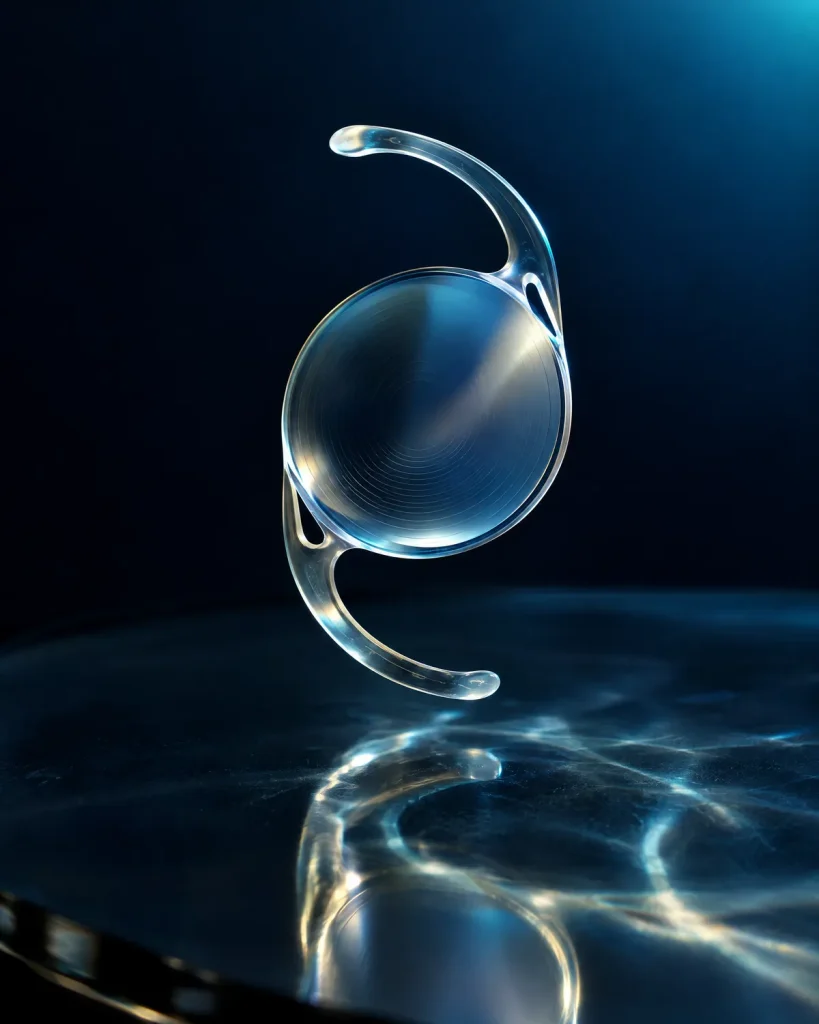
Each lens trades freedom from glasses against optical side effects:
| Lens | What it does | Glasses afterwards | Side effects |
|---|---|---|---|
| Monofocal | One focus distance, usually far | Usually needed for reading | Fewest |
| Blended vision | Monofocal lenses: one eye for distance, one for arm's length | Often still needed for small print | Few |
| EDOF | One stretched focus zone: distance and middle | Often needed for small print | More halos and less contrast than monofocal; better contrast than trifocal |
| Trifocal / multifocal | Several focus zones: near, middle, far | About 4 in 5 patients completely free of glasses | Most halos and glare |
| Toric (add-on) | Built-in correction for astigmatism | Depends on the base lens | As the base lens |
The Royal College of Ophthalmologists (RCOphth) says about four in five patients are completely free of glasses with widely used multifocal lenses, and about 19 in 20 are satisfied three to six months after surgery. About 1% cannot adapt and swap to a monofocal lens. In the FDA study of the PanOptix trifocal lens, 99.2% of patients (126 of 127) would choose the same lens again, against 87.4% with a monofocal; fewer than 5% were "bothered very much" by halos, starbursts or glare at six months. A 2019 analysis of nine studies found EDOF lenses give excellent distance and intermediate vision but moderate near vision.
Will I need glasses after cataract surgery?
Possibly. The NHS says you may still need glasses for reading or distance, and your prescription may change. With a monofocal lens, expect reading glasses; with a multifocal lens, any glasses are usually for one specific task.
Which lens is best for night driving?
A monofocal lens usually causes the fewest night-time side effects. The American Academy of Ophthalmology (AAO) advises people who drive a lot at night to steer clear of multifocal or EDOF lenses, which can cause glare, halos around lights or loss of contrast. These effects tend to fade with time.
Which lens is best if I have astigmatism?
A toric lens. The AAO says people with moderate to high astigmatism are usually happier with toric lenses, and EyeWiki says they are universally recommended from 1 dioptre of corneal astigmatism. That is common: 39.8% of 600 cataract eyes in a 2026 study had 1 dioptre or more. Your surgeon plans a toric lens from corneal measurements, and an irregular cornea, as in keratoconus, is not suitable.
When a multifocal or EDOF lens may not be a good idea
- Other eye disease. The AAO says these lenses are generally not recommended with glaucoma, macular degeneration or other eye disease, because they let less light into the eye. A monofocal lens may still suit you well.
- Complications. If the lens capsule breaks during surgery, a multifocal lens cannot always be implanted safely.
- Previous laser eye surgery. Calculating the lens power is harder, so bring your old records.
- Under 50 with a clear lens. Laser or a phakic implant is generally better than lens replacement.
Is cataract surgery the same as lens replacement?
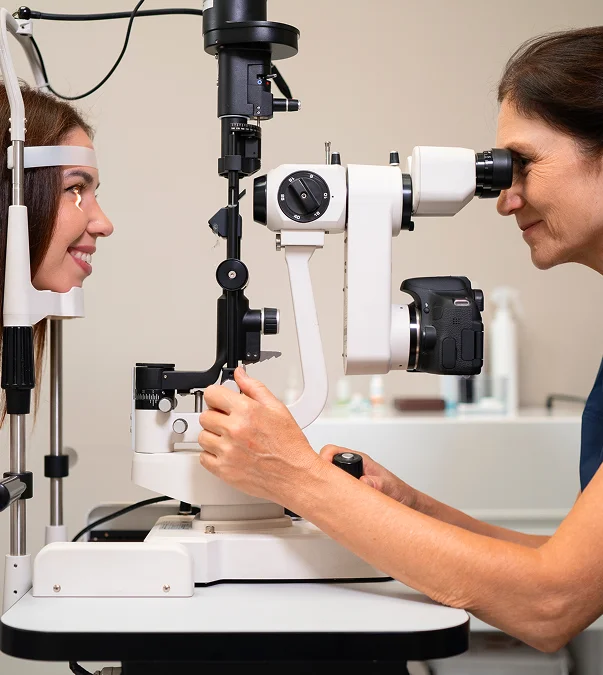
Yes. The RCOphth says lens replacement is identical to modern cataract surgery; only the reason differs. Cataract surgery treats a clouded lens; lens replacement reduces dependence on glasses. The AAO says surgery is considered when cataract gets in the way of driving, reading or night vision.
When to see an eye doctor
Get urgent help today if you notice a sudden shower of floaters, flashes of light, a shadow or curtain spreading across your vision, or sudden loss of vision. These can be signs of retinal detachment. Call your local emergency number (112 in the EU and Türkiye, 999 in the UK, 911 in the US and Canada) or go to the nearest emergency department.
Book an eye examination if your vision is clouding, glare troubles you or reading is getting harder. Only an examination shows whether you have a cataract and which lenses are suitable.
This lens finder quiz is an information tool only. It does not diagnose any eye condition or choose a lens for you, and it does not replace an eye examination by an ophthalmologist. If your vision changes suddenly, see an eye doctor straight away.
More free eye tools
Read about lens replacement surgery in Turkey, cataract surgery in Istanbul or trifocal and multifocal lens surgery (PanOptix, Synergy).
Which lens is best for cataract surgery: frequently asked questions
There is no single best lens. Monofocal gives sharp distance vision with the fewest side effects, EDOF extends the range, trifocal gives the most freedom from glasses and toric corrects astigmatism. Your surgeon recommends one after measuring your eyes.
A monofocal lens focuses at one distance, an EDOF lens stretches one focus zone over distance and middle, and a trifocal lens splits light into near, middle and far. More range generally means more halos and glare at night.
Yes. EDOF, trifocal and toric lenses cost more than a standard monofocal lens. Our price for each lens type, from {{price}}, includes your pre-operation examination and scans, surgery by your named surgeon, medication, follow-up checks in Istanbul, a personal interpreter, a coordinator and remote follow-up. Hotel and airport transfers are not included; we arrange them on request at a separate charge. Flights are not included.
One of the UK's leading NHS eye hospitals says the NHS provides monofocal lenses as standard and can also offer toric lenses. Multifocal and EDOF lenses are available privately.
No. It shows which lens types fit your answers. Your corneal measurements, retina and general eye health decide what is safe, so a surgeon must examine you.
Most people adapt over the first months. The RCOphth says about 1% cannot and swap to a monofocal lens.
Sources for the facts on this page
- IOL types (monofocal, multifocal, EDOF, accommodative, toric, light-adjustable); moderate to high astigmatism usually happier with toric; steer clear of multifocal or EDOF for night driving (glare, halos, loss of contrast); multifocal and EDOF generally not recommended with glaucoma, macular degeneration or other eye disease (less light into the eye); premium lenses usually paid out of pocket: American Academy of Ophthalmology, "Factors to Consider in Choosing an IOL for Cataract Surgery" https://www.aao.org/eye-health/tips-prevention/best-artificial-lens-implant-iol-cataract-surgery
- Definitions of monofocal, multifocal, EDOF, accommodative, light-adjustable and toric IOLs: AAO, "Intraocular Lenses (IOL) for Cataract Surgery" https://www.aao.org/eye-health/diseases/cataracts-iol-implants
- Cataract symptoms (blurry vision, glare, night driving trouble, faded colours); surgery considered when it interferes with driving, reading or night vision: AAO, "What Are Cataracts?" https://www.aao.org/eye-health/diseases/what-are-cataracts
- Presbyopia typically begins after age 40: AAO, "What Is Presbyopia?" https://www.aao.org/eye-health/diseases/what-is-presbyopia
- Toric IOLs: correct corneal astigmatism of about 0.75 to 4.75 D; universally recommended for 1 D or more of corneal astigmatism; irregular astigmatism from corneal scars or ectasia not suitable: EyeWiki (AAO), "Toric IOLs" https://eyewiki.org/Toric_IOLs
- 39.8% of 600 eyes had corneal astigmatism of 1.0 D or more, 9.3% 2.0 D or more: D'Oria F, et al. "Prevalence and clinical relevance of corneal astigmatism in cataract surgery candidates: a southern Italian cohort study." Frontiers in Medicine, 21 January 2026. https://pmc.ncbi.nlm.nih.gov/articles/PMC12867875/
- 126 of 127 (99.2%) PanOptix patients vs 97 of 111 (87.4%) monofocal patients would choose the same lenses again; starbursts, halos and glare the most bothersome symptoms, under 5% "bothered very much" at month 6: US Food and Drug Administration, Summary of Safety and Effectiveness Data, AcrySof IQ PanOptix Trifocal IOL, PMA P040020/S087 https://www.accessdata.fda.gov/cdrh_docs/pdf4/P040020S087B.pdf
- EDOF vs monofocal vs trifocal (9 studies, 1,336 eyes): excellent distance and intermediate, mediocre near; reduced contrast and more halos than monofocal; better contrast than trifocal: Liu J, Dong Y, Wang Y. "Efficacy and safety of extended depth of focus intraocular lenses in cataract surgery: a systematic review and meta-analysis." BMC Ophthalmology, 2019. https://pmc.ncbi.nlm.nih.gov/articles/PMC6719364
- You may still need glasses after cataract surgery and your prescription may change: NHS, "Cataract surgery" https://www.nhs.uk/conditions/cataract-surgery/
- NHS offers monofocal lenses as standard and can also offer toric lenses; wider choice privately: NHS eye hospital patient information, "Should I have NHS or private cataract surgery?" https://moorfields.nhs.uk/for-patients/cataract-london/differences-between-nhs-and-private-cataract-surgery
- Emergency numbers: 112 in the EU, European Commission https://digital-strategy.ec.europa.eu/en/policies/112 · 112 in Türkiye, 112.gov.tr https://www.112.gov.tr/kilis/acil-durumlarda-tek-numara-112 · 999 in the UK, NHS https://www.nhs.uk/nhs-services/urgent-and-emergency-care-services/when-to-call-999/ · 911 in Canada, Parks Canada https://parks.canada.ca/voyage-travel/securite-safety/urgence-emergency (reused from the sibling tool pages, where they were checked)
- Previous laser eye surgery makes IOL power calculation less accurate: ASCRS post-refractive IOL calculator https://iolcalc.ascrs.org/ (page blocked automated access; only a search summary was read, so the reviewing surgeon confirms the sentence "Calculating the lens power is harder")
- Own design choices (not external facts): the question set, the scoring weights, the 0.75 D / 1.00 D cut-offs taken from the toric ranges above, and the tie-break order.
Not sure which lens suits you?
Send us your quiz result and prescription. One of our surgeons will tell you which lens may suit you, with no obligation.
3 eye surgeons
Your case is reviewed by a named surgeon, not a salesperson. Reply within {{response time}}.
 Prof. Dr. Ahmet Satıcı
 Doç. Dr. Muhammet Derda Özer
 Op. Dr. Aysan Bayram