
- Home: eye surgery in Istanbul
- Free eye tools
- Amsler grid test
Amsler Grid Test: A Free Online Check for Macular Changes
Before you start: put on the glasses you use for reading, sit in good light, and hold your face about 33 cm (13 inches) from the screen.
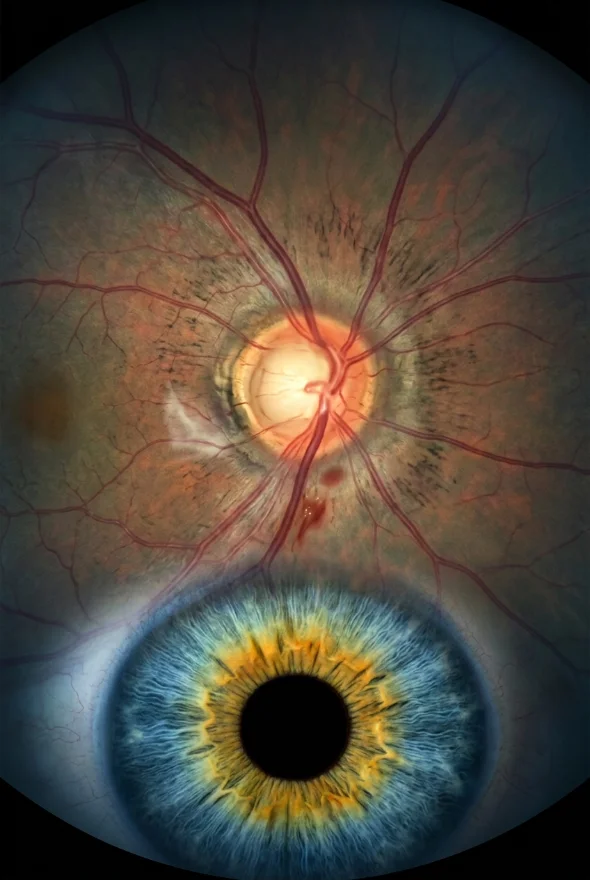
The Amsler grid test is a simple chart of straight lines with a dot in the middle. Looking at the dot with one eye at a time, you check whether any lines look wavy, blurred or missing, which can be an early sign of a problem in the macula, such as wet age-related macular degeneration (AMD). This free online version is sized to your screen and takes about 2 minutes. It is a home check, not a diagnosis. If you find a change, retina specialists Doç. Dr. Muhammet Derda Özer (Doç. = Associate Professor) and Op. Dr. Aysan Bayram can review your scans.
Before you start: put on the glasses you use for reading, sit in good light, and hold your face about 33 cm (13 inches) from the screen.
How to do the Amsler grid test
The Amsler grid test takes about a minute per eye. The American Academy of Ophthalmology (AAO) gives these steps:
Wear your reading glasses
if you use them.
Hold the chart 30–38 cm (12–15 inches) from your face
in good light. On screen, our tool tells you the right distance for your device.
Cover one eye
Look straight at the centre dot
and keep looking at it.
Without moving your eye,
notice whether all the lines look straight and whether any area looks wavy, blurred, dark or blank. Then repeat with the other eye.
Testing each eye on its own matters: with both eyes open, the better eye can hide a change in the other. Eye surgeons at Moorfields Eye Hospital note that distortion from an epiretinal membrane may only be noticed when one eye is covered.

What is an Amsler grid chart?
An Amsler grid chart is a 10 × 10 cm square of evenly spaced lines with a dot in the centre. Swiss ophthalmologist Marc Amsler described it in 1947 (StatPearls). The grid has 20 small squares along each side, each 5 mm wide. Held at about 33 cm, it covers the central 20° of your vision, so each square equals roughly 1° (Estreicher et al., 2026). That central area is seen by the macula, the part of the retina that gives sharp, straight-ahead vision for reading and recognising faces.
Amsler grid test results: what they mean
A normal result: you can see the centre dot, all four corners and sides, and every line looks straight with no missing or blurred squares. An abnormal result means something looked different. Doctors call wavy or bent lines metamorphopsia and missing or dim areas a scotoma (StatPearls).
Amsler grid distortion examples
| What you see | What it can mean | What to do |
|---|---|---|
| Wavy, bent or crooked lines | Distortion of the macula, e.g. fluid from wet AMD, central serous chorioretinopathy, diabetic macular oedema, or traction from an epiretinal membrane | See an eye doctor promptly if new |
| A blank, grey or dark patch | A scotoma: part of the central vision is not working | See an eye doctor promptly if new |
| The centre dot disappears | A problem right at the centre of the macula, e.g. a macular hole | See an eye doctor promptly |
| Some squares look larger or smaller | Distortion of the macula | See an eye doctor if new |
| Corners or edges missing | Can point to field loss beyond the macula, such as glaucoma or retinitis pigmentosa | Book an eye examination |
[Image row: simulated examples of a normal grid, wavy lines, a central dark patch and a missing corner. Illustrations only, approved by the reviewing surgeon.]
These are possibilities, not a diagnosis. Only an eye examination, usually with an OCT scan of the macula, can find the cause.
What does a positive Amsler grid test mean?
A positive Amsler grid test means you saw distortion or a missing area. It does not tell you which condition you have. The US National Eye Institute calls straight lines looking wavy a warning sign of late AMD and advises seeing an eye doctor right away. In the UK, NICE says people with suspected wet AMD should be referred to a macula service, normally within 1 working day.
Is mild distortion on the Amsler grid serious?
Mild distortion that is new deserves the same prompt check as obvious distortion, because early treatment of wet AMD protects sight. First, rule out simple causes: repeat the test with your reading glasses on, in good light, keeping your eye on the dot. If the bend is still there, contact an eye doctor. If your doctor already knows about a stable area, watch for any growth or change.
How accurate is the Amsler grid test?
The Amsler grid is useful but imperfect, so a normal grid is not a clean bill of health. In a 2006 study of 140 people, it picked up 80% of eyes with wet (neovascular) AMD but only 30% with early AMD, and 15% of healthy people reported a false abnormality (Estreicher et al., 2026). In a 2024 primary-care study of 355 patients, sensitivity was 62.7% and specificity 81.3%. Regular eye examinations remain essential.

Download a printable Amsler grid
You can download our printable Amsler grid as a free PDF, with instructions and a record table for each eye. Print it at 100% ("Actual size"), not "Fit to page", then check that the printed ruler measures 10 cm. Keep the chart in the same place, with the same light, so each check is comparable, and mark any changes with the date.
When to see an eye doctor
Get urgent help today if your vision suddenly gets worse, a dark curtain or shadow moves across your vision, or your eye is red and painful (NHS). Call your local emergency number (112 in the EU and Türkiye, 999 in the UK, 911 in the US and Canada), or contact eye casualty or NHS 111.
Contact an eye doctor within a day or so if the grid shows new or worse distortion, a blank patch, or you lose the centre dot. Have this checked where you are; do not wait to travel.
How often should you test? The AAO advises people with AMD to use the grid once a day, every day. Others should follow their eye doctor's advice.
This Amsler grid test is a home screening check only. It does not diagnose any eye condition and does not replace an examination by an optometrist or ophthalmologist. A normal result does not rule out eye disease. If you notice any new or sudden change in your vision, contact an eye doctor promptly.
More free eye tools
If an eye doctor confirms a macular problem, treatment depends on the cause. Wet AMD is treated with anti-VEGF eye injections; a macular hole or epiretinal membrane may need keyhole retina surgery (vitrectomy).
Already diagnosed and want a second opinion? Send us your OCT scans and reports. Doç. Dr. Muhammet Derda Özer or Op. Dr. Aysan Bayram will review them and explain your options, with no obligation.
- Check yourself for astigmatism with the astigmatism test
- Take the colour blindness test (Ishihara-style)
- Understand your glasses prescription: sphere, cylinder, axis
- Convert 20/20, 6/6, decimal and percentage vision
- Which lens is right for me? Take the lens finder quiz
- Eye colour chart and inheritance calculator
- See all free eye tools
Amsler grid test: frequently asked questions
Yes. Our free Amsler grid test online is sized to your screen with a bank card, so the squares are the right size. A tablet or computer works best; on most phones the grid has to be smaller, so hold it closer or use the printable version.
All the lines look straight and evenly spaced, every square is the same size, and you can see the centre dot and all four corners while looking at the dot. Nothing looks wavy, faded, dark or missing.
Download our printable Amsler grid PDF on this page. Print it at actual size and check the 10 cm ruler, so the test matches the standard chart.
It mainly helps spot changes from AMD, macular hole, epiretinal membrane, central serous chorioretinopathy and diabetic macular oedema (StatPearls). It cannot tell these apart; an eye examination and OCT scan can.
Not necessarily. Many causes of distortion can be treated, and AMD affects only central vision, leaving side vision (NHS). What matters is getting a new change checked quickly.
Sources for the facts on this page
- How to use the grid: reading glasses, 12–15 inches, cover one eye, look at the centre dot, note blurry/wavy/dark/blank areas, contact an ophthalmologist right away; people with AMD should test once a day, every day: American Academy of Ophthalmology, "Facts About the Amsler Grid Daily Vision Test" https://www.aao.org/eye-health/tips-prevention/facts-about-amsler-grid-daily-vision-test
- Marc Amsler described the chart in 1947; 10 × 10 cm grid, 33 cm, central 20° (10° each side); seven Amsler charts (chart 1 white lines on black); metamorphopsia and scotoma; indications (wet AMD, CSCR, epiretinal membrane and other macular disease); limitations (low sensitivity for small scotomas, poor repeatability): Tripathy K, Salini B. "Amsler Grid." StatPearls, updated 25 Aug 2023. https://www.ncbi.nlm.nih.gov/books/NBK538141/
- 5 mm squares, each about 1°; test procedure; missing corners suggesting glaucoma or retinitis pigmentosa; conditions (AMD, CSCR, DME, ERM, macular hole); Kampmeier et al. 2006 (140 patients: 30% sensitivity early AMD, 80% neovascular AMD, 15% false positives in healthy controls); Üşümüş et al. 2024 (355 patients: sensitivity 62.7%, specificity 81.3%): Estreicher A, et al. "The Amsler Grid in Everyday Practice: A Review of Its Role and Limitations in Primary Care." Clinical Ophthalmology, 12 Feb 2026. https://pmc.ncbi.nlm.nih.gov/articles/PMC12912174/
- Straight lines looking wavy is a warning sign for late AMD, see an eye doctor right away; AMD a leading cause of vision loss in older adults: National Eye Institute, "Age-Related Macular Degeneration (AMD)" https://www.nei.nih.gov/learn-about-eye-health/eye-conditions-and-diseases/age-related-macular-degeneration
- AMD symptoms (blurred or distorted central area, straight lines wavy or crooked); affects central vision only; urgent if vision suddenly gets worse, a dark curtain or shadow, or a red painful eye; NHS 111: NHS, "Age-related macular degeneration (AMD): Symptoms" https://www.nhs.uk/conditions/age-related-macular-degeneration-amd/symptoms/
- Macular hole: blurred and distorted vision, straight lines wavy or bowed, missing patch in the centre: NHS, "Macular hole" https://www.nhs.uk/conditions/macular-hole/
- Epiretinal membrane: straight lines wavy or crooked; may only be noticed when one eye is covered: Moorfields Eye Hospital NHS Foundation Trust, "Epiretinal membrane" https://www.moorfields.nhs.uk/eye-conditions/epiretinal-membrane
- Suspected wet AMD referred to a macula service normally within 1 working day: NICE guideline NG82, "Age-related macular degeneration" (2018) https://www.nice.org.uk/guidance/ng82/chapter/Recommendations
- Emergency numbers: 112 in the EU, European Commission https://digital-strategy.ec.europa.eu/en/policies/112 · 112 in Türkiye, 112.gov.tr https://www.112.gov.tr/kilis/acil-durumlarda-tek-numara-112 · 999 in the UK, NHS https://www.nhs.uk/nhs-services/urgent-and-emergency-care-services/when-to-call-999/ · 911 in Canada, Parks Canada https://parks.canada.ca/voyage-travel/securite-safety/urgence-emergency
- ID-1 card size 85.60 × 53.98 mm (ISO/IEC 7810), for screen calibration: summary at https://en.wikipedia.org/wiki/ISO/IEC_7810 (developer may confirm against the standard)
- Own calculation (not an external fact): phone viewing distance scaled as 330 mm × grid size / 100 mm, so each square keeps the same angle as the standard chart.
Found a change, or already have a diagnosis?
Send us your scans or eye reports and a retina specialist will tell you what they show and which treatments may suit you.
3 eye surgeons
Your case is reviewed by a named surgeon, not a salesperson. Reply within {{response time}}.
 Prof. Dr. Ahmet Satıcı
 Doç. Dr. Muhammet Derda Özer
 Op. Dr. Aysan Bayram