
- Home
- Knowledge centre
- Eye glossary A–Z
- Ptosis: What It Is, Causes, Symptoms and Treatment of a Droopy Eyelid
Ptosis: What It Is, Causes, Symptoms and Treatment of a Droopy Eyelid
Medically reviewed by {{surgeon}}, {{surgeon's title and specialty}}, on {{review date}}. Last updated {{date}}.
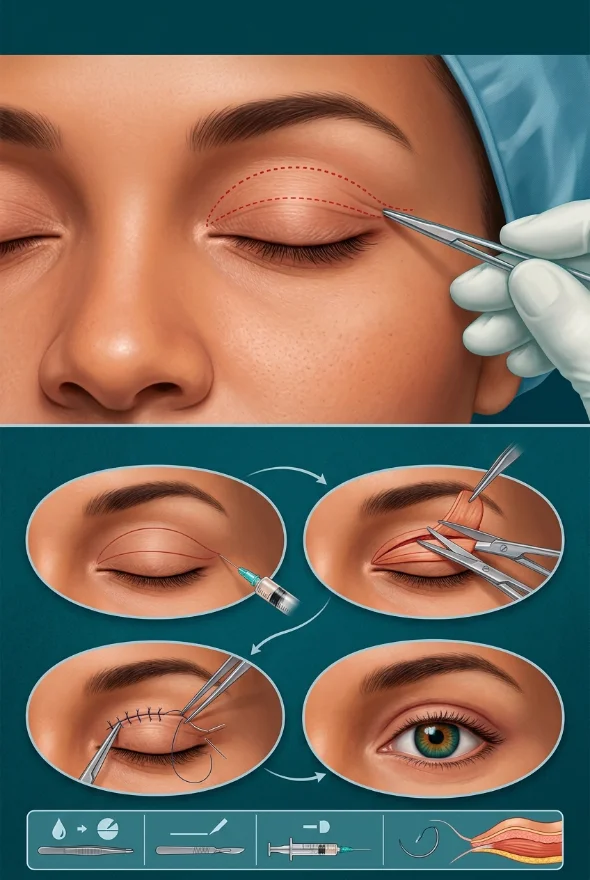
Ptosis (noun, pronounced "TOH-sis", the p is silent): ptosis is a drooping of the upper eyelid, so that the edge of the lid sits lower than normal over the eye. It can affect one eye or both, can be present from birth or develop later in life, and in more severe cases the lid covers part of the pupil and blocks vision. The word comes from the Ancient Greek ptōsis, meaning "falling".
In short: ptosis (blepharoptosis) is most often caused in adults by the muscle that lifts the lid stretching or coming loose with age, eye surgery, injury or long-term contact lens wear. It is diagnosed with an eye examination and simple lid measurements, and when it is treated, the usual fix is a short operation, led at Laser Istanbul Clinic by eyelid surgeon Prof. Dr. Ahmet Satıcı. A lid that droops suddenly is an emergency and needs same-day medical care.
Ptosis: key facts
- Medical name
- Blepharoptosis (ptosis of the upper eyelid)
- What it is
- An abnormally low upper eyelid margin when you look straight ahead
- Normal position
- The upper lid covers only about 1–2 mm of the top of the cornea (EyeWiki, AAO)
- One eye or both
- Either; ptosis in one eye is common
- Two main groups
- Congenital (present at birth or in the first year) and acquired (develops later)
- Commonest adult cause
- Stretching, thinning or detachment of the levator tendon (aponeurotic ptosis)
- Main treatments
- Monitoring for mild cases; eye drops for some acquired cases; eyelid crutches; surgery, usually under local anaesthetic
- Specialist
- Eyelid (oculoplastic) surgeon or ophthalmologist; at Laser Istanbul Clinic, Prof. Dr. Ahmet Satıcı
What are the types and causes of ptosis?
Ptosis has two main groups. Congenital ptosis is present at birth or appears within the first year, usually because the muscle that lifts the lid did not develop normally (MedlinePlus; EyeWiki). Acquired ptosis develops later and is far more common in adults.
The most common cause of a droopy eyelid in adults is a stretched or detached lid-lifting tendon. The levator muscle raises the upper lid through a thin tendon called the aponeurosis. According to the American Academy of Ophthalmology (AAO, January 2026), this muscle can stretch or separate from the lid with age or after injury or eye surgery; less often, diseases or tumours are the cause. NHS patient information adds long-term contact lens wear to the list of causes.
| Type of ptosis | Cause | Typical features |
|---|---|---|
| Aponeurotic (age-related) | The levator tendon stretches, thins or detaches; more likely with ageing, eye surgery or years of contact lens wear | Gradual; often one side more than the other; the commonest type in adults |
| Congenital | The lid-lifting muscle did not develop normally; sometimes linked to nerve or eye-movement problems | Seen from birth or the first year; in one or both lids |
| Myogenic (muscle) | Muscle diseases such as myasthenia gravis, chronic progressive external ophthalmoplegia or oculopharyngeal muscular dystrophy | Can vary through the day; may come with double vision |
| Neurogenic (nerve) | Third nerve palsy or Horner syndrome | Often sudden; may come with double vision or a pupil of a different size |
| Mechanical | A lump, cyst, swelling or scar weighs the lid down | A visible or palpable lump or scar |
| Traumatic | A cut or injury that damages the muscles that raise the lid | After an accident or injury |
Classification from EyeWiki (AAO), "Blepharoptosis".
Why is only one of my eyelids drooping?
Ptosis in one eye is common and is usually the slow, age-related aponeurotic type. But a droopy eyelid on one side can also be the first sign of a nerve or muscle problem, so how quickly it appeared and what comes with it matter more than which side it is on. A lid that has drooped slowly over months or years, with no other symptoms, is a very different situation from one that dropped over hours or days.
What are the symptoms of ptosis?
The main sign of ptosis is an upper eyelid that sits lower than it should, sometimes making the eye look smaller, "sleepy" or tired. According to the AAO, other signs include:
- an upper lid that covers part of the pupil, so the top of your vision is blocked
- a lid crease that sits at a different height from the other side
- tilting your head back, lifting your chin or raising your eyebrows to see under the lid
MedlinePlus also lists tiredness and achiness around the eyes, and increased tearing despite a feeling of dryness. In children, ptosis can affect one or both lids and, if the lid blocks the pupil, vision.
Symptoms that come with a droopy lid help the doctor find the cause. For example, drooping that gets worse as the day goes on and improves after sleep, with double vision, is a classic pattern of myasthenia gravis, according to the NHS.
Is ptosis the same as hooded eyelids?
No. In ptosis the edge of the upper lid itself sits too low. With hooded eyelids (excess upper-lid skin, called dermatochalasis), extra skin folds down over the lid and can make the eye look heavy even when the lid edge is in a normal position. MedlinePlus lists loose upper eyelid skin as one cause of "eyelid drooping", which is why the two are often confused, but they are treated differently: removing skin does not lift a lid whose muscle has stretched. The two can occur together.
| What you see | What it usually is | Usual approach |
|---|---|---|
| The edge of the upper lid sits low, close to or over the pupil | Ptosis: a stretched, detached or weak lid-lifting muscle | Ptosis treatment, often surgery |
| A fold of skin hangs over the lid, lid edge in a normal position | Excess upper-lid skin (dermatochalasis) | Upper blepharoplasty |
| Both together | Ptosis with excess skin | Ptosis surgery, which can be combined with blepharoplasty |
Not to be confused with proptosis or exophthalmos. These words sound alike but mean the opposite: an eye that bulges forward. MedlinePlus treats proptosis and exophthalmos as the same thing, most often caused by thyroid disease, especially Graves' disease. A bulging eye needs a medical check; it is not treated with ptosis surgery.
Other lid terms. A lid that turns inward (entropion) or outward (ectropion) is a different problem of lid position, covered in our glossary entry on entropion and ectropion.
When is a droopy eyelid an emergency?
Warning: a lid that droops suddenly needs same-day medical care. Go to an eye emergency service or A&E (in the UK, call 999 if symptoms are severe) if a droopy eyelid appears suddenly, especially with:
- double vision, or an eye that does not move normally
- a pupil that is larger or smaller than the other one
- a severe headache, or weakness, numbness or drooping elsewhere in the face or body
The AAO calls third nerve palsy, which causes a drooping eyelid and sometimes an enlarged pupil, "a medical emergency", because it can signal a dangerous swelling of a blood vessel (an aneurysm) in the brain, and advises that everyone with it is assessed immediately by a doctor. Horner syndrome, a drooping lid with a smaller pupil and reduced sweating on the same side, is described in the AAO's journal EyeNet as a red flag for possible malignancy, stroke or aneurysm. Do not book cosmetic or elective surgery for a lid that dropped suddenly; have it investigated first.
How is ptosis diagnosed?
Ptosis is diagnosed with a complete eye examination. The AAO notes that the ophthalmologist may also order blood tests and imaging to look for an underlying cause. MedlinePlus lists a slit-lamp examination and visual field testing among the usual tests.
Your surgeon typically measures:
Marginal reflex distance (MRD1)
The distance from the light reflex at the centre of your pupil to the edge of your upper lid, in millimetres. The lower the number, the more the lid covers the pupil.
Levator function
How far the lid travels from looking down to looking up with the brow held still. EyeWiki grades more than 10 mm as excellent, 5–10 mm as fair to good, and 0–5 mm as poor. This number largely decides which operation is suitable.
Lid crease height, brow position and any excess skin
Visual field
How much the lid blocks the upper part of your vision.
Tests for specific causes
An ice pack test can be used if myasthenia gravis is suspected, and drops that stimulate Müller's muscle show whether an operation from inside the lid is likely to work (EyeWiki).
The eye itself
Tear film and surface, pupil reactions and eye movements, because lifting a lid exposes more of the eye.
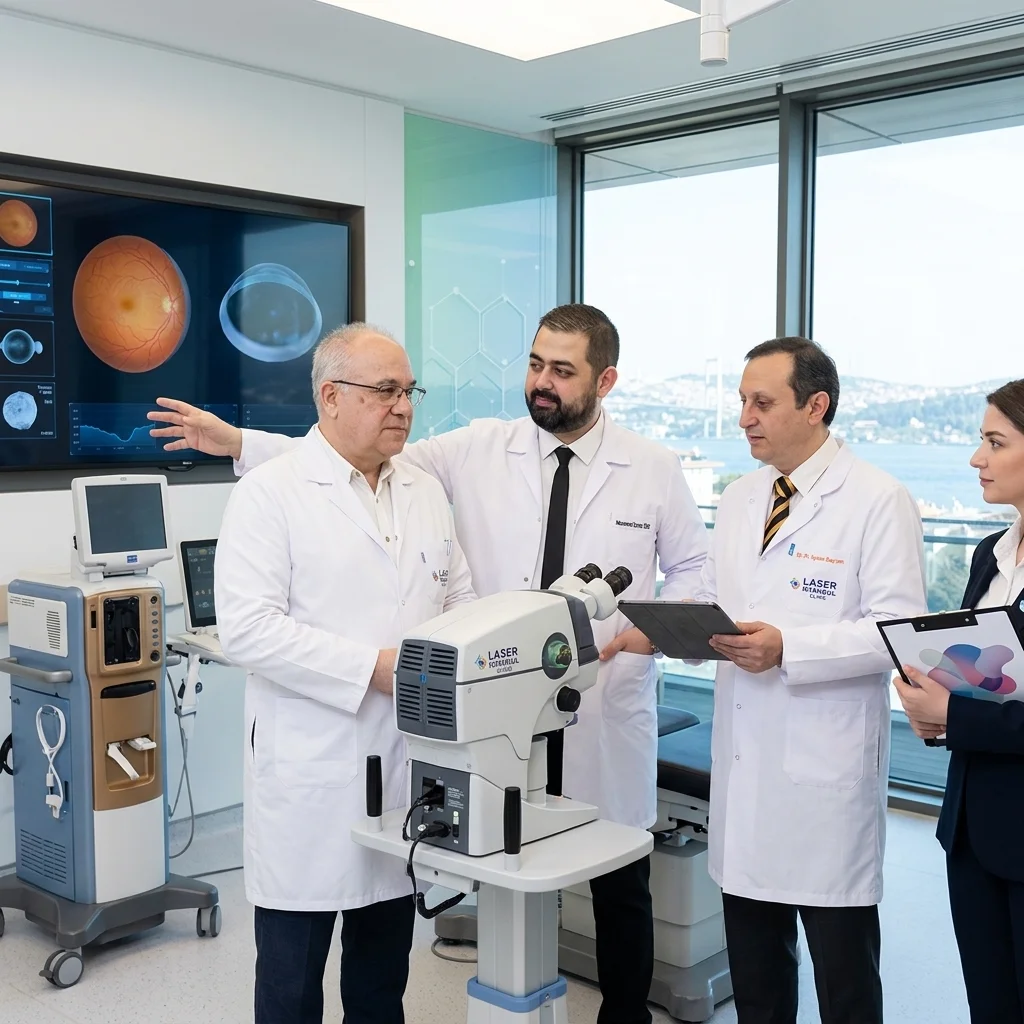
At Laser Istanbul Clinic you can send photos and any existing reports first, and Prof. Dr. Satıcı reviews them before you decide to travel.
How is ptosis treated?
Treatment depends on the cause, how much the lid droops, whether it affects vision and how well your levator muscle works.
Does ptosis need treatment?
Not always. A mild droop that does not affect your vision or bother you may not need treatment, and your surgeon will tell you whether it is worth treating. A droop caused by another condition, such as myasthenia gravis or a nerve problem, needs that condition assessed first.
Non-surgical options
| Option | What it does | Limits |
|---|---|---|
| Oxymetazoline 0.1% eye drops (Upneeq) | Stimulate the small Müller's muscle to lift the lid slightly; the effect lasts about 8 hours after one daily drop. FDA-approved in the US in 2020 for acquired ptosis in adults | Temporary; must be used every day (AAO). Side effects include eye irritation, redness, dry eye and blurred vision. Not for everyone, for example untreated narrow-angle glaucoma (EyeWiki) |
| Eyelid crutches (a prop attached to glasses) | Hold the lid up mechanically | Often need custom fitting; non-surgical options are limited and incomplete blinking can harm the cornea (Sun et al., Orbit, 2018) |
Ptosis surgery
Surgery is the usual treatment for ptosis that affects vision or appearance. The AAO describes it as tightening or reattaching the levator muscle, usually as an outpatient operation under local anaesthetic. The technique depends on how well the levator muscle works (EyeWiki):
| Technique | How it is done | Usually chosen for |
|---|---|---|
| Levator advancement or resection | Through an incision in the natural lid crease, the levator is shortened or reattached | Good or fair levator function (more than about 5 mm) |
| Müller's muscle–conjunctival resection | From inside the upper lid, so no skin incision | Mild to moderate ptosis with excellent levator function and a good response to the drop test |
| Frontalis suspension (sling) | A strip of material connects the lid to the forehead muscle, so raising the brow lifts the lid | Poor or absent levator function (under about 4 mm) |
Awake for a reason. In adults, local anaesthetic (drops plus a small injection into the upper lid) is standard, with optional sedation, because the surgeon can ask you to open your eyes and adjust the height and shape of the lid during the operation. NHS patient information gives the operating time as about 45 minutes to 1 hour per eye.
What recovery and risks look like. According to NHS patient information, the eye is padded overnight, bruising and swelling can last 10–14 days, and antibiotic ointment and lubricating drops are used for two weeks. Surgeons are happy with the lid height 80–90% of the time, there is a 10–20% chance of over-correction (the lid ends up too high), and under-correction is rarer. Other risks listed by EyeWiki and the NHS include bleeding, infection, swelling, an uneven lid position, dry or gritty eyes and exposure of the corneal surface. Blood-thinning drugs may need to be stopped before surgery, but only after checking with your own doctor.
Ptosis in children. Congenital ptosis is treated mainly with surgery. According to MedlinePlus, surgery may wait until age 3–4 if vision is not affected, but is done earlier if the lid blocks vision, to prevent amblyopia ("lazy eye"). Treatment for amblyopia can include patches, glasses or drops (AAO).
Treatment with us. Eyelid and oculoplastic surgery, including ptosis repair, is led by Prof. Dr. Ahmet Satıcı, who chooses the technique after measuring your lids. Operations take place in a fully equipped, Ministry of Health–licensed operating theatre in Istanbul. When a lump or growth on the eyelid is pushing the lid down, Doç. Dr. Muhammet Derda Özer (Doç. means Associate Professor), who treats eye tumours, can take part in your care. {{techniques Prof. Satıcı uses for ptosis, e.g. levator advancement, Müller's muscle resection, frontalis sling; sling material; stitch type}}

When to see a doctor about a droopy eyelid
Seek same-day care for a lid that droops suddenly, or any droop with double vision, a pupil of a different size, a severe headache or weakness elsewhere (see the warning above).
Book an appointment with an eye doctor if:
- a lid has drooped slowly and now blocks part of your vision, or you tilt your head or lift your brows to see
- the droop is getting worse, or varies through the day, particularly with double vision, which can point to myasthenia gravis
- your child's lid droops, or one lid seems to close suddenly
- your droopy eyelid bothers you and you want to know the options
If your lid has drooped slowly and you want an opinion on treatment, you can send photos and any reports for review before you travel.
Frequently asked questions
Ptosis is a drooping of the upper eyelid, so that the lid margin sits lower than normal over the eye. It can affect one or both eyes, and in more severe cases the lid covers part of the pupil and blocks vision.
In adults, the most common cause is a stretched or detached levator tendon, from ageing, eye surgery, injury or long-term contact lens wear. Less often it is caused by nerve or muscle disease, a lump on the lid or an injury. Congenital ptosis is usually due to a lid-lifting muscle that did not develop normally.
A lid that sits low, sometimes covering part of the pupil, so that the upper part of your vision is blocked. You may tilt your head back or raise your eyebrows to see, and the eyes can feel tired or achy. Check urgently if it comes on suddenly, or with double vision or a different-sized pupil.
Ptosis caused by a stretched or detached tendon is not expected to correct itself, and the AAO's treatment for it is surgery. Drooping that is a symptom of another condition may improve when that condition is treated. A doctor needs to find the cause.
Not always. A mild droop that does not affect your sight may not need treatment, and eye drops can give a temporary lift in some adults. Surgery is the usual treatment when ptosis blocks vision or bothers you.
In adults, usually yes. Local anaesthetic is used, with optional sedation, so that the surgeon can ask you to open your eyes and fine-tune the lid height during the operation.
No. In ptosis the lid edge sits too low because of the lid-lifting muscle. In a hooded eyelid, extra skin hangs over the lid. They can occur together and be corrected in the same operation.
Yes. Congenital ptosis appears at birth or in the first year. If the lid blocks vision, treatment should not be delayed, because it can lead to amblyopia.
Sources for the facts on this page
- All opened and checked on 7 Oct 2026 (source 11 and the Wiktionary note were also used in the related ptosis treatment page).
- American Academy of Ophthalmology. What Is Ptosis? (reviewed by Cesar A. Briceno MD, 15 Jan 2026). https://www.aao.org/eye-health/diseases/what-is-ptosis
- EyeWiki (AAO). Blepharoptosis. https://eyewiki.org/Blepharoptosis
- EyeWiki (AAO). Oxymetazoline. https://eyewiki.org/Oxymetazoline
- American Academy of Ophthalmology. Third Nerve Palsy. https://www.aao.org/basic-skills/third-nerve-palsy
- American Academy of Ophthalmology, EyeNet. 4 Neuro Conditions Not to Be Missed. https://www.aao.org/eyenet/article/4-neuro-conditions-not-to-be-missed
- NHS. Myasthenia gravis: symptoms. https://www.nhs.uk/conditions/myasthenia-gravis/
- NHS patient information leaflet. Ptosis correction (adults). https://www.cuh.nhs.uk/patient-information/ptosis-correction-adults/
- NHS patient information leaflet. Ptosis surgery. https://www.guysandstthomas.nhs.uk/health-information/ptosis-surgery
- MedlinePlus (US National Library of Medicine). Eyelid drooping (reviewed 9 Jul 2024). https://medlineplus.gov/ency/article/001018.htm
- MedlinePlus. Ptosis, infants and children (reviewed 20 Jan 2025). https://medlineplus.gov/ency/article/003035.htm
- MedlinePlus. Bulging eyes. https://medlineplus.gov/ency/article/003033.htm
- Sun MT, et al. 3D printing for low-cost, rapid prototyping of eyelid crutches. Orbit 2018. https://pmc.ncbi.nlm.nih.gov/articles/PMC6119648/
- Wiktionary. ptosis (etymology and pronunciation). https://en.wiktionary.org/wiki/ptosis
Droopy eyelid? Send us your photos.
Send us front-on photos and any eye reports. Prof. Dr. Ahmet Satıcı, our eyelid surgeon, will review them and tell you whether treatment may be worthwhile and what the options are, with no obligation.
3 eye surgeons
Your case is reviewed by a named surgeon, not a salesperson. Reply within {{response time}}.
 Prof. Dr. Ahmet Satıcı
 Doç. Dr. Muhammet Derda Özer
 Op. Dr. Aysan Bayram