
- Home
- Knowledge centre
- Eye glossary A–Z
- Eye Colour: What It Is, What Decides It and When a Change Matters
Eye Colour: What It Is, What Decides It and When a Change Matters
Medically reviewed by {{surgeon}}, {{surgeon's title and specialty}}, on {{review date}}. Last updated {{date}}.
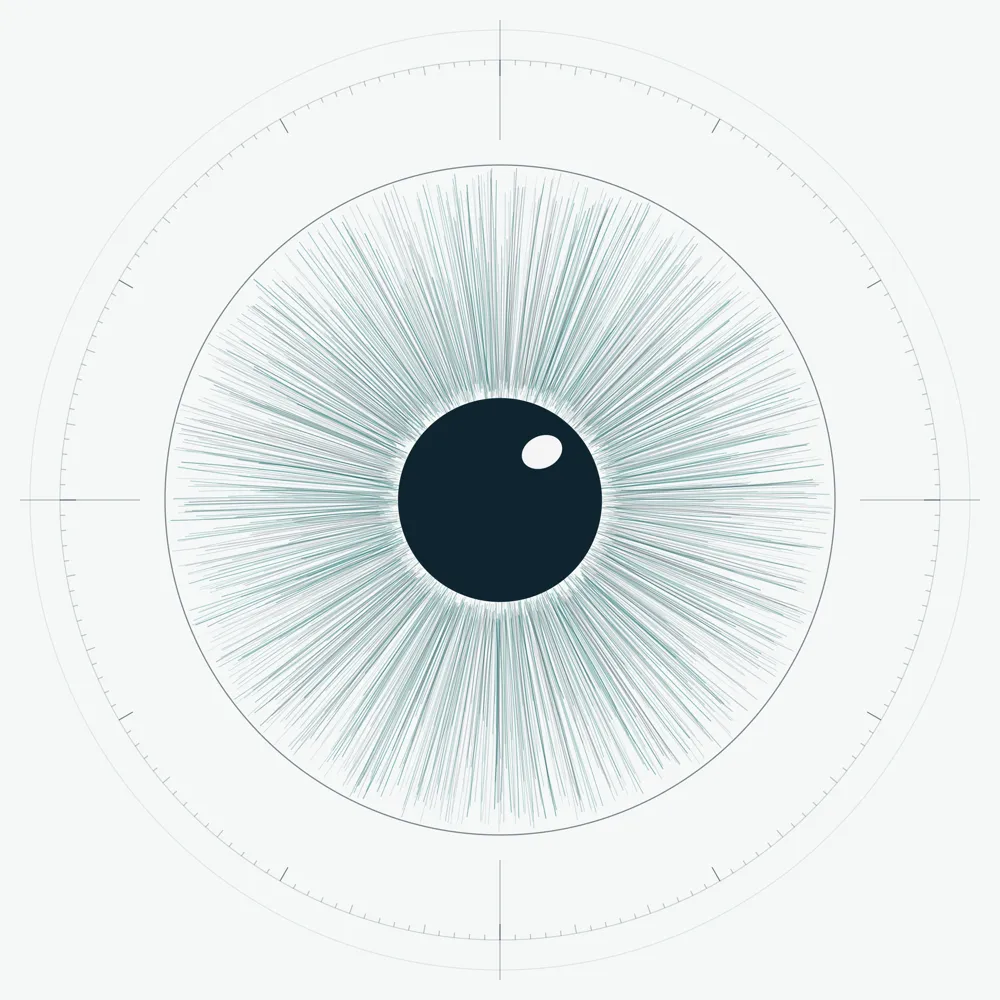
Eye colour (noun; US spelling eye color): the colour of the iris, the ring of tissue around the pupil that controls how much light enters the eye. It is set mainly by the amount of the pigment melanin in the front layers of the iris, and by how those layers scatter light: a lot of melanin gives brown, very little gives blue, and amounts in between give hazel and green. Eye colour is inherited through many genes, and a lasting change in an adult's eyes, or two differently coloured eyes in a baby, should be checked by an eye doctor such as Doç. Dr. Muhammet Derda Özer (Doç. means Associate Professor).
Eye colour: key facts
- What it is
- The colour of the iris, the coloured ring around the pupil
- What sets it
- Melanin in the front layers of the iris, plus how light scatters in those layers
- Common natural colours
- Brown, hazel, green, blue and grey (amber is usually counted as a shade of brown)
- Most common
- Brown: more than half of people worldwide (American Academy of Ophthalmology, AAO)
- Rarest of the main colours
- Green: about 2% of people worldwide (AAO)
- US snapshot (2014 poll quoted by the AAO)
- 45% brown · 27% blue · 18% hazel · 9% green · 1% other
- Genes
- Many. The AAO says as many as 16; the main two, OCA2 and HERC2, sit on chromosome 15
- Babies
- Often born with blue-grey eyes; colour usually settles after about the first year
- Adults
- Colour is normally stable; a distinct change in one or both eyes needs an eye exam
- Specialist
- Ophthalmologist; at Laser Istanbul Clinic, Doç. Dr. Muhammet Derda Özer (uveitis, ocular tumours) and Prof. Dr. Ahmet Satıcı (glaucoma)
What determines eye colour?
Eye colour is determined by the amount of melanin in the front layers of the iris. Melanin is the same pigment that colours skin and hair. According to MedlinePlus, the US National Library of Medicine's genetics service, brown eyes contain a large amount of melanin and blue eyes much less. The AAO adds that the brown colour comes from melanin and that the more melanin there is, the darker the brown.
Blue and green are not pigments. Blue eyes contain no blue pigment. With very little melanin in the front of the iris, light scatters and more blue light is reflected back out, in the same way that water and the sky look blue (AAO). Green works similarly: it is not only a matter of melanin but of how light scatters in the iris. That is why a blue or green eye can look different in different light, while a dark brown eye changes much less.
Everyone's iris is unique. The AAO notes that the distribution of melanin in the iris differs from person to person, so two people with "blue eyes" rarely look exactly alike.
What are the natural eye colours, and how common are they?
Researchers often group eye colour on a three-point scale of blue, green/hazel and brown, but in everyday life people describe six shades. Reliable figures exist for only some of them.
| Colour | What it looks like | What is behind it | How common |
|---|---|---|---|
| Brown | From light honey to near-black | The most melanin in the front of the iris | The most common colour: more than half of people worldwide (AAO); 45% in the US (2014 poll) |
| Hazel | A mix of brown and green, often changing with light | A little more melanin than in blue eyes, giving brown and green tones | 18% in the US (2014 poll) |
| Green | Pale to deep green | Little melanin plus light scattering | The rarest of the main colours: about 2% worldwide (AAO); 9% in the US |
| Blue | Pale to deep blue | Very little melanin; light scatters back as blue | 27% in the US (2014 poll) |
| Grey | Silvery or steel grey | Low melanin and the way the iris tissue scatters light; usually grouped with blue in research | No reliable figure |
| Amber | Solid golden, yellow-brown or copper | Usually treated as a shade of brown | No reliable figure |
Which eye colour is the rarest? Green is usually named as the rarest of the main colours, at about 2% of people worldwide according to the AAO. Grey and amber may be just as uncommon, but studies tend to group them with blue and brown, so there are no dependable percentages for them. Red or pink-looking eyes are not a natural colour: they can occur in albinism, where the iris has little melanin and blood vessels show through (AAO).
Colour mix also differs by region. The AAO notes that brown eyes are more frequent in hotter parts of the world such as Africa and Asia than in Europe.
How is eye colour inherited?
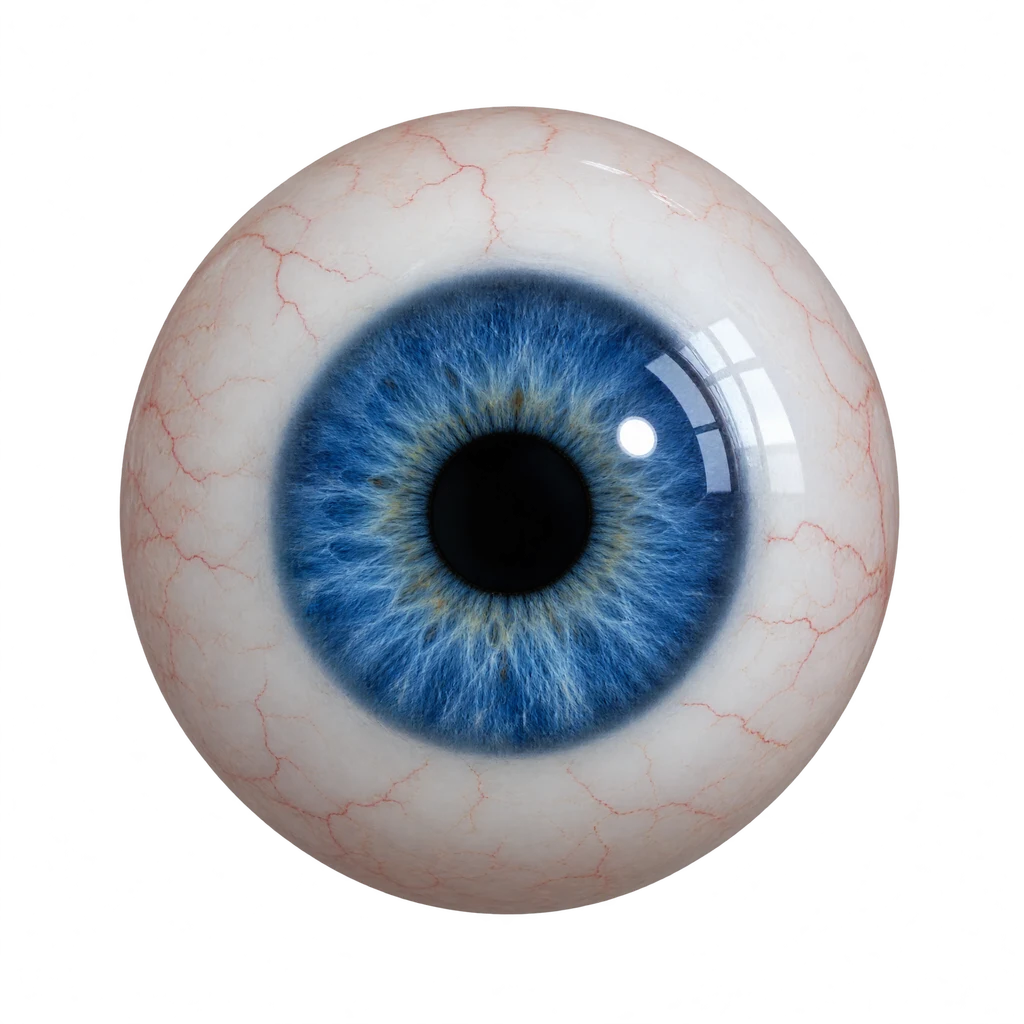
Eye colour is inherited through several genes, not one, so it cannot be predicted exactly from the parents' eyes. Two genes next to each other on chromosome 15 do most of the work. MedlinePlus explains that OCA2 makes the "P protein", which helps melanin-producing structures in the iris mature, and that variants in a neighbouring region of HERC2 switch OCA2 down, producing less melanin and lighter eyes. Several other genes (including ASIP, IRF4, SLC24A4, SLC24A5, SLC45A2, TPCN2, TYR and TYRP1) play smaller roles and together create the continuum of shades.
Two scientific papers put figures on this:
- A 2009 review in Pigment Cell & Melanoma Research (Sturm and Larsson) reports that one interval on chromosome 15 containing OCA2 explains about 74% of the variation in human eye colour, and that a variant in the HERC2 region accounts for most of the difference between blue and brown. The old school idea that brown is simply "dominant" and blue "recessive" is, in the authors' view, too simple.
- A 2010 genome-wide study of nearly 6,000 Dutch adults, published in PLoS Genetics (Liu and colleagues), measured eye colour from digital photographs and found three further genetic regions linked to iris colour.
What this means in practice. Two brown-eyed parents can have a blue-eyed child, and two blue-eyed parents can, rarely, have a brown-eyed child. The AAO says you cannot reliably predict a child's eye colour just from looking at the parents' eyes. Simple odds tables are fun to explore but are teaching models, not genetic tests.
When does a baby's eye colour settle?
Most babies' eye colour settles after about their first birthday. Newborns usually have little pigment in the iris, so their eyes often look blue or blue-grey at first. Melanin-producing cells in the iris keep working after birth, and as melanin builds up the eyes may darken. The American Academy of Pediatrics' parenting site says it takes about a year for eye colour to stabilise and that change slows after six months but is not finished. The AAO says most children's colour stabilises after age one, although some children keep changing for several more years.
Two things in a baby are worth raising with a doctor. One is two differently coloured eyes: the American Academy of Pediatrics advises bringing it to the doctor's attention, because it can occasionally be linked to a rare syndrome such as Waardenburg syndrome, and MedlinePlus advises a check for any infant with differently coloured eyes. The other is an eye that turns in or out after six months, which needs an eye examination.
Heterochromia: different-coloured eyes
Heterochromia means that a person's irises are different colours. There are three forms, according to the AAO:
- Complete heterochromia: one iris is a different colour from the other.
- Partial (sectoral) heterochromia: part of one iris differs from the rest.
- Central heterochromia: an inner ring around the pupil is a different colour from the outer iris.
Present from birth. Heterochromia can be a harmless variation. It can also be associated with conditions including Horner syndrome, Sturge-Weber syndrome, Waardenburg syndrome and others, which is why an infant with different-coloured eyes should be examined (AAO; MedlinePlus).
Appearing later in life. Acquired heterochromia can follow eye injury, bleeding inside the eye, inflammation (iritis or uveitis), eye surgery, glaucoma medication, pigment disorders, iris tumours, diabetes or blocked blood vessels (AAO). It is more likely to matter than a colour difference you have always had.
Why can eye colour change in an adult?
For most people eye colour is stable from childhood into old age, so a distinct change in one or both eyes is a reason to see an ophthalmologist. The AAO says to see an ophthalmologist right away. Causes it lists, and what each means:
| Cause | What happens to the iris | Notes |
|---|---|---|
| Prostaglandin glaucoma drops | The iris can darken permanently over time | Common glaucoma medicine; the AAO says the eyelash-growth product Latisse does not appear to affect iris colour. Do not stop glaucoma drops without advice from your doctor |
| Fuchs heterochromic iridocyclitis | Low-grade inflammation makes the affected iris lighter, with a "moth-eaten" look in some eyes | One-sided; heterochromia is found in about 75–90% of cases; it accounts for roughly 2–11% of uveitis; cataract and glaucoma are possible later (EyeWiki) |
| Pigment dispersion syndrome | Pigment is shed from the iris, lightening areas of it | Can be linked to pigmentary glaucoma, so pressure is checked (AAO; MedlinePlus) |
| Horner syndrome | A rare nerve-pathway problem; in congenital cases the iris of the affected eye can be lighter | Drooping lid and a small pupil are the typical signs; sudden painful Horner syndrome needs immediate assessment (EyeWiki) |
| Uveitis | Inflammation inside the eye can alter the iris and pupil | Pain, light sensitivity and redness are common |
| Iris freckle or nevus | A pigmented spot on the iris | Iris nevi are found in fewer than 5% of people and are seen more often in lighter irises; most stay harmless, so doctors photograph and monitor them (EyeWiki) |
| Injury or surgery | Damage to iris tissue or bleeding changes its appearance | Often obvious from the history |
| Iris tumour | A growing, darker or irregular area | Rare, but the reason a new patch should always be examined |
The AAO also mentions arcus senilis, the grey-white ring around the edge of the cornea that is common in older people. It is a corneal ring, not an iris change, and is usually harmless.
Symptoms: when does an eye colour difference need a check?
Normal eye colour causes no symptoms. These signs alongside, or instead of, a colour change suggest the cause needs to be found:
| What you notice | What it can point to |
|---|---|
| One iris getting darker or lighter over weeks or months | Medication effect, Fuchs uveitis, pigment dispersion, iris freckle or tumour |
| A new dark spot or patch on the iris | Iris nevus (usually harmless) or, rarely, a tumour |
| Eye pain, redness and sensitivity to light | Uveitis or other inflammation: needs same-day advice |
| Blurred vision or floaters | Uveitis, cataract and other eye problems |
| One eyelid drooping and one pupil smaller | Horner syndrome |
| Two differently coloured eyes in a baby | Often harmless, but needs an eye check; occasionally a syndrome |
| Very pale iris, light sensitivity, shaking eye movements, poor vision | Albinism (AAO) |
Albinism and eyesight. In ocular or oculocutaneous albinism the iris lacks pigment to screen light, so people can have light sensitivity, rapid involuntary eye movement (nystagmus), reduced vision, squint and refractive error. The AAO says albinism occurs in about 1 in 17,000 births worldwide and is managed with glasses, squint surgery where needed and low-vision aids.
How is an eye colour change diagnosed?
An eye specialist works out why an iris looks different with a short, painless examination:
- History and comparison. Old photographs help to date a change. Tell the doctor about any eye drops, injury, surgery or other medicines.
- Slit-lamp examination. A microscope with a bright, thin beam shows the iris surface, any freckle or nodule, signs of inflammation and the cornea behind it.
- Eye pressure checks. These look for pigmentary glaucoma and other pressure problems that can accompany a pigment change. MedlinePlus notes that a complete eye exam can identify most causes of heterochromia and rule out disorders such as pigmentary glaucoma.
- Photography and imaging. For a freckle or nevus, slit-lamp photographs and imaging are used to monitor it, usually every year if it looks stable and every 3–6 months if it looks suspicious (EyeWiki).
- Further tests. Depending on the findings, a general or neurological examination may be needed, for example if Horner syndrome is suspected.
Normal eye colour itself needs no test. The examination is about finding or excluding the cause of a change.
Treatment: does eye colour need treating?
Normal eye colour needs no treatment, and neither does harmless heterochromia. The AAO says treatment for heterochromia focuses on any underlying cause; if there are no other eye problems, no treatment may be needed. Depending on the cause, that can mean:
| Cause | Typical management |
|---|---|
| Harmless variation, such as central heterochromia | None; a one-off check to confirm |
| Medication darkening (prostaglandin glaucoma drops) | Discuss with your glaucoma specialist; do not stop treatment on your own |
| Uveitis, including Fuchs heterochromic iridocyclitis | Treat the inflammation where needed; most Fuchs cases need no long-term treatment, but cataract and glaucoma are watched for and treated, with surgery if they develop (EyeWiki) |
| Pigment dispersion | Regular pressure checks and glaucoma treatment if pressure rises |
| Iris nevus | Photograph and monitor; act on any growth |
| Iris tumour | Specialist assessment and treatment |
Treatment with us: Doç. Dr. Muhammet Derda Özer treats uveitis and eye tumours, and Prof. Dr. Ahmet Satıcı treats glaucoma. Where surgery is needed, it takes place in a fully equipped, Ministry of Health–licensed operating theatre in Istanbul. For most colour questions, an examination and your existing scans are enough to give you an answer.
Can eye colour be changed safely?
Not by surgery. In January 2024 the AAO warned against cosmetic iris implants and keratopigmentation (pigment placed in the cornea). It listed risks including vision loss, glaucoma, cataract, corneal damage that may need a transplant, inflammation, infection and fading colour, and said iris implants are approved only for people missing part or all of an iris through injury or birth defect. The AAO's advice is that the safest way to change eye colour is to ask whether you are a suitable candidate for coloured contact lenses fitted by an eye care professional. Our surgeons do not perform cosmetic eye colour change.

When to see a doctor about eye colour
Seek same-day care from an eye doctor or eye emergency service if a colour change comes with:
- eye pain, a very red eye or sensitivity to light
- sudden blurred vision or a sudden drop in vision
- an injury to the eye, or a drooping eyelid with a small pupil, especially with pain in the head or neck
Book an appointment soon if:
- the colour of one or both eyes visibly changes (the AAO says to see an ophthalmologist right away)
- a new dark spot or patch appears on the iris, or an old one grows
- you start glaucoma drops and notice your iris darkening
- a baby has two differently coloured eyes
You do not need to worry about the colour you have always had, even if it is unusual, or about a baby's blue eyes darkening over the first year.
If you have had an iris change diagnosed elsewhere and would like a second opinion, you can send your reports and scans for review before you travel.
Frequently asked questions
Eye colour is the colour of the iris. It depends mostly on how much melanin is in the front layers of the iris and on how light scatters there: lots of melanin looks brown, very little looks blue, and in-between amounts look hazel or green.
Melanin in the iris and several genes. OCA2 and HERC2 on chromosome 15 have the largest effect, with other genes adding smaller ones. The AAO says as many as 16 genes may be involved, which is why eye colour is hard to predict from the parents.
Green, at about 2% of people worldwide according to the AAO. Grey and amber may also be rare, but there are no reliable percentages for them.
Rarely, yes. Because several genes are involved, blue-eyed parents can carry gene variants that lead to more melanin, as MedlinePlus and the AAO both note. It is far more usual for them to have a blue- or lighter-eyed child.
Most settle after about a year as melanin builds up in the iris, though some keep changing for several years. A baby born with two differently coloured eyes should be seen by a doctor.
Heterochromia means irises of different colours, or a different colour within one iris. Present from birth it is often harmless, but it can be linked to conditions such as Horner or Waardenburg syndrome, so an infant should be examined. Appearing in adulthood, it needs an eye exam to rule out inflammation, glaucoma, injury or a tumour.
Normally it does not. A distinct change can be caused by glaucoma drops that darken the iris, inflammation such as Fuchs uveitis, pigment dispersion, Horner syndrome, injury or an iris tumour, so see an ophthalmologist promptly.
Ordinary variation in eye colour is not what sets your prescription: short- or long-sightedness comes from the eye's focusing power and length, and is measured in dioptres. The exception is albinism, where too little pigment in the eye can reduce vision.
No. The AAO warned in January 2024 against cosmetic iris implants and keratopigmentation because of risks that include vision loss, glaucoma and cataract. Its suggestion for people who want a different look is professionally fitted coloured contact lenses.
Sources for the facts on this page
- Each source was opened and checked on 7 Oct 2026.
- MedlinePlus Genetics (US National Library of Medicine). Is eye color determined by genetics? https://medlineplus.gov/genetics/understanding/traits/eyecolor/
- American Academy of Ophthalmology. Why Are Brown Eyes Most Common? https://www.aao.org/eye-health/tips-prevention/why-are-brown-eyes-most-common
- American Academy of Ophthalmology. Eye Color: Unique as a Fingerprint. https://www.aao.org/eye-health/tips-prevention/eye-color-unique-as-fingerprint
- American Academy of Ophthalmology. Your Blue Eyes Aren't Really Blue (2014 US poll: 45% brown, 27% blue, 18% hazel, 9% green, 1% other). https://www.aao.org/eye-health/tips-prevention/your-blue-eyes-arent-really-blue
- American Academy of Ophthalmology. Why Are My Eyes Changing Color? https://www.aao.org/eye-health/tips-prevention/why-are-my-eyes-changing-color
- American Academy of Ophthalmology. What Is Heterochromia? https://www.aao.org/eye-health/diseases/what-is-heterochromia
- American Academy of Ophthalmology. What Is Albinism? https://www.aao.org/eye-health/diseases/what-is-albinism
- American Academy of Ophthalmology. News release: Academy Issues Warning on the Dangers of Eye Color-Changing Procedures, 29 Jan 2024. https://www.aao.org/newsroom/news-releases/detail/academy-issues-warning-on-eye-color-procedures
- MedlinePlus Medical Encyclopedia. Heterochromia (reviewed 1 Oct 2025). https://medlineplus.gov/ency/article/003319.htm
- HealthyChildren.org (American Academy of Pediatrics). Newborn Eye Color. https://www.healthychildren.org/English/ages-stages/baby/Pages/Newborn-Eye-Color.aspx
- Sturm RA, Larsson M. Genetics of human iris colour and patterns. Pigment Cell & Melanoma Research 2009 (PubMed 19619260; abstract read via Europe PMC). https://pubmed.ncbi.nlm.nih.gov/19619260/
- Liu F, Wollstein A, Hysi PG, et al. Digital quantification of human eye color highlights genetic association of three new loci. PLoS Genetics 2010 (PubMed 20463881; abstract read via Europe PMC). https://pubmed.ncbi.nlm.nih.gov/20463881/
- EyeWiki (AAO). Fuchs Heterochromic Iridocyclitis. https://eyewiki.org/Fuchs_Heterochromic_Iridocyclitis
- EyeWiki (AAO). Horner Syndrome. https://eyewiki.org/Horner_Syndrome
- EyeWiki (AAO). Iris Nevus. https://eyewiki.org/Iris_Nevus
Noticed a change in the colour of your eyes?
Send us your eye report, photographs or scans. Doç. Dr. Muhammet Derda Özer will review them and tell you whether the change needs an examination and which treatment, if any, may suit your eyes, with no obligation.
3 eye surgeons
Your case is reviewed by a named surgeon, not a salesperson. Reply within {{response time}}.
 Prof. Dr. Ahmet Satıcı
 Doç. Dr. Muhammet Derda Özer
 Op. Dr. Aysan Bayram