
- Home
- Knowledge centre
- Eye glossary A–Z
- Dioptre (Diopter): What It Means and How It Measures Your Eyesight
Dioptre (Diopter): What It Means and How It Measures Your Eyesight
Medically reviewed by {{surgeon}}, {{surgeon's title and specialty}}, on {{review date}}. Last updated {{date}}.
Dioptre (noun; US spelling: diopter; symbol D): a dioptre is the unit that measures the focusing power of a lens, including the lenses in your glasses and the cornea and natural lens inside your eye. One dioptre equals one divided by the focal length in metres, so a +2 D lens brings parallel light to a focus 0.5 metres away. On an eye prescription, a minus number (such as -3.00 D) corrects short-sightedness and a plus number (such as +2.00 D) corrects long-sightedness; the further the number is from zero, the stronger the lens.
Dioptre: key facts
- Symbol
- D (also written dpt)
- Spelling
- Dioptre in British English; diopter in American English; same unit
- Scientific meaning
- One reciprocal metre (1 D = 1 m⁻¹): the focusing power of a lens, the inverse of its focal length in metres
- Minus (-)
- Diverging lens, corrects short-sightedness (myopia)
- Plus (+)
- Converging lens, corrects long-sightedness (hyperopia) and gives the extra power for reading glasses
- Zero
- No focusing power, like a flat window; "plano" on a prescription
- Total power of the eye
- About 60 D, roughly two-thirds from the cornea and one-third from the natural lens
- Eye surgeons for prescription correction
- Prof. Dr. Ahmet Satıcı or Op. Dr. Aysan Bayram for laser and lens-based correction
What is a dioptre?
A dioptre is a unit of optical power. Optical power describes how strongly a lens bends light: the stronger the lens, the shorter the distance at which it focuses parallel rays, and the higher its dioptre value. The relationship is simple. Divide 1 by the focal length in metres and you have the power in dioptres. A lens that focuses light at 1 metre is 1 D, one that focuses at 50 centimetres is 2 D, and one that focuses at 25 centimetres is 4 D.
Because focusing power can be convergent or divergent, the unit carries a sign. A converging lens, which brings light rays together, has a positive value. A diverging lens, which spreads them out, has a negative value. A flat pane of glass has no power at all and measures zero dioptres.
Dioptre or diopter: which spelling is correct?
Both are correct and mean exactly the same thing. "Dioptre" is the British spelling; "diopter" is the American spelling. Whichever your optician or surgeon writes, the number and its meaning are identical.
Dioptres in your eye: how strong is the human eye?
Your eye is a lens system, and its power can be measured in dioptres too. The relaxed human eye has a total focusing power of about 60 dioptres. The cornea, the clear window at the front, provides roughly two-thirds of that (about 40 D). The natural lens behind the pupil provides the rest and, unlike the cornea, can change its power to bring near objects into focus.
This is why a small change at the cornea matters so much. Laser eye surgery works by reshaping the cornea by a fraction of a millimetre, which changes its dioptre value and with it the whole eye's focus.
Dioptres of focusing reserve: accommodation
When you look from far to near, the lens becomes more powerful, in effect adding dioptres. This focusing reserve is called accommodation. According to EyeWiki, it stays in the range of 7–10 dioptres during the first two decades of life, then falls to about 0.5 dioptres by the age of 50. The average age at which people first notice trouble with near vision (presbyopia) is 42 to 44. This is why reading glasses are a plus lens: they add dioptres that the ageing lens can no longer supply.
What do minus and plus dioptres mean on an eye prescription?
On a glasses prescription the dioptre value appears under several headings. Each one is measured in dioptres, except the axis, which is an angle.
| Column | What it shows | Unit |
|---|---|---|
| Sphere (SPH) | The main correction. Minus for short-sightedness, plus for long-sightedness | Dioptres |
| Cylinder (CYL) | The extra power needed for astigmatism | Dioptres |
| Axis | The direction in which the cylinder power is placed, from 0 to 180 | Degrees |
| Add | The extra plus power for near vision, used in reading, bifocal and varifocal lenses | Dioptres |
Values are written to two decimal places, for example -3.75 or +4.00, and the right eye (OD) and left eye (OS) are listed separately. The two eyes often have different values.
What does "minus" or "plus" mean?
A minus sign means a diverging lens. The eye focuses light too strongly or is too long, so images fall in front of the retina, and the minus lens pushes the focus back. This is short-sightedness (myopia). A plus sign means a converging lens: the eye focuses too weakly or is too short, and the plus lens pulls the focus forward onto the retina. This is long-sightedness (hyperopia), and it is also the sign used for reading additions.
Does a higher number mean worse eyesight?
A higher number, whether minus or plus, means a stronger lens and a larger focusing error, so the eye depends more on its correction. It is not a score out of anything: -2.00 and +2.00 are equally strong, just opposite in direction. The number also does not measure eye health; a person with a low prescription can still have an eye disease, which is why routine eye examinations matter.
How many dioptres count as mild, moderate or high?
There is no single "normal" dioptre number. A person who needs no correction has a prescription of zero, or close to it. Beyond that, eye doctors group errors by strength, and the groupings below are the commonly used ones.
| Type | Low | Moderate | High |
|---|---|---|---|
| Short-sightedness (myopia) | Less than -3.00 D | -3.00 to -6.00 D | More than -6.00 D |
| Long-sightedness (hyperopia) | Up to +2.00 D | +2.25 to +5.00 D | +5.25 D or more |
| Astigmatism | Most people have 0.50 to 0.75 D; about 1.50 D or more usually needs correction | n/a | n/a |
The myopia bands come from the American Academy of Ophthalmology (AAO); the hyperopia bands come from EyeWiki, the AAO's clinical wiki. Different clinics and studies use slightly different cut-offs, so treat these as guides rather than strict medical lines.
Why high myopia needs more care
High myopia, usually defined as stronger than -6.00 D (or an eyeball longer than about 26.5 mm), is more than a thicker pair of glasses. According to the AAO and EyeWiki, people with high myopia have a higher risk of retinal detachment, glaucoma, cataract and myopic macular degeneration, and the risk rises with severity. That is why regular eye examinations are recommended, and why anyone with high myopia should know the warning signs of a retinal problem: new flashes of light, a sudden shower of floaters or a dark curtain across the vision.
Does short-sightedness keep getting worse?
Myopia is usually discovered in children between 8 and 12 and often gets stronger through the teenage growth years, then settles in the twenties, according to the AAO. The NHS says it can worsen until about age 20, when eye growth stops. Once your prescription has been stable for a year or more, the number is a good basis for treatment decisions.
Dioptres for each type of vision problem
Short-sightedness (myopia)
Close objects look clear but distant ones blur. It is corrected with minus dioptres. The NHS lists glasses and contact lenses as the main treatments, with laser eye surgery and lens replacement available privately but not through the NHS.
Long-sightedness (hyperopia)
Distance may look clear, but near work causes blur, strain and headaches. It is corrected with plus dioptres. Young people can often use their accommodation to hide mild long-sightedness, which is why it may only show up as eye strain or later in life.
Astigmatism
In astigmatism the cornea or lens is shaped more like a rugby ball than a football, so light focuses at more than one point (NHS). It is measured as the cylinder value in dioptres, plus an axis. Toric lenses correct it, and so can laser surgery.
Presbyopia
From the early forties the natural lens stiffens and the near-focusing reserve drops, as described above. It is corrected with a plus "add" in dioptres, in reading glasses, varifocals or multifocal contact lenses. How strong the addition is depends on your eyes, so it is set at an eye examination rather than by age alone.
How are dioptres measured?
Your eye care professional finds your dioptre values with a mix of objective and subjective tests:
- Autorefractor. A machine measures how light is focused by the eye and gives a starting estimate of sphere, cylinder and axis.
- Phoropter (subjective refraction). You look at a chart while the examiner switches lenses and asks which is better, until the sharpest and most comfortable combination is found. This produces the prescription.
- Keratometry and corneal topography. These measure the curvature of the cornea and map its shape. They are essential for diagnosing astigmatism and keratoconus and for deciding whether laser eye surgery is safe.
Glasses power and contact lens power can differ for strong prescriptions. A lens sits at a different distance from the eye depending on whether it is in a frame or on the eye, and beyond about ±4.00 D this back vertex distance matters. A contact-lens fitting therefore gets its own measurement; do not copy numbers across from a glasses prescription.
How are high dioptres treated? Glasses, lenses and surgery
| Option | What it does | Notes |
|---|---|---|
| Glasses | Lenses of the right dioptre power refocus light onto the retina | Safe and easy to change; high powers give thicker lenses |
| Contact lenses | Same correction, closer to the eye; toric versions for astigmatism | Hygiene is essential |
| Laser eye surgery (LASIK, SMILE, PRK) | Reshapes the cornea to change its dioptre value | For healthy, thick enough corneas and a stable prescription |
| Implantable lens (ICL) | A lens placed inside the eye, in front of the natural lens, leaving the cornea untouched | An option when laser is not suitable, for example high myopia or thin corneas |
| Lens replacement (refractive lens exchange, cataract surgery) | The natural lens is replaced with an artificial lens whose power is chosen to suit your eye | Used for long-sightedness, presbyopia and cataract; premium lenses can reduce dependence on reading glasses |
Can laser eye surgery correct any dioptre?
No. Candidates should be at least 18 (ideally over 21) and their prescription should not have changed much in the past year, according to the AAO. Extreme levels of short-sightedness, long-sightedness or astigmatism, thin corneas, corneal disease and keratoconus can rule laser out. The limit depends on the laser, your corneal thickness and your scans, not on a single number, so your surgeon checks it case by case. If the prescription is too high or the cornea too thin, an ICL or lens replacement may be more suitable.
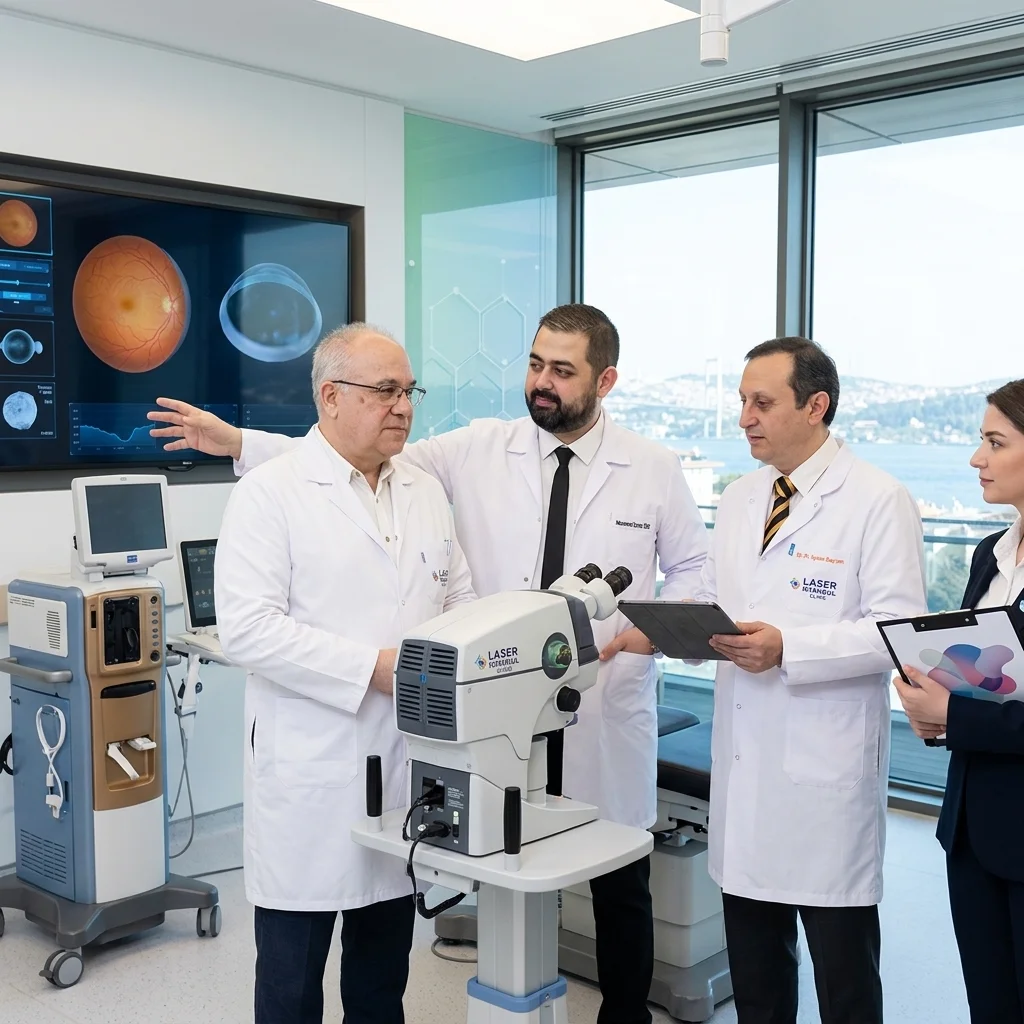
Treatment with us: laser vision correction and lens-based treatments (ICL, lens replacement and cataract) are led by Prof. Dr. Ahmet Satıcı and Op. Dr. Aysan Bayram. Cases involving keratoconus or other cornea problems are assessed by Doç. Dr. Muhammet Derda Özer (Doç. is the Turkish academic title for Associate Professor). Surgery takes place in a fully equipped, Ministry of Health–licensed operating theatre in Istanbul.
When to see a doctor about your dioptre numbers
Seek urgent care the same day if you notice:
- sudden flashes of light, a shower of new floaters or a dark curtain moving across your vision (especially if you are short-sighted)
- a sudden drop in vision in one eye
- a painful red eye with light sensitivity, particularly if you wear contact lenses
Book a routine eye examination if:
- your vision is blurred at distance or near, or you get headaches or eye strain after reading or screen work
- your prescription changes noticeably from one year to the next, especially if astigmatism is rising in a teenager or young adult (the NHS notes astigmatism can be linked to keratoconus)
- your child squints, sits close to the television or struggles to read the board
- you are over 40 and holding things further away to read
- you have a high prescription (stronger than -6.00 D) and have not had an eye examination recently
- you are considering laser eye surgery, ICL or lens replacement and want to know whether your numbers suit it
You can send your prescription and any scans for review before you travel.
Frequently asked questions
A dioptre is the unit that measures the focusing power of a lens. One dioptre equals one divided by the focal length in metres, so a +1 D lens focuses light at 1 metre. On an eye prescription it shows how strong your glasses or contact lenses need to be.
Both are correct. "Dioptre" is the British spelling and "diopter" is the American one. The unit and the symbol (D) are the same.
The relaxed human eye has about 60 dioptres of total focusing power, around two-thirds from the cornea and the rest from the natural lens. The lens can add extra power when you look at near objects.
Minus dioptres (such as -3.00) correct short-sightedness; plus dioptres (such as +2.00) correct long-sightedness and give the extra power for reading glasses. A larger number in either direction means a stronger correction.
A person with no focusing error has a prescription of zero or close to it. In myopia, less than -3.00 D is classed as low, -3.00 to -6.00 D as moderate and more than -6.00 D as high, according to the AAO.
High myopia is usually defined as stronger than -6.00 dioptres. At this level the risk of retinal detachment, glaucoma, cataract and myopic macular degeneration is higher, so regular eye examinations matter.
Astigmatism is measured as the cylinder value in dioptres. The AAO notes that most people have 0.50 to 0.75 D, and that 1.50 D or more usually needs correction.
Sometimes. Laser is suited to a healthy, thick enough cornea and a prescription that has been stable for about a year; extreme errors and thin corneas can exclude it. Your surgeon checks your numbers and scans, and if laser is not suitable an ICL or lens replacement may be offered.
Yes. Short-sightedness commonly increases until about age 20. After about 40, the lens loses its focusing reserve (from 7–10 dioptres in young people to about 0.5 by the age of 50), so people need reading glasses.
No. These are low myopia values (less than -3.00 D). They blur distant objects such as road signs or a whiteboard, but they are easily corrected with glasses, contact lenses or, for suitable eyes, laser surgery.
Sources for the facts on this page
- Wikipedia. Dioptre (unit defined as one reciprocal metre; about 60 D total power of the eye). https://en.wikipedia.org/wiki/Dioptre
- University of Iowa, EyeRounds.org. Laser Refractive Surgery tutorial: corneal anatomy (cornea about two-thirds of the eye's 60 dioptres). https://webeye.ophth.uiowa.edu/eyeforum/tutorials/laser-vision-correction-tutorial/anatomy.htm
- EyeWiki (AAO). Presbyopia (accommodation 7–10 D in the first two decades, about 0.5 D by age 50; onset age 42–44). https://eyewiki.aao.org/Presbyopia
- American Academy of Ophthalmology. Myopia (nearsightedness): low, moderate and high myopia, risks, onset age. https://www.aao.org/eye-health/diseases/myopia-nearsightedness
- EyeWiki (AAO). Myopia (high myopia above 6.00 D or axial length above 26.5 mm; complications). https://eyewiki.org/Myopia
- EyeWiki (AAO). Hyperopia (low, moderate and high bands; correction). https://eyewiki.org/Hyperopia
- American Academy of Ophthalmology. What Is Astigmatism? (0.5–0.75 D typical; 1.5 D or more needs correction; cylinder and axis). https://www.aao.org/eye-health/diseases/what-is-astigmatism
- American Academy of Ophthalmology. What Is Presbyopia? https://www.aao.org/eye-health/diseases/what-is-presbyopia
- American Academy of Ophthalmology. LASIK (candidacy: age, stability, extreme errors, corneal thickness). https://www.aao.org/eye-health/treatments/lasik
- Wikipedia. Eyeglass prescription (sphere, cylinder, axis, add; back vertex distance beyond ±4.00 D). https://en.wikipedia.org/wiki/Eyeglass_prescription
- NHS. Short-sightedness (myopia). https://www.nhs.uk/conditions/short-sightedness/
- NHS. Long-sightedness (hyperopia). https://www.nhs.uk/conditions/long-sightedness/
- NHS. Astigmatism. https://www.nhs.uk/conditions/astigmatism/
Have a prescription and wondering what your options are?
Send us your prescription and scans. One of our surgeons will review them and tell you which treatments may suit your eyes, with no obligation.
3 eye surgeons
Your case is reviewed by a named surgeon, not a salesperson. Reply within {{response time}}.
 Prof. Dr. Ahmet Satıcı
 Doç. Dr. Muhammet Derda Özer
 Op. Dr. Aysan Bayram