Eye Lift Before and After: Eyelid, Squint and Vision Results
This eye lift before and after gallery shows real, consented results from patients treated in Istanbul: upper and lower eyelid surgery, ptosis and squint surgery by Prof. Dr. Ahmet Satıcı, and measured vision before and after laser, lens, cataract and keratoconus treatment by our three surgeons. Every result shows the surgeon, the treatment and how long after surgery it was taken.
Medically reviewed by {{surgeon}} · {{date}}
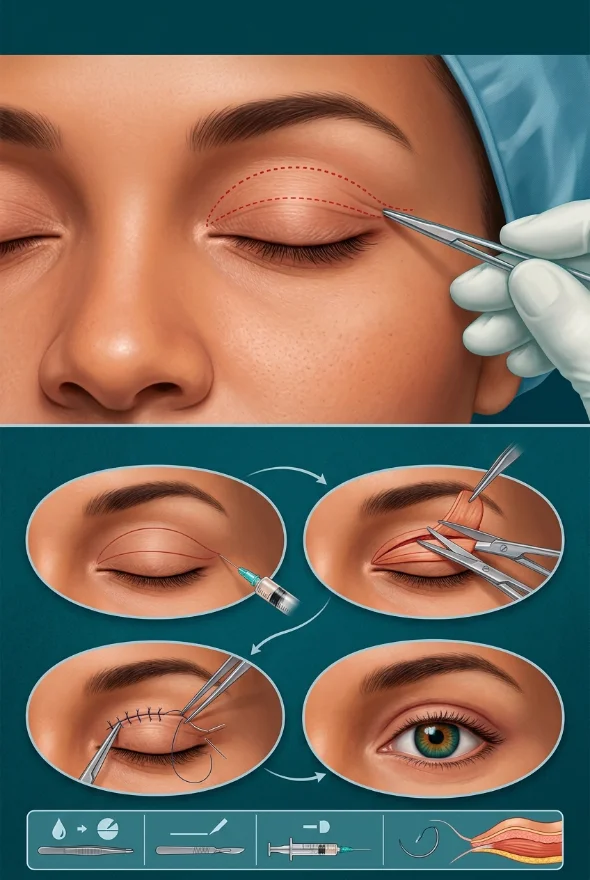
An "eye lift" (blepharoplasty) removes excess upper-lid skin that makes eyes look hooded or tired, or removes and repositions the fat that forms bags under the eyes. Bruising and swelling usually last 10–14 days and numbness settles over 2–4 months, so a fair "after" photo is taken months, not days, later. Our eyelid and squint results come from Prof. Dr. Ahmet Satıcı; laser, lens and cataract results are shown as measured vision.
Filter by treatment, surgeon and time after surgery
Filter the results below:
Treatment
Upper eyelid surgery (hooded eyes)Lower eyelid surgery (eye bags)Upper and lower togetherPtosis (droopy lid)Double eyelidSquint surgeryLaser eye surgeryLens replacementCataract surgeryKeratoconus and cross-linking
Surgeon
Prof. Dr. Ahmet SatıcıDoç. Dr. Muhammet Derda Özer (Doç. = Associate Professor)Op. Dr. Aysan Bayram
Time after surgery
1 week1 month3 months6 months or more
Format
PhotoMeasured visionVideo
Eyelid surgery before and after photos
Eyelid surgery is the one eye operation whose result you can see in a photo, which is why most of this gallery is eyelid results. All eyelid photos are from patients of Prof. Dr. Ahmet Satıcı, an ophthalmologist who has operated on eyes and eyelids since 1992.
{{before photo}} · {{after photo}}, same pose, light and distance; eyes open, and eyes closed for upper-lid cases
{{age range}} · {{sex}} · {{country}} (no name unless the patient asks)
Taken
{{time after surgery}}
Combined with
{{e.g. lens replacement in the same trip, if any}}
Patient's words
{{optional 1–2 sentences}}
Consent
Published with written consent, {{date}}
Hooded eye surgery before and after (upper eyelid)
Upper blepharoplasty removes the fold of skin that hangs over the eyelid crease, and sometimes a strip of muscle and some fat. In a typical before photo the skin rests on or near the lashes and the crease is hidden; after surgery the crease is visible again, and the scar lies inside that crease. The American Academy of Ophthalmology (AAO) notes a practical result as well: when heavy upper-lid skin blocks the top of your vision, removing it can make driving, reading and computer work easier.
Not every hooded look is extra skin. If the edge of the lid itself sits low over the pupil, that is ptosis, a weak lid-lifting muscle; if a low brow pushes the skin down, a brow lift may be needed. Prof. Dr. Satıcı checks for both before planning surgery, and the gallery labels which problem each patient had.
Ptosis before and after
Ptosis surgery tightens or shortens the muscle that lifts the lid, so the photo shows the lid edge sitting higher over the coloured part of the eye. NHS patient information from a UK university hospital eye service reports that surgery gets the lid to a satisfactory height in 80–90% of cases, with a 10–20% chance of over-correction and, more rarely, under-correction; some of these need further surgery.
Before and after eye surgery for bags (lower eyelid)
Lower blepharoplasty, often called under eye plastic surgery, treats bags and puffiness under the eyes. The surgeon repositions or removes the fat that forms the bag, sometimes removes a little skin, and supports the lid if needed (NHS). When the cut is made on the inside of the lid, there is no skin scar in the after photo. When loose skin is the problem, the surgeon judges how much to remove with a gentle skin pinch: EyeWiki (AAO) describes pinching the skin below the lashes to measure the excess without pulling on the lid edge. A small strip of skin is then removed, which is the "skin pinch" result you may see in under-eye surgery photos.
Double eyelid before and after surgery
Double eyelid surgery creates an upper-lid crease where there is none. EyeWiki puts a natural-looking crease at about 6–8 mm above the lid margin and checks preliminary results at around two weeks. Uneven creases are the most common complication, in up to 35% of cases, so look for results photographed at the same angle on both sides. {{Confirm whether Prof. Satıcı offers double eyelid (Asian) blepharoplasty; if not, remove this subsection and the filter value in all languages.}}
Eye lift results are visible within days, but they are not final for several months, because swelling, bruising and scar tightness settle in stages. The timeline below is why every photo in this gallery states how long after surgery it was taken.
First 1–2 days
Puffy, bruised, sometimes numb lids; most people resume light, normal activities within 24–48 hours (AAO)
Around 1 week
Stitches out; bruising still visible
10–14 days
Bruising and swelling usually fading (AAO); about 2 weeks off work for most people (NHS)
Several weeks
Remaining bruises and redness fade (NHS)
2–4 months
Numbness of the upper-lid skin settles (AAO); scars may feel tight for a few months, then fade to almost invisible (NHS)
Our "after" photos are taken at {{standard photo times, e.g. 1 month and 3–6 months}}. A photo taken in the first two weeks shows healing, not the result.
Squint surgery before and after
Squint surgery moves or tightens the muscles that turn the eye, so the eyes line up better. The AAO explains that an ophthalmologist can loosen, tighten or move these muscles through a small cut in the tissue covering the eye. The NHS adds that surgery can improve alignment even when a squint has been left untreated for a long time. Squint surgery in adults and children is performed by Prof. Dr. Ahmet Satıcı.
{{before}} · {{after}}, looking straight ahead, same light and distance
Squint type
{{e.g. eye turning in / out / up}}
Measured angle
{{before}} → {{after}}
Double vision
{{before / after, if relevant}}
Patient
{{adult / child}} · {{country}}
Taken
{{time after surgery}}
Consent
Written consent {{date}}; for children, a parent's consent
What to expect from squint results. The white of the eye is often red after squint surgery; NHS patient information for adult squint surgery says redness can last up to ten weeks, and they assess the full result at three months. The eyes may not be exactly straight after one operation. EyeWiki (AAO) reports that about 20% of adults do not reach satisfactory alignment with one procedure, and that in one study 9% of adults had temporary double vision after surgery, usually gone within 6 weeks, while 0.8% had persistent double vision.
{{3–6 consented squint before-and-after cards}}
Vision results: laser, lens, cataract and keratoconus
After laser, lens or cataract surgery the eye looks the same, so a photo shows nothing. These results are shown as measured vision before and after, the way eye surgeons record them.
How to read the numbers. Distance vision is written as 6/6 in the UK, which is the same as 20/20 in the US, the level often called "normal" vision. In the UK's national cataract audit, 6/12 is the level needed to drive.
{{Prof. Dr. Ahmet Satıcı / Doç. Dr. Muhammet Derda Özer / Op. Dr. Aysan Bayram}}
Prescription before
{{e.g. −4.50 D with −1.00 astigmatism}}
Vision without glasses, before
{{e.g. 6/60}}
Vision without glasses, after
{{e.g. 6/6}}
Reading vision (lens surgery)
{{before / after}}
Measured
{{time after surgery}}
Consent
Published with written consent, {{date}}
How our results compare with published outcomes. Each card shows one patient. To judge whether results are typical, compare them with large published figures:
Treatment
Published benchmark
Source
Cataract surgery
6/12 or better in 93.0% of eyes, and 96.4% of eyes with no other eye disease; median result about 6/6
Royal College of Ophthalmologists, National Cataract Audit (8th report, 2025)
Laser eye surgery
Over 95% of patients satisfied; up to 1 in 10 need some additional surgery for the best result; results at three months equally good for all laser types
Royal College of Ophthalmologists patient information
Keratoconus cross-linking
The main aim is to stabilise the cornea, not to improve vision; about 94% effective at a large UK NHS eye hospital since 2013
NHS patient information (see Sources)
Our surgeons' own figures
{{our audited results, e.g. % of eyes 6/12 or better at a stated time}}
{{our records, period, number of eyes}}
Laser and lens surgery is performed by Prof. Dr. Ahmet Satıcı and Op. Dr. Aysan Bayram, cataract surgery by all three surgeons, and keratoconus treatment by Doç. Dr. Muhammet Derda Özer, who specialises in cornea, keratoconus and retina. For keratoconus, the meaningful "after" is a corneal scan that has stopped changing, so those cards show scans over time rather than a single vision number.
{{6–12 consented vision result cards}}
How we take and check before-and-after photos
Before-and-after photos are only honest if the two pictures are taken the same way. Medical photography guidance for eyelid and face surgery (Nair and Santhanam, Journal of Cutaneous and Aesthetic Surgery, 2016) recommends soft, even lighting without direct flash, a plain neutral background, the same camera distance every time, no make-up or jewellery, and written consent before any photo. We follow these steps:
Same set-up
Same room, light, background and camera distance before and after.
Same head position
Head level, looking straight ahead. Tilting the head changes how eyelids look: a 2021 study of eyelid photos found that lower-lid bags were rated best at a neutral head position, while tilting the chin down made the lid–cheek junction more visible (Vaca et al., Aesthetic Surgery Journal Open Forum).
No make-up, no filters, no retouching
Photos are not edited beyond {{cropping and anonymising}}.
Labelled
Treatment, surgeon and time after surgery on every photo.
Consented
Written consent for each use, which you can withdraw at any time.
What before-and-after photos cannot show you
A photo shows how one patient's eyes looked on one day. It does not show the risks they accepted, and it is never a promise of your result. The NHS is clear that eyelid surgery results cannot be guaranteed, and that some people feel they need another operation.
Before choosing surgery from a gallery, know the risks the photos leave out:
Eyelid surgery: temporary swelling, dry or watery eyes and bruising are common; uneven lids, scarring, double vision and difficulty closing the eye are occasional; bleeding behind the eye and loss of vision are rare (NHS, AAO).
Ptosis surgery: over- or under-correction, sometimes needing more surgery (NHS patient information).
Squint surgery: about 1 in 5 adults need more than one operation, and temporary double vision is possible (EyeWiki).
Laser and lens surgery: glare, halos and dry eyes are common for a few months; up to 1 in 10 laser patients need additional treatment (RCOphth).
Your surgeon explains your personal risks in writing, through your interpreter, before you agree to anything.
How to judge any eye plastic surgery before and after photo
Whether the photo is on our site, social media or another clinic's page, these checks separate useful results from marketing:
Same angle, light and distance? Different light can hide or invent bags and creases.
Is the time after surgery stated? Photos at one week show healing; photos from 3 months or later show the result.
Is the surgeon named? A result belongs to a surgeon, not a building.
Does the "before" match your problem? Hooded skin, ptosis and a low brow need different operations.
Are there ordinary results too? A gallery of only dramatic cases is a selection, not a picture of what usually happens.
Reviews behind the results
Many patients in this gallery have also left a written or video review. Read them, including the critical ones, and check our independent profiles, where we cannot edit or remove anything.
Google reviews:{{Google Business Profile link}} · {{rating}} from {{number}} reviews
Trustpilot:{{Trustpilot link}} · {{rating}} from {{number}} reviews
Eye lift before and after: frequently asked questions
Before an upper eye lift, skin often hangs over the eyelid crease and can rest on the lashes; after it, the crease is visible and the scar sits inside it. Before a lower eye lift, there are bags or puffiness under the eyes; after it, the lower lid is smoother. Results differ from person to person and cannot be guaranteed.
You see a change within days, but bruising and swelling usually take 10–14 days to fade and numbness settles over 2–4 months, according to the AAO. Scars can feel tight for a few months before fading. That is why our "after" photos state how long after surgery they were taken.
Yes. Every photo belongs to a real patient of our surgeons, is published with written consent, and shows the surgeon and the time after surgery. Photos are not retouched beyond {{cropping and anonymising}}.
Not always. Hooding from excess skin is treated with upper blepharoplasty, but a low brow may need a brow lift and a low lid edge (ptosis) needs ptosis surgery. Prof. Dr. Ahmet Satıcı examines which one you have before recommending surgery.
Before surgery there is no upper-lid crease, or only a faint one; after it, a crease sits about 6–8 mm above the lash line (EyeWiki). Swelling makes the crease look higher at first, and preliminary results are usually checked at around two weeks. {{Confirm whether this procedure is offered.}}
Your result depends on your anatomy, skin and healing, so it may differ from anyone else's. Photos help you see what the surgery can change, not what it will do for you. Your surgeon can show you results from patients with a similar starting point to yours.
The eyes look straighter when looking ahead. The white of the eye can stay red for up to ten weeks, and the full result is assessed at around three months (NHS patient information). About 1 in 5 adults need more than one operation (EyeWiki).
Because the eye looks the same before and after. For laser, lens and cataract surgery we show measured vision instead: your prescription and how well you see without glasses, before and after, with the date measured.
Yes. Send your photos or eye report and ask for results from patients with a problem like yours; your surgeon can show more consented cases at your assessment.
Sources for the facts on this page
American Academy of Ophthalmology, Upper Eyelid Blepharoplasty: bruising and swelling typically 10–14 days; upper-lid numbness resolves over 2–4 months; normal activities within 24–48 hours; excess skin linked to difficulty driving, reading and computer work. https://www.aao.org/eye-health/treatments/upper-eyelid-blepharoplasty
NHS, Eyelid surgery (blepharoplasty): lower-lid technique (fat repositioned or removed, some skin, lid support); about 2 weeks off work; bruises and redness may take several weeks to fade; scars visible and tight for a few months, fading to almost invisible; "results cannot be guaranteed"; some people feel they need another operation; side effects and rare risks. https://www.nhs.uk/conditions/cosmetic-procedures/eyelid-surgery/
EyeWiki (AAO), Lower Eyelid Blepharoplasty: skin "pinch" with a haemostat to judge skin redundancy without traction on the lid margin. https://eyewiki.org/Lower_Eyelid_Blepharoplasty
EyeWiki (AAO), Asian Blepharoplasty (Double Eyelid Procedure): crease 6–8 mm above the lid margin; suture removal 5–7 days; preliminary results around two weeks; uneven height or shape the most common complication, up to 35%. https://eyewiki.org/Asian_Blepharoplasty_(Double_Eyelid_Procedure)
Cambridge University Hospitals NHS Foundation Trust, Ptosis correction (adults): satisfactory lid height 80–90%; 10–20% chance of over-correction, under-correction rarer; swelling usually 10–14 days. https://www.cuh.nhs.uk/patient-information/ptosis-correction-adults/
Cambridge University Hospitals NHS Foundation Trust, Adult squint surgery: aims (appearance, eye-movement control, double vision); may need a second operation; double vision often goes in the first week; home 2–4 hours after; grittiness 3–5 days; redness up to ten weeks; full assessment at three months. https://www.cuh.nhs.uk/patient-information/adult-squint-surgery/
NHS, Squint: surgery realigns eye muscles; can improve alignment even if left untreated for a long time. https://www.nhs.uk/conditions/squint/
American Academy of Ophthalmology, Strabismus treatment: muscles loosened, tightened or moved through a small cut in the tissue covering the eye; more than one surgery may be needed; daily routine within a few days. https://www.aao.org/eye-health/diseases/strabismus-treatment
EyeWiki (AAO), Strabismus Surgery Complications: around 20% of adults do not achieve satisfactory alignment with one procedure; 9% temporary diplopia resolving within 6 weeks, 0.8% persistent intractable diplopia. https://eyewiki.org/Strabismus_Surgery_Complications
The Royal College of Ophthalmologists, National Ophthalmology Database, Eighth Annual Report of the National Cataract Audit (2025): 6/12 (required to drive) or better in 93.0% of eyes, 96.4% without ocular co-pathology; median postoperative VA ≈6/6. https://nodaudit.org.uk/sites/default/files/2025-07/NOD%20Cataract%20Audit%208th%20Annual%20Report%202025%20Final.pdf
Moorfields Eye Hospital NHS Foundation Trust, Corneal cross-linking: main aim is to stabilise, not to improve vision; about 94% effective since 2013; scans repeated at six months. https://www.moorfields.nhs.uk/eye-conditions/keratoconus/corneal-cross-linking
Nair AG, Santhanam A. Clinical Photography for Periorbital and Facial Aesthetic Practice. J Cutan Aesthet Surg 2016;9(2):115–121: standard views, Frankfort plane, soft diffuse light without direct flash, neutral background, uniform camera distance, no make-up or jewellery, written consent. https://pmc.ncbi.nlm.nih.gov/articles/PMC4924408/
Vaca EE, et al. The Influence of Sagittal Head Tilt on Periorbital Appearance: Implications for Clinical Photography and the Evaluation of Postoperative Results. Aesthet Surg J Open Forum (published 30 Oct 2021), doi:10.1093/asjof/ojab043: eyes with lower-lid bags rated most attractive at neutral head tilt; downward tilt increases demarcation of the eyelid–cheek junction. https://pmc.ncbi.nlm.nih.gov/articles/PMC8830303/
Google Search Central, Review snippet guidelines (self-serving reviews not eligible for stars; schema decision): https://developers.google.com/search/docs/appearance/structured-data/review-snippet
Want to know what your result could look like?
Send a few photos of your eyes (looking straight ahead, eyes open and closed, without make-up) or your eye report. The surgeon who specialises in your problem will tell you what surgery could change, what it would not, and the risks for you, with no obligation.